-

The Comet Was Never the Problem
Read more: The Comet Was Never the ProblemBy – Sarthak Katewa Abstract This article examines Adam McKay’s Don’t Look Up as a satire of governmental denial, using the film to explore why scientific evidence is so often ignored in public policy. It argues that the film’s central warning extends beyond climate change: political leaders frequently delay action not because the science is…
-
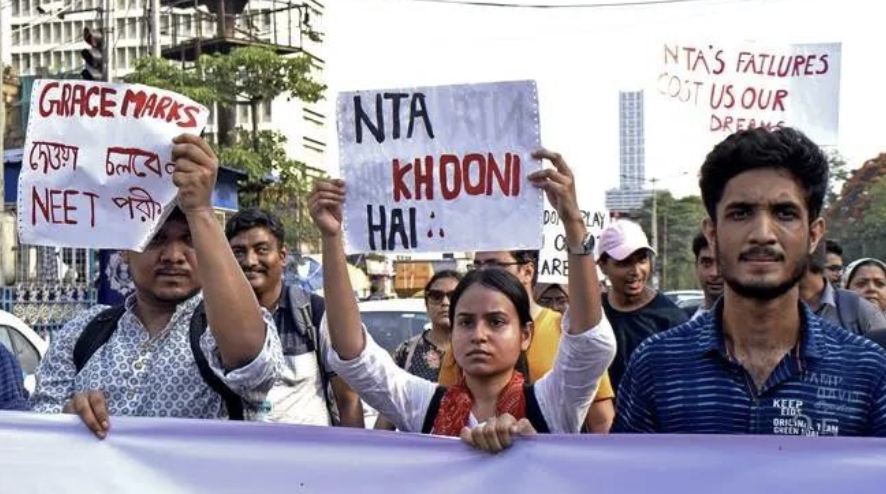
Equal on Paper, Unequal in Practice: The Systemic Failure of Centralised National Exams.
Read more: Equal on Paper, Unequal in Practice: The Systemic Failure of Centralised National Exams.By – Shatakshi Sharma Abstract This article looks into the idea of “One Nation, One Examination” where Government of India practices making college entrance examination equal and uniform for all students like JEE, NEET, CUET and so on, to provide students with opportunities based on merit. This practice has been backfiring into a major social…
-

Uttarakhand’s Uniform Civil Code:Between Constitutional Aspirations and Implementation Challenges
Read more: Uttarakhand’s Uniform Civil Code:Between Constitutional Aspirations and Implementation ChallengesBy – Neel Das Abstract On 27th January 2025, Uttarakhand became the first state to implement the Uniform Civil Code (UCC). The UCC is based on the idea of achieving secularism and aims to establish a common framework for all communities for the purposes of marriage, divorce, inheritance, and adoption, replacing religion-based personal laws with…
-

Basements and Towers: Parasite Through an Indian Policy Lens
Read more: Basements and Towers: Parasite Through an Indian Policy LensBy – Yashaswini Sirwar Abstract This review looks at Bong Joon-ho’s Parasite through the lens of Indian public policy. The film is highly acclaimed and most commonly discussed as a commentary on class inequality. While this is true, its deeper strength lies in its nuanced way of portraying inequality as something produced through everyday governance.…
-

Strategic Petroleum Reserves and Energy Diversification in India: Why Reducing Vulnerability Does Not Help in Achieving Independence?
Read more: Strategic Petroleum Reserves and Energy Diversification in India: Why Reducing Vulnerability Does Not Help in Achieving Independence?By – Akshara Gupta Abstract As India acquires its role as one of the fastest growing economies, so is increasing its demand for energy. Currently, India imports nearly 87% if its crude oil, and therefore, security becomes a central pillar of its foreign and economic policies. In response to the volatility of global oil markets, which further gets affected by…
-

From Access to Administration: Reservation and the Institutional Visibility of Caste in Indian Higher Education
Read more: From Access to Administration: Reservation and the Institutional Visibility of Caste in Indian Higher EducationBy -Yashaswini Sirwar Abstract Reservation in Indian higher education was originally designed as an instrument of access. Its purpose was to make up for historical exclusion by guaranteeing entry into institutions that reproduced caste inequality. Overtime however, reservation has evolved into a more complex administrative system involving compliance frameworks, grievance redressal mechanisms, and institutional oversight.…
-

Risk as the New Inequality
Read more: Risk as the New InequalityBy — Hritika Mishra Abstract This article argues that current forms of economic disparity are also influenced by unfairly distributed risks of injustice, in addition to unequal incomes. Although economic inequality is often understood primarily in terms of differences between the rich and the poor, the fact is that a person’s exposure to risk in…
-

The Political Economy of Chronic Health Risk in India
Read more: The Political Economy of Chronic Health Risk in IndiaBy Yashaswini Sirwar Abstract India’s health system is expanding insurance coverage through public and private schemes that promise financial protection. The country has positioned insurance as the main tool for managing the cost of illness, especially for low-income households. Chronic diseases such as diabetes, hypertension, and heart conditions now make up a large share of…
-

Governing Equality – Article 15 and Constitutional Morality
Read more: Governing Equality – Article 15 and Constitutional MoralityBy – Vansh Aggarwal Abstract: This article reads Article 15 as a critique of the gap between constitutional equality and everyday governance in India. It examines how policing, development, and public policy continue to perpetuate caste-based inequality despite formal legal guarantees. The film highlights institutional apathy, selective governance, and societal silence as key factors contributing…
-

Automated Credit Scoring and Its Implications for Financial Inclusion
Read more: Automated Credit Scoring and Its Implications for Financial InclusionBy — Akshara Gupta Abstract In banking, many forces work silently behind the curtains that the layman is not aware of. The credit system plays a major role in the financial system of a country. It acts as a direct catalyst for promoting Economic Growth as it enables individuals to fulfill their long-term prosperity goals.…
-

Managed by Metrics: How Rating Systems Govern Gig Workers
Read more: Managed by Metrics: How Rating Systems Govern Gig WorkersBy — Hritika Mishra Abstract Digital labour platforms are increasingly governing gig work through rating algorithms, shaping workers’ income, working hours, and continued access to jobs. This article examines how platforms such as Uber, Swiggy, and Zomato use customer ratings and performance metrics as tools for algorithmic management, thereby exerting employer-like control without the corresponding…
-

Aadhar and Algorithmic Exclusion from Welfare: Case Study from Jharkhand
Read more: Aadhar and Algorithmic Exclusion from Welfare: Case Study from JharkhandBy: Ayushmaan Abstract: In the recent decade, most public service delivery systems have been linked through Aadhar identification. The system brought the necessity of timely public service delivery to a greater extent; however, it placed more reliance upon the three-level algorithmic identification system, which relies on a poor quality of data, especially for the Below…

Nickeled & Dimed
Penny for your thoughts?
We are accepting articles on our new email: cnes.ju@gmail.com