By – Shatakshi Sharma
Abstract
This article looks into the idea of “One Nation, One Examination” where Government of India practices making college entrance examination equal and uniform for all students like JEE, NEET, CUET and so on, to provide students with opportunities based on merit. This practice has been backfiring into a major social crisis for the Ministry of Education, which they have yet to resolve and build better structural support for the examination process. The main issue with such failure of the NEET examination is directly impacting millions of students and parents who struggle to access coaching institutions and receive technological, educational and financial resources for examination preparation. The structural weakness of the National Testing Agency (NTA) is on one end, and the repercussions dealt by the students are on the other. The core theme being explored is to understand the bridging factors that are causing harm to the future of thiscountry and its education due to unstable systems where one loophole is breaking down the entire idea behind the purpose of having a uniform and equal merit-based system to provide an opportunity for hard work and knowledge to become the reason for a child’s bright future.
Introduction
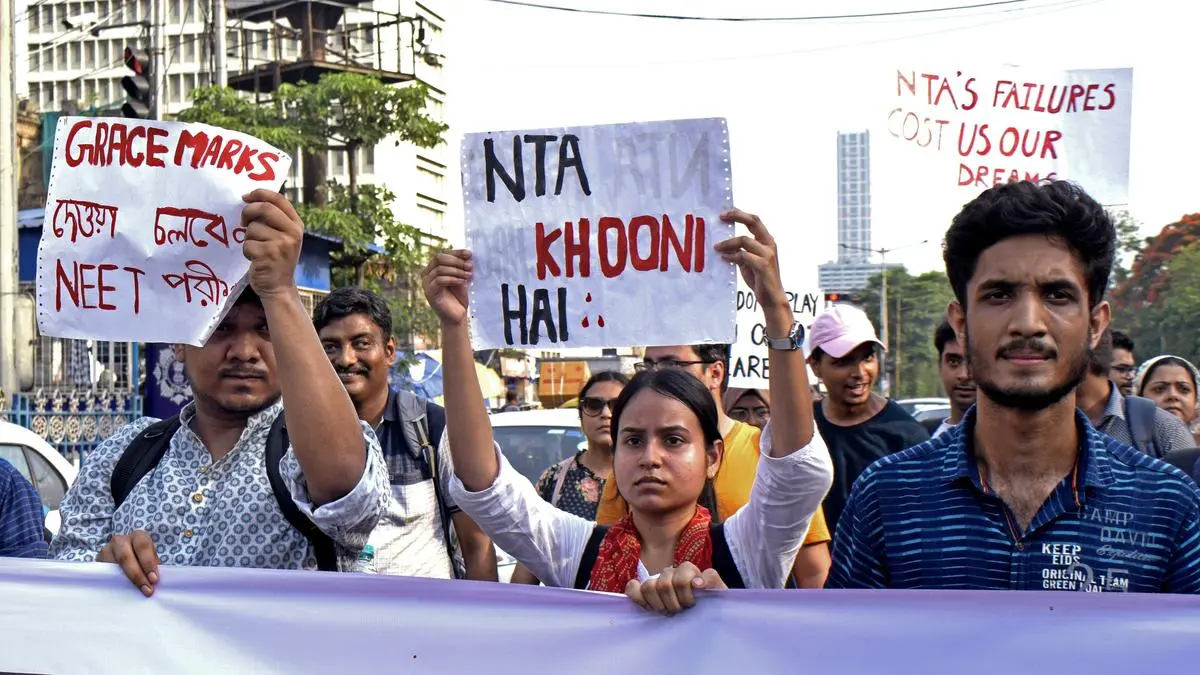
National Testing Agency, also known as NTA, was created in 2017 under the Ministry of Education and the Department of Higher Education. The main agenda was to conduct unified and equal examinations for students to attain and secure higher educational opportunities in reputed Indian universities, institutes and colleges. NTA is known for conducting major entrance exams like CUET, JEE, and NEET. In recent years, additional developments to the entrance examination paradigm have brought attention to many structural failures that come under the ambit of NTA. The biggest incident was the 2024 NEET scandal, where the exam questions were leaked, and around 67 students got the perfect score of 720/720.
This one incidence held a greater impact than just perfect scores. There are millions of students who study for this exam day and night, take gap years just to attain quality education on the basis of their merit and hard work. Many students come from underprivileged families and struggle to receive genuine and quality attention, resources, education, and opportunities. For such students, such entrance tests are a gateway to a better life that they dare to dream. This article will dive into understanding how such policies of equality are differentiating among students on the basis of unfair means attained by unequal practices.
NEET tragedy
The 2024 controversy marked the first of a series of institutional failures of NEET examination and the followingunfortunate events due to fragile structural policies and their implementation. The first cycle of tests brought forward the allegations of paper leak with the declaration of results when 67 students scored 720/720, along with others who helped incheating and students who got admissions by benefiting from the paper leak. Further in the year of 2025, brought further structural failures. Failure of biometric verification, religious discrimination, power cuts, removal of optional questions and so on.
The NEET examination for 2026, also faced a question paper leak and unfair means, leading to the conduct of a second cycle of the examination. This is the third time in a row that due to structural gaps and security incompetencies, the credibility of the NEET examination is in question . Millions of students who took these examinations had to sacrificemonths or years of their lives to prepare for this exam. Whereas parents work hard to make sure financial insecurities are not the reason behind lack of opportunities. Such students are challenged again with such structural loopholes these exams have that are hidden under the idea of “equal” and “merit-based” education in our country.
Curriculum misalignment
Education systems in India vary from state to state. That includes different textbooks, syllabi, and teaching procedures. NEET and JEE use the NCERT curriculum that the CBSE board follows. The exams are conducted by the NTA. CBSE is responsible for the curriculum. The two are thus affiliated to the same Ministry of Education. Considering the two as a part of the same ideological framework that uses the same textbook, the connection between NTA and CBSE stands evident. Simply put, there is a national exam that functions as a CBSE exam. A student who studied in the state board isnot writing the same exam as a student from the CBSE board. They are taking a test created based on a different state’s curriculum, and there is no support (e.g., designing a curriculum based on foundational concepts rather than a CBSE syllabus guideline) from the concerned institution to reduce that gap. The state has taken the effort to design an exam but has failed to create the necessary conditions for all students to be able to write it.
Prior to NEET, students of the Tamil Nadu State Board had more than 86% of the seats in the medical colleges within the state. Now that number has plummeted to less than 23% while CBSE students, which constituted less than 8% of the totalprior to NEET, occupy 33.3% of seats in the state. It isn’t as if Tamil Nadu started producing inferior students. The problemlies in the criteria used to judge them.
More worryingly, there are wider implications for the issue. According to the Supreme Court petition filed by Tamil Nadu, families are forced to give up on state board education and switch to CBSE not due to any better education offered by it, but due to the fact that CBSE is the only system which will help in getting good marks in the test. What began as a policy to ensure equal opportunities is ending up becoming a system to standardise education.
Broken social systems
Reservations are the constitutional obligation of the Indian state towards students from traditionally marginalized groups.The argument here is simple: if the system has been designed by the state to keep out certain communities over generations, then the state should work towards bringing them into the system. Reservations alone solve the problem at a single stage, the entry. The preparation prior to entry is done through an exclusively market-based preparatory system.The annual fee of coaching for NEET ranges between ₹1.5 to ₹4 lakh, way beyond the financial capacity of most SC, ST, and OBC students. The state created an entry test and then handed over the process of preparing for that entry to the market. Marginalized students enter the exam, and subsequently the institutions, with a preparation disadvantage that is not their fault, but that of the state’s.
What follows after the reservation also sheds light on the same issue. More than 25,000 students belonging to SC, ST, andOBC categories have left Indian Institutes of Technology (IITs) and central universities within only five years, which was officially verified in a written reply to the Rajya Sabha by the Minister of State for Education. They did not fail the entrance examination to join IITs; they joined but did not fit into it. According to IIT Bombay’s own internal statistics,70% of the students who had the worst academic results were from SC and ST backgrounds. The gap between preparationand poor academic performance became the gap between performance and dropout rates.
The policy issue is multi-layered. Reservation policy without the preparation program, mentoring, financial support, and accountability does not challenge the existing inequalities but shifts them to another place within the educational structure.
Conclusion
The centralized Indian examination system was established based on a sincere belief that merit can emerge from the fog of privilege through a single test. This was a flawed yet true belief. The part where the Indian system got it wrong is that merit emerges under certain conditions. Conditions like being educated by a teacher in class, coming from a family with a stable environment and money to support their learning rather than work. When the state builds the gates but not the path leading up to it, they do not create equality but merely its illusion.
These are the students paying the price for such an incomplete system. They are the ones who are spending a year inbetween after getting into college just to prepare for the test, the ones
whose parents have exhausted all their resources paying coaching fees, and the ones who passed the test but were not prepared to join the institution anyway. Anitha managed to score almost perfect marks and could never be a doctor. When a country demands of its most disadvantaged learners that they demonstrate their worthiness in an uneven playing field, and declares such process as fair, such a country is not a failure to its exam system, but to its children.
About author
This article is written by Shatakshi Sharma (she/her), a final-year student pursuing her undergraduate degree in GlobalAffairs at JSIA. She has been a Columnist for Nickeled and Dimed since June 2026.
Image Source:https://fl-i.thgim.com/public/incoming/f2mwhn/article68306755.ece/alternates/LANDSCAPE_1200/N EET%20protest.jpg