
By — Prishaa
Abstract
This article traces the course of madness through four centuries, where it questions the dominant definition of madness throughout time as well as scrutinizes those who had the right to name it. Starting with demonic possessions in early modern Europe, and its violent denouement in Salem in 1692, which proceeds to demonstrate how communities account for disconcerting behaviour in terms of whatever categories are most easily at hand. It then turns to chart the rise of the Victorian asylum in the nineteenth century, where John Conolly’s humane experiment at Hanwell buckled under the weight of institutional scale and chronic overcrowding, leaving a space that both healed and imprisoned individuals. Before looking at Mary Elizabeth Braddon’s Lady Audley’s Secret and Stanley Kubrick’s A Clockwork Orange as cultural witnesses to establish the idea of how fiction absorbed and sharpened public perception about confinement and reform.
Introduction
Madness has forever been a concept of ambiguity throughout human history, descriptively it is the constant error of every age that has studied the depths of insanity to even imagine what it ever was. Possession, derangement, melancholia, moral insanity and the diagnostic manuals that accumulated behind modern psychiatry are not successive interpretations of one timeless condition into a modern, more accurate language. These are regimes of explanation, each sufficiently understood in the intellectual furniture of its own century, each of which announce with sheer confidence catching the hold of a final prescriptive measure of the thing itself. The question then turns more historical, than clinical, when understanding not what was wrong with victims of madness, but what sort of epistemic system a society relied on for rendering disturbing behaviour intelligible, and who that system turned to as the authority entitled to classify so. What survives within the constant change of language, is a narrower and more stubborn set of concerns, deviances and the social order that abnormality is always assumed to threaten.
The Salem Witch Trials
Understanding madness, one must inevitably look into a world where the boundary between visible and invisible conduct ran considerably less rigid than the present. Early modern Europe often brought up the Devil beyond a metaphorical remnant of theology and culture, but as an active presence in a Christian universe whose natural and supernatural orders were conceived as thoroughly entangled. Thus, illness and disturbances translated into behaviours which often were invested with religious language without seeming to strain the intellectual conventions of the age. Possession became an immediate category of an uncertain middle ground, allowing experiences that seemed to defy ‘ordinary explanations’ to fall under, while placing them in an established theological order. This entailed possession to a perspective, which wasn’t a failure of explanation, but an explanation internally coherent and wholly serious to all individuals who operated within it. As was the case described by Stuart Clarkin his book on early modern demonology, where belief in demonic affliction was integrated into the religious, philosophical and political architecture of the period, which wasn’t floating free of any pre-existing structures of the time.
A hundred years later the same framework spilled its ugliest bits at Salem, when more than 150 people were accused of possession between 1692 and 1693. Out of which, nineteen were hanged and the rest were pressed to death from stone pelting. Since then, there have been repeated attempts of resolving this period by later historians into a more legible chronology of events for fraud, ergot poisoning, mass hysteria and retrospective psychiatric diagnosis. Each diagnosis carries a risk of linking a modern category backward into a Puritan world that did not fully describe it, and each flattens what the historic record shows to have been an intersection of family feud, gendered accusations, and theological crisis. Salem isn’t merely a supposed proof that ‘witches’ were the proclaimed mentally deranged of their day, rather it serves as evidence that a community faced with behaviour it cannot digest will produce the explanatory categories it already has lying around.
The Question of Categories
Andrew Scull’s primary remark elaborates on this fact that the psychiatric categories do not retain stability over time. What a nineteenth-century physician meant by mania or moral insanity cannot just be relabelled with a modern diagnosis and passed off as continuity. It wasn’t the examined phenomenon that changed but the apparatus that was to observe and understand it. The examination of behaviour moved away from being prayed over or exorcized but to be categorized and treated. Although religious, familial and legal explanations did not entirely vacate the premises so much as surrender their dominance.
Therefore, such a change wasn’t just a new version of repression, as medical categorization could make previously unintelligible forms of suffering sensible as conditions that could be treated. Here Foucault’s question of the production of knowledge becomes especially relevant when understanding how psychiatric categorization creates new boundaries of what could be recognized as normal, dangerous or deviant. Thus, classification might provide a language for rendering distress manageable, while also stressing on the power of institutions to determine who would be allowed the term ‘sane’.
Confinement within the Victorian Asylums
The strange gift of the nineteenth century marked a great shift, which presented a new authority of a physical address. A building in which diagnosis and confinement could occur under one roof, so that what had once been dispersed across pulpit and family hearth was now concentrated in a single institution answerable to no one but its own authority. William Parry-Jones traces a line from workhouses and houses of correction, through small private madhouses, to the vast public system of the nineteenth century. A chronology of acts actually records a transfer of practical custody, from family to medical institutions designed to diagnose and confine all too often in the same gesture. The best example of the real reforming ambition of the asylum is the period that John Conolly was employed at Hanwell. He abolished the use of mechanical restraint, improved the food, hygiene and ventilation, and introduced occupation and education for those in his care. But the limit on that ambition was his own later experience where chronic patients shot up, leading to decline of individualized care and the humane premise gave way under the weight of the institution. The asylum was in a position where it became a little more than a hospital but no less than a prison. It was these two projects running simultaneously within a single institution, often blurring out the lines between diagnosis and confinement.
The Lunatic Eye of Fiction
While the concept of asylums circulated within society a similar parallel was drawn in fiction, as Anne-Marie Beller reads Mary Elizabeth Braddon as using the asylum as a literary fixture because it was a social one. In Lady Audley’s Secret (1862), the heroine’s removal to a Belgian madhouse is less a medical event than a laundering device, developing a timeline of scandal transmuting into confinement. Beller’s further observation, that Braddon’s fiction sharpened after her own experience of mental ill health, is also treated as evidence of the period’s discourse. Sensation fiction did not invent the cultural charge of the asylum, but it did capture the power of a symbol of secrecy and danger which was already haunting Victorian society.
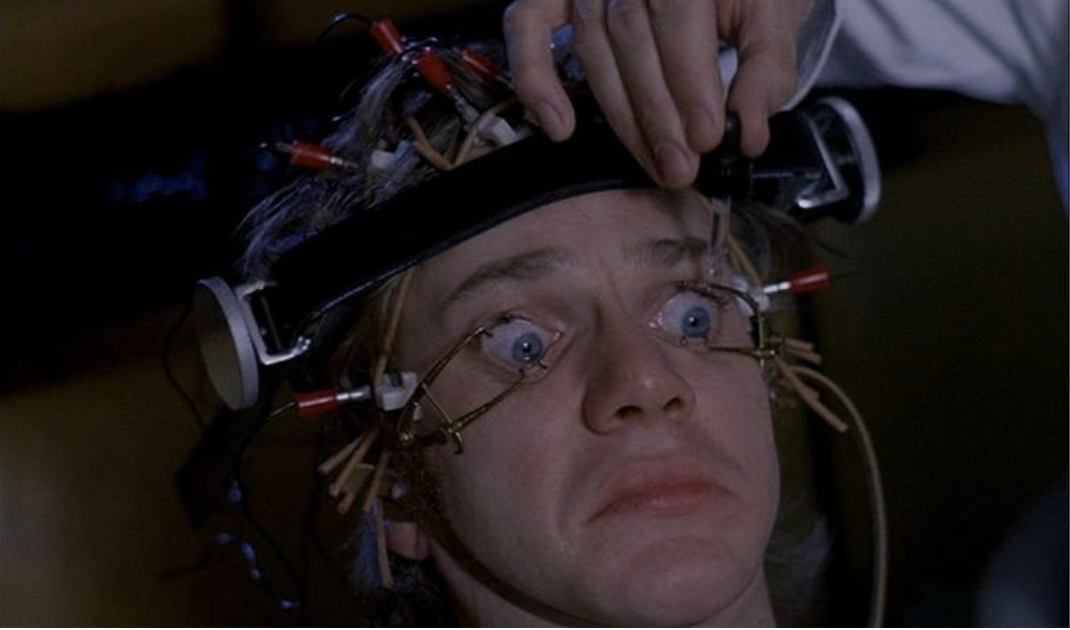
Stanley Kubrick’s A Clockwork Orange (1971) provides a modern-day lens to the idea of madness in itself, where its fictional aversion-conditioning program overexaggerates the notion of mental reformation as it reworks the unresolved problem in the contemporary register. Once an institution is given the authority to define dangerous behaviour, the distinction between the ethical treatments and re-engineering individuals becomes all but impossible to locate from the inside. The apparatus of medical use comes to an interrogation, along with the idea of an authority that seems to determine the categorization of all such behaviour outside the limits of what is considered suitable or sane, without the supposed interference of pre-existing social structures within society.
Conclusion
To conclude, the line was never possession which gave way to science that built the path to modern medicine. Rather, there was a slow transfer of power, from priest to doctor and from family to institution with each new guardian taking on the same incomplete argument of danger and deviance which has throughout centuries shaped our perception of what madness looks like. Replacing the possessed with modern diagnosis does not automatically fix the stigma or exclusion around the period it came about. Or the movement of individuals into new institutions with an alternative authority, does not leave the original question behind, which remains unanswered as newer categories and methodologies surrounding madness arise, what really is madness?
About the Author
Prishaa is a second-year student at O.P. Jindal Global University, pursuing Philosophy, Politics and Economics.
Image Source: https://film-grab.com/2010/07/07/a-clockwork-orange/#bwg475/29061