
By – Anisha Jyotirmayee
Abstract
The Baltic Sea has recently become one such area of geopolitical rivalry due to the damage done to submarine cables, interconnectors, and pipelines, which highlights the importance of protecting underwater infrastructure. This article discusses the Baltic Sea as an example of evolving geography of hybrid warfare through sabotage, attribution, and maritime security. The examination of particular events, such as the damage to Balticconnector in 2023 and interference with telecommunications and energy networks in 2024, shows the problem with differentiating between intentional sabotage and unintentional harm and attributing actions to states.
Introduction:
In the post-Cold War period, critical infrastructure was treated primarily as an economic and civilian concern. Submarine cables, electricity interconnectors and gas pipelines were important to national economies, but they were rarely understood as central components of military strategy. However, with the advent of a series of incidents involving damage to telecommunications cables, energy infrastructure and pipelines, the Baltic Sea has emerged at the centre of European security debates.
The importance of these incidents lies not simply in the physical infrastructure damaged, but in the uncertainty surrounding responsibility. A vessel dragging an anchor can damage a cable accidentally, but the same action could also be deliberate. Establishing intent and proving state responsibility are considerably more difficult than identifying physical damage. This ambiguity makes undersea infrastructure particularly relevant to hybrid warfare, where states may seek strategic effects through activities that remain below the threshold of conventional armed conflict. The Baltic Sea therefore represents a new geography of geopolitical competition: one in which the security of states depends not only on territory, borders and military installations, but also on infrastructure running across the seabed.
The Strategic Importance of the Seabed
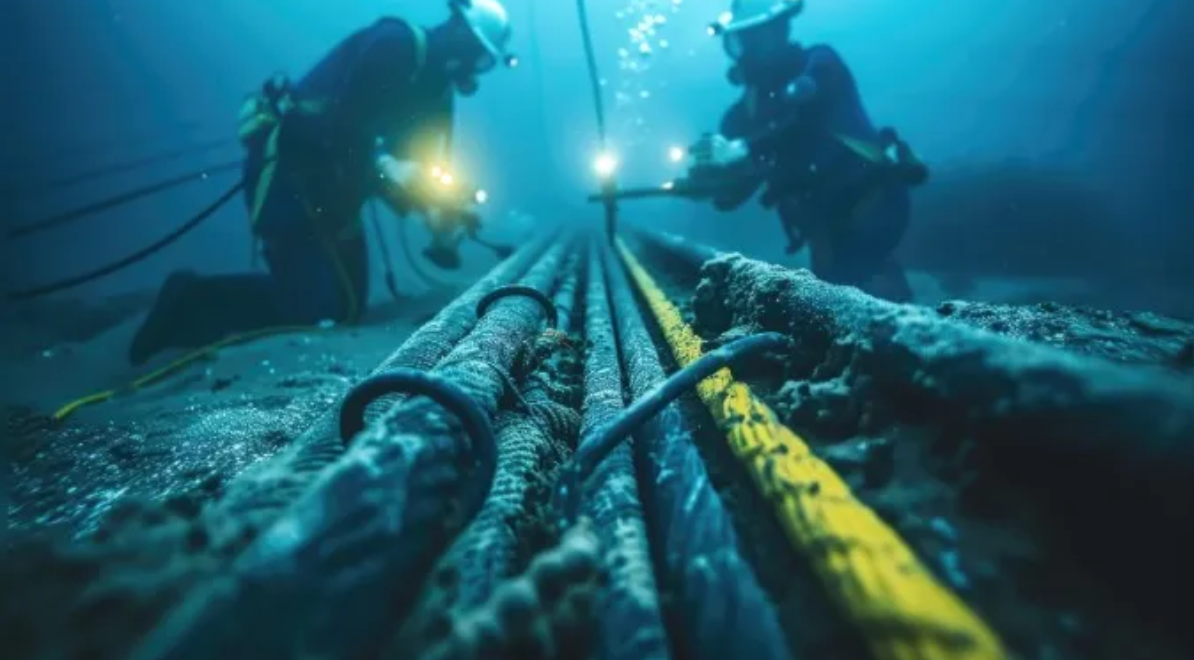
The apparent intangibility of digital connectivity obscures its physical foundations. International telecommunications rely heavily on fibre optic cables lying at the bottom of oceans, while the energy networks in Europe have been increasingly dependent on submarine electricity grids and pipelines. According to NATO Secretary General Mark Rutte, “more than 95 percent of internet traffic is secured via undersea cable”. This creates a particular strategic vulnerability. A cable may be physically small relative to a naval vessel or military installation, but disruption can affect communications, financial transactions and energy systems. More importantly, submarine infrastructure is difficult to monitor continuously. It extends across large areas of seabed and passes through waters governed by different legal jurisdictions.
The Baltic Sea is especially significant because of its geography. It is a relatively enclosed maritime space surrounded by several European states, while the accession of Finland and Sweden to NATO has further altered its strategic configuration. Infrastructure in the region consequently exists within a dense network of overlapping national, commercial and military interests. The result is that the seabed has become a space where economic infrastructure and national security increasingly intersect.
From Accidental Damage to Hybrid Threat
The concept of hybrid warfare is useful for understanding the Baltic because it focuses attention on actions that deliberately exploit the boundary between peace and conflict. Hybrid operations can involve cyberattacks, disinformation, economic coercion, sabotage and other forms of disruption without necessarily taking the form of conventional military attack. However, applying the term too broadly creates an analytical problem. Not every damaged cable is evidence of hybrid warfare.
Both the Balticconnector natural gas pipeline and telecommunication cable suffered damage in October 2023 in the coastal area between Finland and Estonia. The investigation by the Finnish National Bureau of Investigation found that the damage was caused when the dragging anchor of a Hong Kong-registered container ship, NewNew Polar Bear, scratched the seafloor. The way the damage happened could thus be examined, but proving whether it was intentional was another matter altogether. This distinction is fundamental to understanding subsea security. Causation does not automatically establish intent, and intent does not automatically establish state responsibility. That evidentiary problem is precisely what gives undersea infrastructure its potential relevance to hybrid warfare.
The Baltic Cases:
In November 2024, two telecommunications cables were damaged in the Baltic within a short period. One connected Sweden and Lithuania, while another connected Finland and Germany. Attention focused on the Chinese bulk carrier Yi Peng 3, which had been operating in the relevant area. Swedish authorities sought Chinese cooperation in the investigation. Reuters reported that Western officials believed the vessel was responsible for the physical damage, while questions remained about whether the damage was deliberate. This uncertainty is significant because it demonstrates how attribution becomes a strategic problem in itself. If an incident is conclusively identified as an accident, the appropriate response is primarily legal and regulatory. If it is established as deliberate state-sponsored sabotage, it becomes a national-security matter. The space between those two possibilities is where hybrid warfare operates most effectively.
Estlink 2, the power cable connecting Finland to Estonia, was damaged on 25 December 2024, as were some telecommunications cables. The Finnish investigators inspected the ship named “Eagle S”, which was operating in the same area. The vessel was associated in reporting with Russia’s so-called shadow fleet, a term used for vessels involved in transporting Russian oil under circumstances designed to circumvent Western restrictions. The incident consequently received considerable geopolitical attention. Yet again, attribution required caution. The presence of a vessel associated with a politically sensitive network does not itself demonstrate that the vessel deliberately damaged infrastructure or that a state ordered the action. This is precisely why subsea infrastructure creates a distinctive security challenge. Suspicion can arise much faster than legally or politically conclusive attribution.
When an Accident Becomes a Security Threat:
The Baltic Sentry launched by NATO in January 2025 is an example of how such actions influenced the region’s security strategy. According to NATO, this project will enhance the organization’s presence in the maritime area and will increase the surveillance of important underwater structures. The capabilities of this system involve frigates, maritime patrol planes and naval unmanned aerial vehicles. The significance of the Baltic Sentry is broader than the protection of individual cables. It represents an institutional shift in the understanding of infrastructure security. Previously, a damaged cable could largely be treated as an issue for telecommunications companies, maritime authorities or national regulators. Increasingly, such infrastructure is being incorporated into defence planning. NATO describes Baltic Sentry as a response to destabilising acts and states that it is intended to deter both state and non-state actors from damaging critical undersea infrastructure. This produces a new security environment in which commercial maritime activity is increasingly monitored through a security lens.
The Militarisation of Infrastructure Protection
The increasing deployment of naval and surveillance assets around critical infrastructure creates another dilemma. Greater surveillance can make sabotage more difficult and improve the ability to identify vessels operating near cables. But greater military activity also increases the possibility that ordinary maritime behaviour will be interpreted through a security framework.
NATO’s Baltic Sentry combines military assets with cooperation involving industry and national authorities. This reflects an important reality: much of the infrastructure being protected is commercially owned or operated, while the consequences of its disruption can be national or collective-security concerns. The result is a hybrid governance structure involving private companies, coast guards, navies, intelligence agencies, maritime regulators and international organisations. This is arguably one of the most important characteristics of the new geography of hybrid warfare. Security is no longer confined to military institutions.
Conclusion
The Baltic has demonstrated that critical infrastructure can become part of geopolitical competition without resembling conventional military targets. Its vulnerability derives from the combination of physical exposure, commercial ownership, complex jurisdiction and the difficulty of attribution. This creates a distinctive form of hybrid-security problem. The objective of an actor seeking to exploit infrastructure vulnerabilities need not necessarily be the destruction of a network. Creating uncertainty, forcing governments to increase surveillance, raising insurance and security costs, or testing the response of an alliance can also have strategic consequences. As can be seen from the responses through the Baltic Sentry case, both European nations and NATO view the defense of the underwater region as being part of collective security. The problem lies in creating mechanisms that will allow for differentiating between an accident and an intentional interference.
Author’s Bio
Anisha Jyotirmayee is a student of Journalism and Media Studies at O.P Jindal Global University. Starting with an inclined interest towards literature, she started writing research-based articles that defined and worked with real social issues.
Image Source: https://mahabahu.com/sabotage-in-the-baltic-the-mystery-of-severed-undersea-cables/