
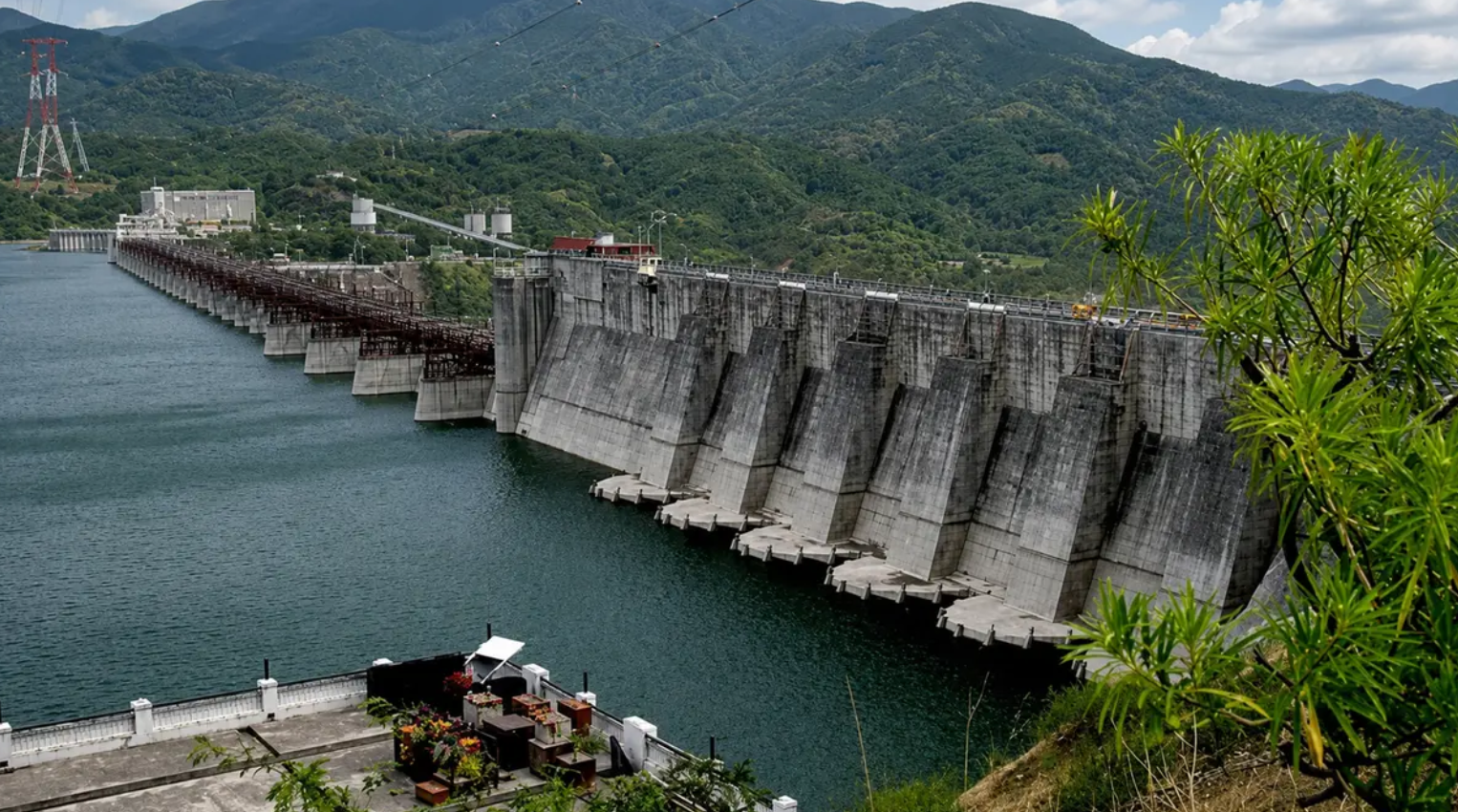
By – Suryaansh Gupta
Abstract
The Kalpasar Project proposes damming the Gulf of Khambhat to build one of the world’s largest freshwater reservoirs, alongside a highway, renewable power and fisheries development, to solve Gujarat’s chronic water shortage. Conceived in the 1980s and formally adopted by the state in 1995, it has outlived its own inventor and been inherited and re-announced by a long line of Chief Ministers from the same ruling party, its estimated cost multiplying many times over without a single dyke being built. Read alongside its economics, Kalpasar’s political history suggests it has functioned less as an infrastructure plan awaiting money than as a recurring promise, revived on a rhythm that tracks Gujarat’s election calendar as reliably as its monsoon.
Introduction
Every monsoon season, drought prone Saurashtra villages see fresh water being carried by the rivers straight into the Gulf into the Gulf of Khambhat, where it dissolves into the sea.This results in nearly 30,000 million cubic metres of water flowing out unused every year, in a state where per capita water availability is 920 cubic metres instead of the required 1,700. Gujarat has spent decades chasing that water back through canals and pipelines. The Kalpasar Project, formally the Gulf of Khambhat Development Project, proposes to stop chasing it and dam the gulf itself, holding the water back as a freshwater lake before it ever meets the sea.
The idea to build this dam has been here since the late 1900s. The project was conceptualized in 1998, and it has been continuously inherited and re-announced by the Chief Ministers, till date. Examined economically, the case for Kalpasar is genuine. Examined politically, it has delivered far more than it has built.
An Idea That Outlived Its Inventor
The credit of this project goes to Dr Anil Kane, who was a mechanical engineer who later became Vice Chancellor of Baroda’s MS University. Dr. Kane had initially suggested this to the then Chief Minister Keshubhai Patel, with preliminary studies being conducted in the 1990s. When Narendra Modi succeeded Keshubhai in 2001, the project passed to him too.
By 2012, Keshubhai, by then estranged from the party he had built, was publicly blaming his successor for failing to deliver a project his own administration had conceived in 1998 at an estimated cost of ₹33,000 crore. An older, bigger version of the scheme, complete with a tidal power plant, had earlier been priced at ₹55,000 crore before that component was dropped. Officials themselves later conceded establishing feasibility alone could take twenty years. By 2018, despite crores already spent on studies, the state government still could not say whether the project was viable.
Unfortunately, Dr Kane passed away in 2024 before any of it was resolved. . The project has now been revived. Gujarat’s Kalpasar Department applied for environmental clearance in May 2026, pricing the project at ₹1.33 lakh crore. The Chief Minister told the Assembly a Detailed Project Report was nearing completion. Recently, India and the Netherlands signed a Letter of Intent for technical cooperation for this project, with construction of the dam aimed to begin by 2028 and finished by 2035. This announcement has been made approximately eighteen months before Gujarat’s next election.
The Economic Case
There is strong argument for this project as well, since Gujarat suffers from an acute water shortage, expected to turn critical by 2047. The proposed dam would result in the creation of a massive reservoir holding 7,800 million cubic metres of fresh water, which would be sufficient to irrigate roughly 10 lakh hectares. Additionally, the road created through this dam would reduce the travel distance between South Gujarat and Saurashtra from 240 kilometres to 60.
However, it has been hard to ascertain the cost of the project. A 2012 estimate put the cost at around ₹33,000 crore, and the government’s own 2022 pre-feasibility report raised that to ₹1,00,200 crore. The 2026 clearance filing prices it at ₹1.33 lakh crore, and separate reporting on the Dutch collaboration cites ₹1.57 lakh crore. Actual spending so far is a rounding error against any of these figures: reportedly just ₹30.71 crore by 2018, and ₹1,489 crore on the Bhadbhut barrage, a precursor structure on the Narmada now delayed to July 2026 for its first phase and June 2027 in full. The gulf’s tidal range is also far more extreme than anything the Dutch faced when their Afsluitdijk sealed off the Zuiderzee in 1932 across just 32 kilometres, barely half of Kalpasar’s length.
The Fishermen Kalpasar Doesn’t Advertise
Closing a tidal estuary this large does not just hold back fresh water. It completely changes the salinity and the flow of water, which heavily impacts the fisherfolk. The Bhadbhut barrage alone has drawn repeated protest in Bharuch, and in 2018, there was a march including roughly four thousand fisherfolk on behalf of an estimated thirty-five thousand people, who are expected to be impacted by the project. The Netherlands offers a blunt precedent too. An ecologist there has noted that migratory fish lost their routes entirely once the Afsluitdijk cut the sea off. Gujarat is borrowing Dutch expertise on building the dyke. It has said far less about avoiding that other legacy.
The Patidar Calculus
Water in Saurashtra has been a major political concern for BJP. The party fell from 115 seats in 2012 to 99 in 2017, majorly due to its poor performance in Saurashtra, as a result of the Patidar quota movement. The recovery since has been community-specific. Hardik Patel was brought into power ahead of 2022, and BJP won those seats where the Patidars dominated. Kalpasar’s 2026 revival is aimed at Saurashtra and headed by a Patidar Chief Minister governing the exact belt that nearly cost his party power in 2017, reads as one more instrument in the same playbook.
Why the Delay Might Be the Point
Repeated re-announcement is not necessarily a failure of strategy. For an incumbent, it can be the strategy. Unlike SAUNI, launched just ahead of the 2017 vote in this same belt, or the Sardar Sarovar project, both of which reached execution and put visible water in front of farmers before polling day, Kalpasar has stayed at the announcement stage for three decades, politically the safer place to be. A Chief Minister can be photographed committing to a wish-fulfilling ocean without ever being held to a completion date measured in years rather than decades. With construction pushed to 2028 and completion to 2035, whether the 2026 Dutch partnership marks a genuine turning point or the next scheduled revival is worth asking before the answer is taken on faith.
Conclusion
None of this means Kalpasar should be shelved. Gujarat’s water arithmetic is not manufactured, and if Dutch engineering can finally resolve the problems that have stalled the project for thirty years, the case for building it only strengthens. But a state that has re-announced the same dam repeatedly without laying its first stone owes its farmers more than another Letter of Intent. Until a Gujarat government is willing to be judged on a finished dyke rather than a fresh feasibility study, Saurashtra’s monsoon water will keep finding its way, unclaimed, into the sea.
About the Author
Suryaansh Gupta is a fourth-year law student at Jindal Global University and a member of the Economics and Finance Cluster of Nickeled & Dimed. He is an avid reader and a problem solver. He also is deeply passionate about aviation and politics.
Image Source : https://clarityupsc.com/news/article/kalpasar-project-gujarats-gulf-of-khambhat-reservoir-proposal-3685