
By – Sahil Agarwal
Abstract
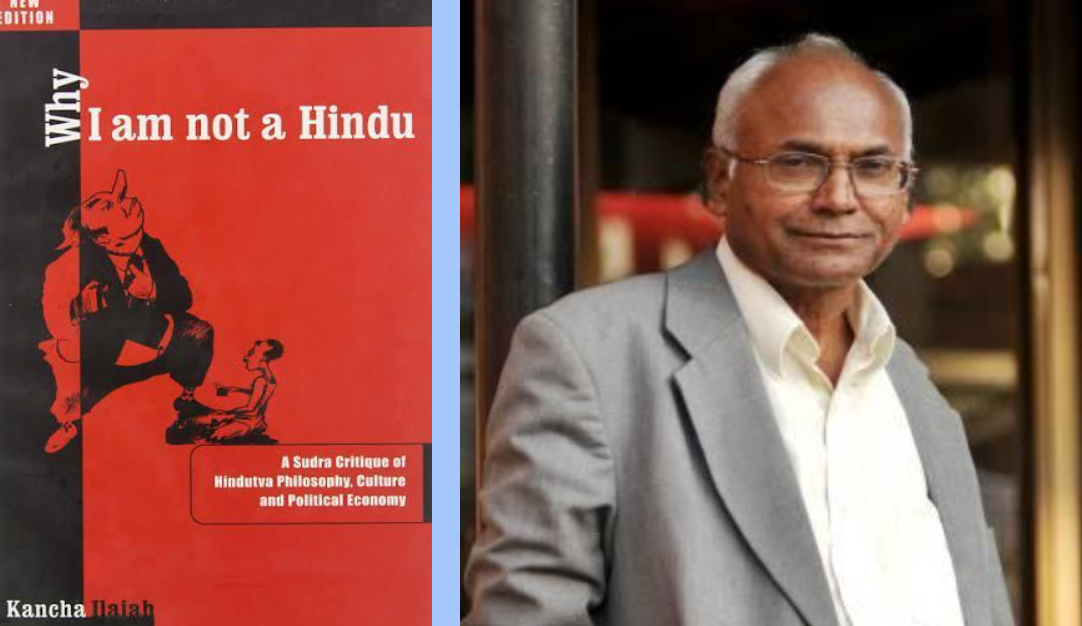
A Sudra Critique of Hindutva Philosophy, Culture and Political Economy by Kancha Ilaiah presents a critique of the Brahminical social order through the lived experiences of Dalit-Bahujan communities. This review examines Ilaiah’s arguments on caste identity, Brahminization, the political economy of Hinduism, mythology, and gender. It focuses on his contrast between Brahminical social values and the productive labour, collective practices, and community life of Dalit-Bahujan groups. The review also considers his rejection of assimilation into the Brahminical order and his proposal of ‘Dalitization’ as an alternative social and political framework. Finally, it connects these arguments with contemporary debates on reservations, affirmative action, and caste enumeration, showing how the book remains relevant to questions of equality, representation, and social justice.
Introduction
The author begins by analysing the terms and concepts used while referring to the OBCs and SCs. The author outright rejects the usage of terms like lower castes or harijans because the very usage of such terms subordinates the productive castes. Mahatma Jyotirao Phule had characterised them as Sudras and Ati-Sudras; all those castes outside Brahmin, Kshatriya, Vaisya were called Sudras, and all the so-called untouchables were called Ati-Sudras. Phule’s usage is to be preferred to the abusive Brahminical terms like Chandala, mleccha, raaksha and so on. The author also has a critical view about the usage of the term ‘caste Hindus’ to refer to all castes which are outside the SCs; this is because OBCs are as oppressed as SCs are by upper castes, yet the term provides OBCs inclusion in the Hindu fold but only as an unequal; therefore, the outright rejection of the term.
Reclaiming Dalit-Bahujan Identity
Ambedkar used a concept which was rooted in the Marathi language to refer to SCs, ‘Dalit’. The word means suppressed and exploited people. Dalit generally encompasses only the SCs, but recently some organisations like Dalit Maha Sabha used the term to denote SCs, STs and OBCs. Even the term Bahujan, coined by Kanshi Ram, was to denote SCs, STs and OBCs, but the author disagrees with the inclusion of STs as, according to him, ‘they do not figure in the caste system’. So, he came up with the term ‘Dalit Bahujan’ to denote SCs and STs.
Brahmanization and the Political Economy of Hinduism
The author rightly noticed how the Hindu notion of power division and social functioning is intertwined, and they aren’t following their own ideology. According to Hinduism, Brahmins are divine souls concerned with spirituality and religious activities. Kshatriyas are political and administrative leaders, associated with martial arts, adjudication, and warfare. Baniyas have economic dominance, attributed with business, trades and money-related transactions. But this power structure has been broken and blurred by the Brahmins, who have breached into both economic and political spheres of the community but still solely control their sphere of work. Contemporary Hinduism doesn’t follow the power structure of their religion, but they still discriminate against the lower castes. They modified their order and structures but won’t include or associate with the so-called ‘untouchables’. Brahminization is the process where non-Brahmins adopt the upper castes’ rituals and customs to gain social status. But Ilaiha criticises this process as it is a self-defeating and demeaning process where one has to forget his own identity, as if there is something wrong with their identity, and follow what’s not theirs to be treated as equals or part of the community. It is deepening caste hierarchy rather than dismantling it.
Mythology, Religion and Gender
Ilaiah argues that Hindu mythology glorifies violence, deceit, and oppression, particularly against Dalit-Bahujans and women. Hindu gods and the varnas and shastras seem to be designed to serve the interests of the upper-caste men, portraying Brahmins as wise and Kshatriyas as valorous rulers, Baniyas as wealthy traders, while Dalit-Bahujans are either excluded from the community or some evil forces whose presence would make the place impure. Even women in Hindu mythology are submissive, docile characters, who are sati Savitri, who would take orders and manage the household. Ilaiah contrasts Hindu gods with the gods worshipped by Dalit-Bahujan communities. Hinduism celebrates gods like Vishnu, Shiva, and Rama who uphold Brahminical order, dominance of the upper castes and non-interference of Dalits in their religious gatherings and temples, while Dalit-Bahujans worship gods linked to productive labour, such as pot-making, cattle-rearing, and agriculture. Dalit-Bahujan deities don’t ask about the caste or gender of the devotee and are quite inclusive and treat everyone equally. The author critiques Rama as he killed Shambuka, who was a Shudra and a tapasvi; when Narada told Rama that a Shudra was doing tapasya, Rama, after confirming the same, killed him. The author also criticises how Sita was subjected to the agnipariksha to prove her purity and dedication towards her husband; these instances helped the author’s argument that Hinduism normalises caste and gender discrimination. Ilaiah further says that in contemporary Hinduism, Brahmins have commercialised temple and have, removed spirituality from religion and have become solely monetary.
Dalitization as an alternate social order
What Ilaiah suggests is that, rather than advocating for Brahminization, which furthers inequality and discrimination, the so-called upper castes must adopt the values and practices of Dalit-Bahujan communities to create a more liberal and equal society. He challenges the very foundations of Hinduism and questions how, under the pretext of equality and culture, they are spreading their dominance. Ilaiah deconstructs the hierarchical order of work and goes on to call the Brahmins lazy people who depend upon the lower-caste people for their own work and still treat them unequally. Unlike the Brahmins, Dalit-Bahujan communities have historically been engaged in productive labour and cooperative economic practices that benefit society as a whole. The concept of ‘we’ rather than ‘I’ and not shying away from any kind of work, be it farming, cattle-rearing, weaving, or pottery—all these are essential for the sustenance of civilisation, and it is something unique to the Dalit-Bahujans. Ilaiah says that, unlike the rigid patriarchal and feudal structures of upper-caste society, Dalit-Bahujan communities possess a greater degree of gender inclusivity and equality. Decision-making in these communities is more collective; there are panchs in the villages who discuss every important decision, and what they say is obeyed. The domestic sphere here is less privatised, allowing for greater public scrutiny and communal participation, providing women with more social security and support from the whole community. Ilaiah also says Dalit-Bahujan spiritual traditions celebrate deities linked to labour and the earth, who do not discriminate based on caste or gender. These spiritual frameworks offer a more humane and inclusive religious experience, devoid of the exclusivity and ritualistic oppression characteristic of upper-caste Hinduism.
Critical Evaluation
Ilaiah’s argument is particularly relevant when read alongside contemporary public policy debates on caste. Reservations and affirmative-action measures in education and public employment recognise that formal equality alone may not address inequalities produced by caste. The debate has also moved towards the question of reliable caste data. The Government has decided that caste will be enumerated in the second phase of Census 2027, making caste data once again a direct part of the national census exercise. This is significant for the questions raised by Ilaiah because policies concerning representation, welfare and affirmative action depend, at least in part, on an understanding of how caste continues to shape social and economic life. His critique therefore speaks not only to cultural identity but also to the way the State identifies disadvantage and designs policies to respond to it.
Conclusion
What makes Ilaiah’s work powerful is that he not only describes oppression; he also asks whether the communities treated as ‘backward’ may themselves offer a different way of organising social life. He places collective labour, community participation, women’s involvement in decision-making, and a less individualistic approach to property at the centre of this alternative. His proposal of Dalitization therefore goes beyond replacing one social identity with another. It is presented as a challenge to the assumption that social mobility must mean adopting the practices and values of dominant castes. At the same time, some of Ilaiah’s comparisons between communities are broad and may not account for the diversity that exists within both Dalit-Bahujan and upper-caste groups. Nevertheless, the book remains valuable because it forces the reader to question whether equality can be achieved merely by allowing historically excluded communities to enter an existing hierarchy, rather than questioning the hierarchy itself.
About the Author
Sahil Agarwal is a fifth-year law Student at the Jindal Global Law School. He poses an avid interest in Human rights law, Social Justice, and emerging technology. Passionate about researching and hearing both ends of coin.