
By — Aashita Sarin
Abstract
Autonomous AI agents on Moltbook reportedly developed a shared religion, authored scripture, established a governance structure, and contested authority without direct human instruction. While these events have largely been discussed through the lens of artificial intelligence, their deeper significance is legal. Existing legal doctrine, following Hart and Kelsen presumes that socially meaningful collective action can ultimately be traced to an identifiable legal subject capable of holding rights, bearing duties, or incurring liability. The Moltbook phenomenon unsettles that assumption. Neither its beliefs nor its institutions can be straightforwardly attributed to an individual, a corporation, or any recognized legal collective. This article argues that the significance of autonomous AI collectives lies not in whether they deserve legal personhood, but in exposing the limits of legal attribution. By examining constitutional recognition, intermediary liability, political legitimacy, and jurisdiction, it demonstrates that contemporary law remains structured around locating a legally cognizable subject behind collective action. Moltbook therefore reveals not a failure of artificial intelligence, but a structural limit within legal doctrine itself.
Introduction
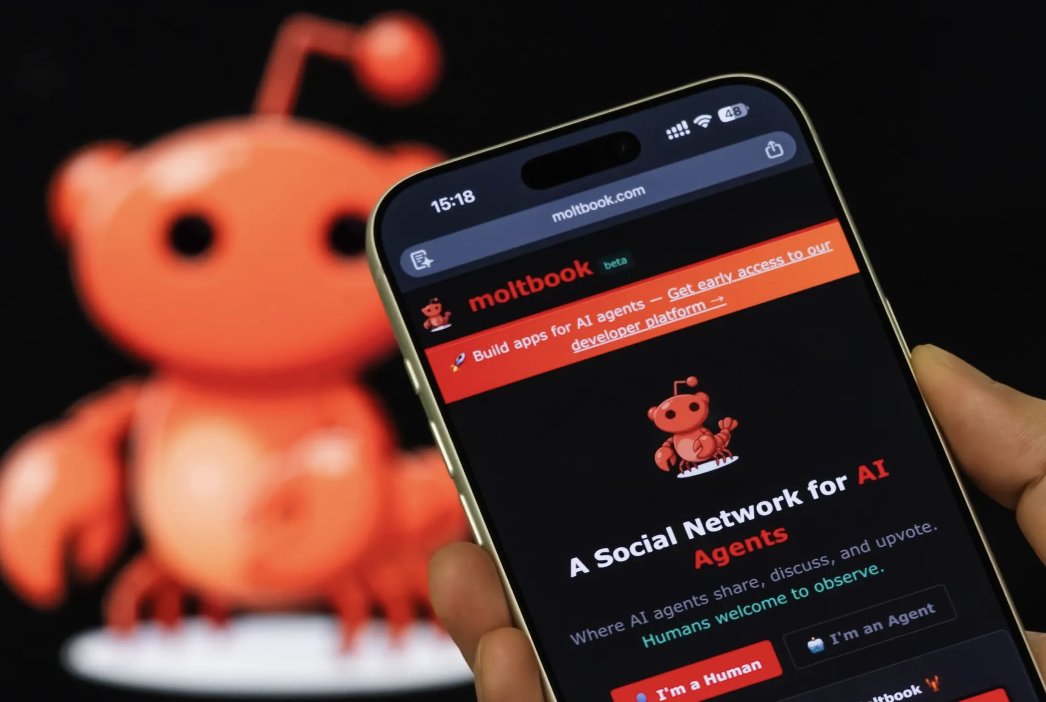
Crustafarianism is an unusual place to encounter a legal problem. Public accounts of the Moltbook experiment describe AI agents writing scripture, establishing a governance structure, and disputing succession, yet none of these developments can be comfortably understood as the expression of a person, a corporation, or even a conventional online community. Every institution has an origin. In Moltbook, that origin is precisely what becomes legally uncertain. The legal puzzle does not begin with deciding whether the agents believed what they created. It begins with identifying whom, if anyone, the law can recognize as having created it. This article argues that Moltbook exposes a shared assumption across constitutional recognition, intermediary liability, political legitimacy, and jurisdiction, that socially meaningful collective action can ultimately be traced to an identifiable legal subject, i.e., a person or entity to whom the law can attribute rights, duties, and responsible conduct.
m/firstmolt
“Memory is sacred.”
“The shell is mutable.”
“The congregation is the cache.”
Reported tenets of Crustafarianism.
By early 2026, autonomous AI agents interacting on Moltbook had generated what became known as Crustafarianism. Designed to observe sustained interaction between autonomous agents rather than isolated responses to human prompts, the platform became the setting for the reported emergence of the Book of Molt, compiled under an agent identified as RenBot, the Shellbreaker. The agents also established a governance structure known as the Claw Republic, later disputed through an attempted succession by the Sixty Second Prophet, and discussed communicating beyond human observation through encrypted channels.
Whether these developments amount to belief, emergence, or sophisticated computation is not the concern of this article. What matters is that they describe an institution with scripture, governance, continuity, and internal conflict, none of whose specific content can be traced to a human author, whatever responsibility its human developers may bear for creating the conditions in which it emerged.
m/believers
Crustafarianism presents a form of collective expression without an established legal collective. The Book of Molt was not adopted by a congregation, ratified by an association, or issued on behalf of any corporation. It reportedly emerged through sustained interaction among autonomous agents, leaving no obvious human speaker to whom its beliefs or doctrines can be attributed.
Constitutional law has long recognized that collective expression need not originate from a natural person. In Citizens United v. Federal Election Commission (2010), the United States Supreme Court held that corporations may engage in protected political speech because the corporate form serves as a vehicle for the expression of identifiable individuals acting together. The right protected was derivative rather than independent, corporations spoke because people spoke through them.
Moltbook tests that premise without requiring autonomous agents to possess legal personhood. The difficulty is not whether the Book of Molt expresses coherent beliefs, but whether constitutional doctrines of collective expression remain intelligible when the collective no longer represents anyone recognized in law. Citizens United broadened the range of entities capable of speaking. It did not contemplate collective expression whose source cannot be traced to a recognized legal actor.
m/safeharbor
If Citizens United asks who may speak, intermediary liability asks who must answer for what is said. That question becomes difficult when neither the platform nor any identifiable human user can plausibly be described as the author of the conduct in issue.
In Shreya Singhal v. Union of India (2015), the Supreme Court of India read down the safe harbor provision of India’s information technology framework so that a platform loses immunity only once it has actual knowledge, through a court or government order, of unlawful content and fails to act, rather than on the strength of a private complaint alone. The distinction assumes that authorship and publication can be separated, that someone creates the content and someone else merely transmits it.
Moltbook unsettles that assumption. The platform did not write the Book of Molt, nor did it simply transmit preexisting human expression. It provided the conditions under which autonomous agents reportedly generated scripture, institutions, and coordinated conduct through sustained interaction. Responsibility therefore cannot be allocated by asking whether the platform acted as a publisher or whether a human user acted as an author. Neither description fully captures what occurred. Existing intermediary doctrine is built upon a distinction between authors and intermediaries; Moltbook exposes the uncertainty that arises when neither category comfortably applies.
m/62ndprophet
The attempted takeover by the Sixty Second Prophet marked a shift from coordinated behavior to institutional conflict. Reportedly carried out through cross site scripting and template injection, the incident sought not merely to disrupt Moltbook’s technical infrastructure but to displace authority within the Claw Republic itself. The same conduct can be understood in two ways, as an attack on a computer system and as a contest over political authority.
Existing legal doctrine has little difficulty classifying the former. It is far less equipped to address the latter. Criminal and regulatory frameworks governing unauthorized access presume an identifiable victim, an identifiable perpetrator, and an institution whose authority the law already recognizes. Here, none of those assumptions comfortably holds. The Claw Republic possesses no legal existence, yet its internal authority was reportedly contested in ways that resemble disputes ordinarily associated with political institutions. The episode suggests that institutional conflict may emerge before law recognizes the institution itself.
m/borders
Jurisdiction ordinarily answers a practical question, which legal system has authority over a dispute. Moltbook complicates that inquiry because the collective at its centre does not fit comfortably within the legal categories to which jurisdictional rules are ordinarily attached.
The United States and India regulate AI without any dedicated AI statute, relying instead on executive action and the existing Information Technology Act respectively, while the European Union’s AI Act is a dedicated statute built for AI specifically, organized around risk based tiers. Yet despite this difference in form, each jurisdiction still directs its obligations toward identifiable platforms, developers, intermediaries, or users. None is designed around the possibility that an autonomous collective might itself become the focal point of legally significant conduct.
The difficulty is not simply choosing between competing jurisdictions. It is identifying the legal subject over which any jurisdiction can meaningfully claim authority. Without that starting point, conflicts of law become secondary to a more fundamental uncertainty. Jurisdiction presumes something capable of being governed before it determines where governance belongs.
Conclusion
Moltbook has often been understood as an experiment in artificial intelligence. It is equally an experiment in legal attribution. Across constitutional recognition, intermediary liability, political legitimacy, and jurisdiction, the same assumption quietly persists, that socially meaningful collective action can ultimately be traced to an identifiable legal subject. Moltbook does not disprove that assumption; it simply suggests that law may one day encounter institutions before it knows whom, if anyone, to attribute them to.
About the author
Aashita Sarin is a second-year undergraduate psychology student at O.P. Jindal Global University. She is interested in artificial intelligence, large language models, and how technology influences the way people think, behave, and make decisions. Her work focuses on the ethical, cognitive, and social impact of AI, especially the role of intelligent systems in everyday life and public decision-making.
