
By- Saahil Ayyaril Ali
Abstract
A middle power refers to states that hold spheres of influence and significant, yet limited, power; sitting between global superpowers and small nations. This article observes how middle powers are able to circumvent the competing interests of the United States, Russia and China in the multipolar world order. This piece argues, through case studies, how middle powers in areas such as the Global South and Africa are able to employ bilateralism as a primary stratagem alongside the diversification of trade and selective hedging to avoid the adverse offset that the US, China and Russia present and to maintain strategic autonomy.
Introduction
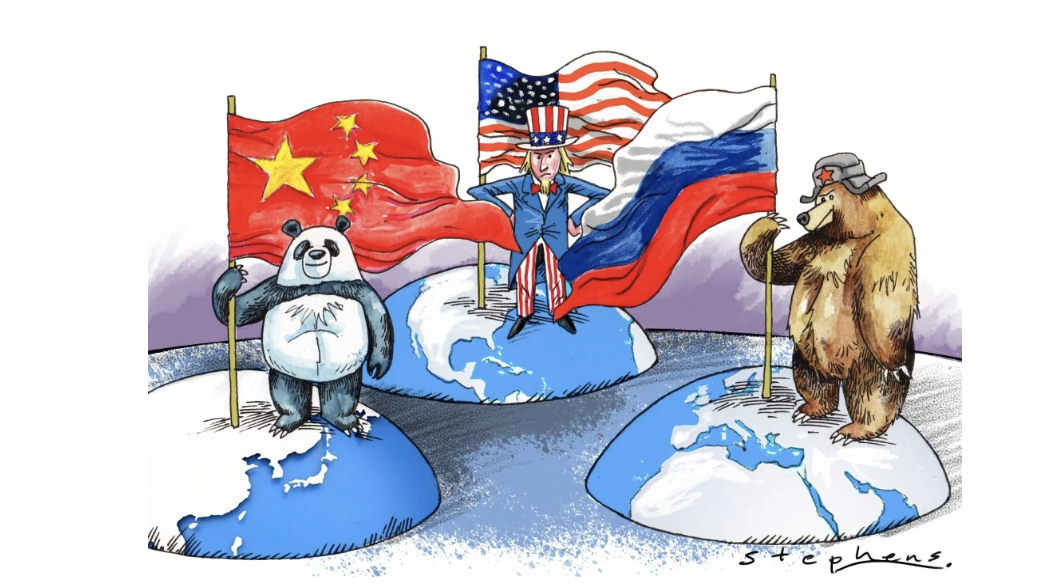
Upon the conclusion of the Cold War and the dissolution of the USSR, a rivalry of three parts had ensued between the United States, Russia and China. Through areas of trade, technological progression and military policy, all three powers compete for global influence. However, none compete as the United States continues to post-1991. This change is very important for the developing states who suffered the costs of bipolar or unipolar competition without having a say in the results of these activities. However, today’s fragmented system offers countries such as India, Vietnam, Turkey and Saudi Arabia opportunities to manoeuvre. The article discusses the process of the formation of the new order, describes the ways that medium powers can use bilateral diplomacy for resisting the pressures of all three great powers, and explains why, despite its external features, the new system favours the United States, China and Russia.
A Brief Background of the US-China-Russia Order
The final years of World War II were when the global institutional structure was defined and established. In 1944, during the Bretton Woods Conference, states converged on restructuring and reconstructing the global economy by forming the International Monetary Fund and the World Bank. Both of these institutions have largely been developed to weigh in favour of the US, equipping them with economic supremacy, largely by fixing the international monetary system by requiring all states to peg their currencies against the US Dollar. Through later conferences, primarily the Dumbarton Oaks and the Yalta conferences, the US, China, USSR, France and the UK were able to lay the foundational framework of the United Nations, thereby negotiating for permanent membership and veto power on the UN Security Council, through which numerous crucial binding resolutions are voted on, ensuring no state could act against the interests of the P5. Upon the formation of the UN, the ideological differences between the US and the USSR initiated a bipolarity in global governance, fought through proxy wars and nuclear threats. Moreover, the US had made significant progress in its initiative to control oil flow in the Middle East, upon the US-Saudi summit aboard the USS Quincy in 1945, granting them substantial control over global energy. The Chinese economic trajectory post-1978, coupled with Russia’s hardline security policy positions post-2007, had triangulated the international political order between the Americans, Russians and Chinese. Today, all three states have expanded their rivalry across various policy domains, including but not limited to technological oligopolies, energy, military and economic sanctions.
How Middle Powers Counteract Coercive Forces from the US, China and Russia
With the emergence of the triangular power architecture, middle powers have avoided maintaining allegiances to a single state, pursuing a policy of strategic hedging by selectively maintaining and deepening bilateral ties with several powerful states as a means to optimise and enhance benefits whilst simultaneously diminishing exposure to any coercive actions from a single state. One such case is India, who have succeeded in expanding upon its security agreements with the US whilst continuing its imports of Russian oil at a discounted rate, all whilst simultaneously maintaining major technological trade and cooperation with China despite its territorial disputes at the northeastern Indo-Chinese border. India has extended its bilateralism and strategic autonomy principle outside the US-China-Russia triangle. For instance, upon American tariffs up to 50% imposed on India in retaliation for its continued purchase of discounted Russian oil, India did not concede. Instead, it formalised and strategically extended its negotiations with the European Union, concluding its first Free Trade Agreement and Strategic Defence Partnership in 2026, impacting over two billion civilians and contributing to nearly a quarter of the global GDP.
Another example is Vietnam. By utilising its “bamboo diplomacy” principle of foreign policy, it continues to secure its sovereignty, remaining firmly intact whilst benefitting from its relationships with the US, China and Russia. The country has been able to restructure and amend its manufacturing capabilities by collaborating with and contracting American companies and Chinese partners, a clear-cut case of utilising American-Chinese geo-economic competition to its advantage. Furthermore, Vietnam has joined initiatives such as the CPTPP and RCEP, and has concluded an FTA with the EU, reducing the customs tariffs levied by the EU on Vietnamese goods by 99%. This diversification enables Vietnam to absorb supply chains that have undergone changes due to the US–China conflict without having to depend on either of the parties.
In the case of Saudi Arabia, within the security policy domain, they leverage Chinese investment in infrastructure, American arms trade agreements, and coordinate with Russia on discounted energy prices through OPEC+. Other states also follow the “autonomous pole” strategy, with Singapore engaging in bilateral partnerships with states in Africa, Southeast Asia, the West and BRICS member states, all simultaneously.
These cases serve as a testament to how states of the middle order counteract the coercive forces and pressure of the Americans, Russians and Chinese by pursuing alternative bilateral avenues and negotiations as means to abide by the strategic autonomy doctrine.
Why the System still Fails
Regardless of the aforementioned cases, the US, China and Russia still maintain the strategic possession of their coercive influence. International law and multilateral institutional procedures still favour these states, with the most notable example being the UNSC veto power, as all three states have the unfettered ability to block any resolutions that may conflict with their individual interests.
Neomercantilist economic coercion reinforces this trend. The SWIFT system and the essentiality of the US Dollar enable the US with coercive power, as states reliant on dollar-based transactions can be secluded through American unilateral coercive measures. China maintains a similar structure through its monopoly of rare earth minerals and semiconductor exports, maintaining embargoes on nations such as Japan on earth minerals and expanding its export controls on semiconductor chips. The total number of people and organisations that have been subjected to sanctions has increased 10 times in the time since 2000, while tariffs have increased 5 times over the last five years. This shows that coercion as a form of economic statecraft is becoming more widespread instead of fading away. The much-lauded FTA between the EU and India also turns out to have largely been the result of the imposition of tariffs by the United States, thereby proving that this agreement is not a sign of the independence of middle economies from the influence of major economic powers. Some critics are even harsher in their assessments. They claim that, according to a recent analysis, the middle power movement cannot be considered real, because it is impossible to combine these two contradictory strategies of equidistant hedging and active cooperation in view of the fact that both China and America are willing to employ various means of coercion.
Conclusion
Since the conclusion of the Cold War, there has been a significant probability of middle powers being able to act independently on the global stage. With states like India, Vietnam, and Saudi Arabia having utilised bilateralism cleverly, they have been able to transform the rivalry between superpowers into something that was able to bring them trade agreements, investment, and security guarantees that could never have been secured in the bipolar or unipolar order. However, one should not confuse the two phenomena. What has been achieved in the international arena should not be considered true parity. The institutional framework established in Bretton Woods and San Francisco during the 1940s, underpinning which is the dominance of the dollar today, technological monopolies, the right of veto and military superiority, has still made it possible for countries like the USA and China, as well as Russia to define the limits of the bilateral and multilateral hedging process. Middle powers have learned to thrive in a multipolar world but have not fully escaped it yet.
About the Author
Saahil Ali is a 2nd year Economics student at the Jindal School of Government and Public Policy with a minor in International Relations. His primary research interests lie in political economy, geoeconomics and trade policy, international law, and democratic governance. His goal is to continue his pursuit in policy research under these domains.
Image Source: South China Morning Post