
By – Harshi Upadhyay
Abstract
Nations rarely fail because they lack ambition. They fail when ambitious policies begin competing for resources that no longer exist in abundance. India’s simultaneous pursuit of AI infrastructure and ethanol expansion reveals precisely such a conflict. Beneath two widely celebrated development strategies lies a shared dependence on freshwater, a resource whose scarcity is becoming increasingly difficult to ignore. The real question is no longer whether these ambitions are defensible, but whether they remain compatible.
Introduction
Water scarcity isn’t just an environmental issue anymore. It has become an economic constraint, one that should actively shape how public policy gets designed. India supports nearly 18% of the world’s population but holds only about 4% of its freshwater resources. That imbalance has turned water into one of the country’s most limited strategic assets, even as demand keeps climbing from agriculture, cities, industry, and a fast-growing digital economy. To bridge this gap, India has become the world’s largest extractor of groundwater, while nearly 90% of extracted groundwater is directed towards irrigation. The result is a growing dependence on a resource that is being depleted faster than it can naturally recover in many parts of the country. Water, once treated as an abundant input to development, has instead become one of its defining constraints.
Yet, at precisely this moment, India is accelerating two flagship policy ambitions. One seeks to position the country as a global hub for hyper scale AI and data centre infrastructure. The other aims to expand ethanol blending in pursuit of energy security, reduced fuel imports, and higher farm incomes. Each policy makes sense on its own, offering real economic and strategic benefits. However, taken together, they raise a harder question: Can a country already facing deepening groundwater stress, afford to chase multiple water-intensive development strategies at once, without ever tallying up what they collectively cost the same shrinking resource?
Hey GPT, How Am I Feeling?
The AI boom has set off a race among tech giants to build data centres that are bigger and more powerful than the last. Picking where to build one isn’t just an engineering decision anymore, it’s turned into a political one. These places need huge amounts of land, power that never cuts out, plenty of water, and, more than anything, a government that will quickly nod instead of sitting on approvals for years. India, eager to be seen as a global AI powerhouse, has jumped headfirst into this race. That eagerness has created a setup where economic ambition tends to move faster than environmental caution, which makes the country an appealing spot for hyper scale AI infrastructure to land.
By contrast, this so-called ‘digital revolution’ has a footprint that’s anything but digital. A single hyper scale data centre can pull close to 100 megawatts of power, enough to light up around 80,000 homes, all while using massive amounts of water just to keep thousands of servers from cooking themselves.
As OpenAI CEO Sam Altman recently remarked, the average ChatGPT query consumes roughly one-fifteenth of a teaspoon of water which might be a seemingly insignificant amount for a single question, but one that becomes far more consequential when multiplied across billions of interactions every day. Hence, that AI query that feels like it costs nothing, is really being carried by an entire industrial machine underneath it: power lines, cooling towers and millions of litres of water. This race is reshaping India right now. Hyperscale data centres are shooting up fast in Maharashtra (Mumbai), Telangana (Hyderabad), Tamil Nadu (Chennai), Uttar Pradesh (Noida) and Andhra Pradesh (Visakhapatnam). It’s not a coincidence that these are also the exact places already struggling with water. This paves the way for the real question: not whether India can become an AI superpower, but whether it can get there without pushing an already stretched water supply past its limit.
The Ethanol Push
Every nation dreams of discovering a solution that solves multiple problems at once. For India, ethanol seemed to offer exactly that, a fuel that could reduce dependence on imported crude oil, increase farmers’ incomes, strengthen energy security, and help meet climate commitments, all without fundamentally changing the way people travelled. It sounds almost too good to be true. And perhaps that is the problem. India’s ethanol push rests on a resource that’s already running dangerously low: water.
To reduce dependence on imported crude, the government has rapidly scaled up the Ethanol Blended Petrol (EBP) Programme, under which petrol gets mixed with ethanol produced mainly from sugarcane and, increasingly, maize. The promise looks attractive on paper. The hidden cost, though, starts long before the ethanol ever reaches a fuel tank. Sugarcane, the programme’s main feedstock, happens to be one of the most water-guzzling crops grown anywhere in India. NITI Aayog’s own Roadmap for Ethanol Blending in India puts the agricultural water footprint of just one litre of sugarcane-based ethanol at roughly 3,000 litres, and sugarcane and paddy together already soak up nearly 70% of the country’s irrigation water. In the process of trying to cut dependence on imported oil, the policy ends up deepening dependence on something even harder to come by. Through all this, the common man is still footing the same bill he always has, arguably a heavier one now. Fuel hasn’t gotten any cheaper, and everyday expenses have only crept higher.
This raises an economic question that extends beyond ethanol itself: what is the opportunity cost of allocating finite freshwater to fuel production? Water diverted towards cultivating ethanol feedstocks cannot simultaneously support food production, replenish depleted aquifers, sustain ecosystems, or meet the growing demands of households and industry. None of this diminishes the programme’s strategic intent; reducing import dependence and diversifying energy sources remain legitimate national objectives. Rather, it suggests that the programme’s greatest weakness lies not in its ambition, but in its execution. Accelerating an inherently water-intensive policy in a country already confronting mounting water scarcity transforms what appears to be an energy solution into a far more complex problem of resource allocation.
The Overlap
As India races towards two defining ambitions of this decade, an uncomfortable overlap is beginning to emerge. The country has not only positioned itself as a global destination for AI infrastructure but has also advanced its target of achieving 20% ethanol blending from 2030 to 2025. Individually, each decision appears economically compelling. Together, they raise a question that has received remarkably little attention: where will the water come from? The target may have arrived five years early, but India’s water resources did not.
The answer gets more unsettling the moment you look at a map. Maharashtra, Karnataka, Tamil Nadu, and Telangana are pulling in hyper scale AI data centres owing to their industrial ecosystems and dependable power infrastructure. Here’s the catch: several of these states are also major hubs for ethanol production or sugarcane farming, and they’re already struggling with recurring water stress. Heading further north, Punjab and Haryana are still draining groundwater at rates that can’t be sustained, to keep water-hungry agriculture going. Aquifers in these states are already running dry. Expanding ethanol production here does not solve a farming problem. It deepens a water crisis that has moved well beyond agriculture. Adding AI infrastructure scaling up on top of that, suddenly causes two of the country’s biggest priorities to be competing for the same dwindling pool of water.
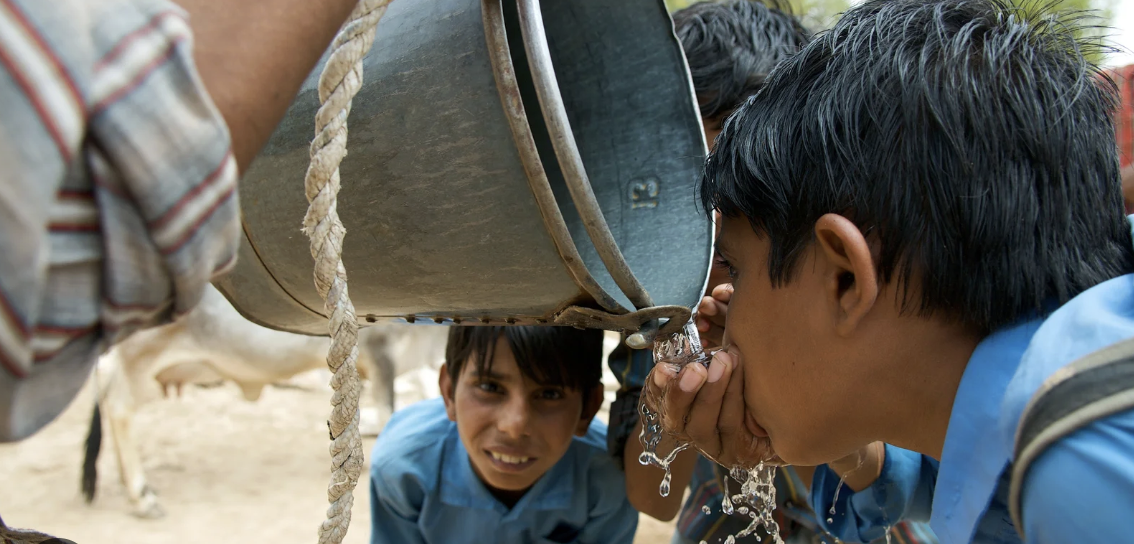
Water does not distinguish between an AI server rack and a sugarcane field. Every additional litre committed to one inevitably leaves less for the other. For millions of Indians, this is not an abstract policy dilemma but a daily reality. Across many parts of the country, households already grapple with declining groundwater, erratic water supply and the growing burden of securing safe drinking water. As these water-intensive industries keep growing side by side, it is the ordinary communities, not the people writing policy or running corporations, who pay the real price for a resource that’s running out.
Conclusion
India’s ambitions need not be smaller, they need to be better aligned. As the country simultaneously pursues energy security, technological leadership and industrial growth, the trade-offs between these priorities deserve far greater scrutiny than they currently receive. The consequences of getting this balance wrong will not be borne in policy documents, but in the lives of millions who already struggle for something as fundamental as clean water. If today’s policy choices will determine tomorrow’s water security, shouldn’t we be asking harder questions before those choices become irreversible?
About the Author
Harshi Upadhyay is a second year Economics student at the Jindal School Of Government Policy and a member of the Economics and Finance Cluster of Nickeled & Dimed. She is a curious mind shaped by Economics, Literature, story telling, and a constant need to question the obvious.
Image Source : https://www.globalcitizen.org/en/content/indias-water-scarcity-problem-hits-its-poor/