
By -Madhav Pransukhka
Abstract
Most arms control agreements of the last hundred years share a hidden assumption. They assume a dangerous weapon is something you can find. Nuclear warheads can be counted. A uranium enrichment plant can be inspected. A chemical agent can be sampled and confirmed. Treaties like the Non-Proliferation Treaty and the Chemical Weapons Convention are built around this. The weapon is a physical object: you can locate it, and you can verify whether a state is keeping its word.
Artificial intelligence does not behave like that, and the world has not yet worked out a good answer to the problem.
Introduction: A Weapon Made of Code
Think about what AI actually is when a military uses it. It is not a missile or a tank. It is code. A machine learning model that recommends songs on a music app could, if you trained it on different data, help an army work out which building to hit. There is no warehouse you can walk through and no stockpile to weigh. A model can be copied a thousand times in an afternoon and emailed across a border in seconds. Inspecting it is not just difficult, it is close to meaningless.
People call AI a dual-use technology, but the phrase makes it sound tamer than it is. Enriched uranium has almost no everyday purpose, which is exactly why governments can keep track of it. The maths behind a targeting algorithm is the same maths taught in undergraduate computer science and used every day by companies that have nothing to do with the military. You cannot outlaw knowledge without shutting down a large part of ordinary economic life. Some of the scientists and company founders who built these systems have started publicly warning about where they might go, which tells you something about how uneasy even the insiders have become.
There is also the question of pace. A treaty can take years to negotiate, sometimes longer. The technology changes within months. A definition states that this year can be out of date before anyone signs it. Arms control has always been slow, but it used to regulate things that were slow as well. That is no longer true.
It would be easy to file all this under science fiction, the stuff of distant scenarios and walking robots. The reality is more ordinary, and it has already happened.
That difference changes the entire logic of arms control. Traditional treaties regulate objects; AI would require regulating capabilities, software, and human decision-making instead.
Gaza Was the First Draft
The clearest example is the war in Gaza. The Israeli outlets +972 Magazine and Local Call reported on AI systems the Israeli military used to help pick targets, and their reporting was later examined by The Guardian and assessed by Human Rights Watch. One system, nicknamed the Gospel, generated lists of buildings recommended for attack. Another, called Lavender, reportedly gave people in Gaza a score based on their suspected links to armed groups and assembled a database of possible targets.
This is the part worth slowing down on, because it is where a lot of writing on the subject goes off the rails. These were not machines deciding on their own to kill anyone. They suggested targets to human officers, and the officers decided whether to strike. The Israeli military said its analysts reviewed each target against the rules of international law. What people argue about is how serious that review really was. According to the reporting, some officers spent only a brief moment confirming a target before signing off, and the system was understood by its own users to be wrong in roughly one case in ten. The Israeli military rejected the way its systems were portrayed but did not deny they were being used.
You do not have to settle the argument over any single airstrike to take the broader point. AI was used to speed up targeting in a real war, the legal questions were serious, and there was no specific treaty anywhere governing it. Yuval Abraham, the journalist behind the original investigation, made a point that is hard to shake. The technology did not invent the decision to bomb people in their homes, he argued, but it let that decision be carried out at a scale that would not have been possible before. That is the thing arms control is supposed to slow down, and the thing it cannot touch right now.
Geneva Is Talking, Not Arriving
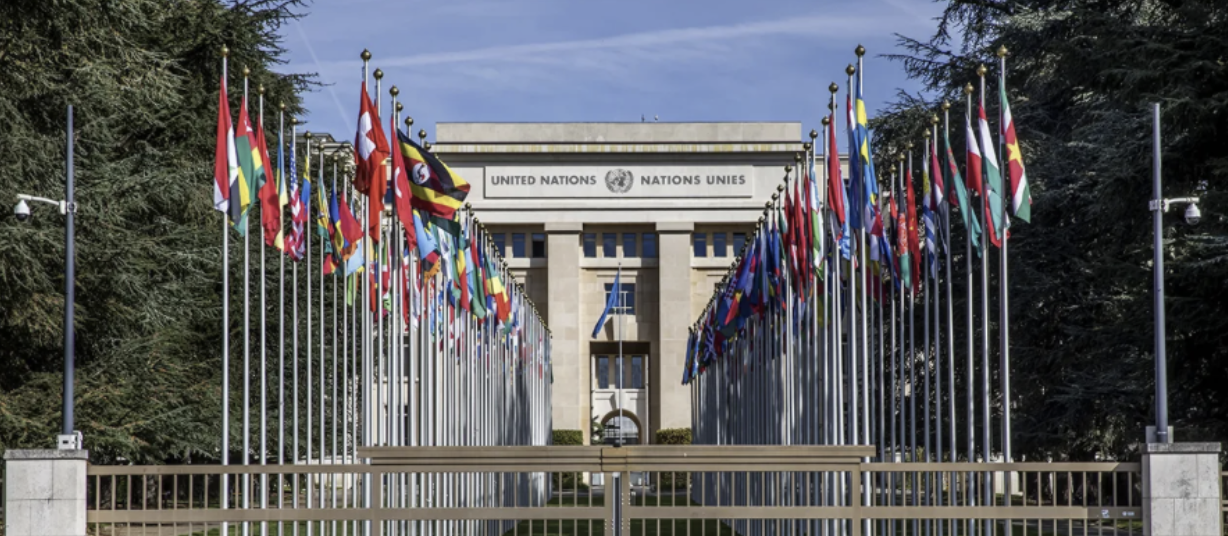
Governments have not ignored the issue entirely. Since 2014 states have been discussing lethal autonomous weapons in a forum in Geneva called the Convention on Certain Conventional Weapons. The UN Secretary General, Antonio Guterres, along with the President of the International Committee of the Red Cross, has urged states to agree to a legally binding treaty by the end of 2026, calling weapons that operate without human control politically unacceptable and morally repugnant. By 2025, more than 120 countries supported the idea of negotiating such a treaty, and that year France, Germany and more than forty other states declared that the draft material was ready for actual negotiation.
So there is some movement. The trouble is that talking about a treaty and having one are different things, and the obstacles in the way are not new.
The Geneva process runs by consensus, which in plain terms means any one country can stop it. The states with the most advanced military AI have the least reason to tie their own hands. People who follow the talks closely point out that even if the discussions move forward, a state like Russia or the United States could simply block the step to real negotiations, or insist on something far weaker than a binding deal. The current round of talks runs only to the end of 2026, and formal negotiations probably would not start before 2027, if they start at all.
Anyone who has studied international law will recognise the shape of this. The institutions are there. They put out statements, host conferences and produce thoughtful documents. Whether any of it is enforced comes down to whether powerful states are willing to be bound, and when their own strategic interests are on the line, that willingness has a habit of disappearing. AI weapons are just the latest place the old pattern shows up.
Why This One Is Worse
What makes this case harder than the ones before it is the nature of the technology. Nuclear arms control had something going for it that is missing here. Only a handful of states could build a bomb, and the materials were rare and traceable. Military AI has neither advantage. A great many countries can develop it, the building blocks are everywhere, and a capable system could end up with groups no treaty would ever reach. Experts have warned that fairly cheap autonomous systems might fall into the hands of militias or criminal networks, which makes the old approach of policing a short list of governments look almost out of date.
Conclusion
That does not make the effort worthless. A treaty with clear limits, even a flawed one, would still beat the silence we have now. Rules shape what people do even when they get broken, and a shared standard at least gives critics something solid to point at. But it would be dishonest to pretend the outlook is good. The technology keeps racing ahead, the politics stay stuck, and the gap between the two is being filled, for now, by what happens on real battlefields.
We are trying to govern the weapons of this century with the habits of the last one. Until that changes, the rules that matter most will keep being written the worst way possible, one war at a time.
About the Author
I am Madhav Pransukhka. Currently, I am studying BA PPE ’25, at Jindal Global University.
Image Source : https://timesofindia.indiatimes.com/travel/geneva/palais-des-nations/ps55492499.cms