
By – Kamya Sharma
Abstract
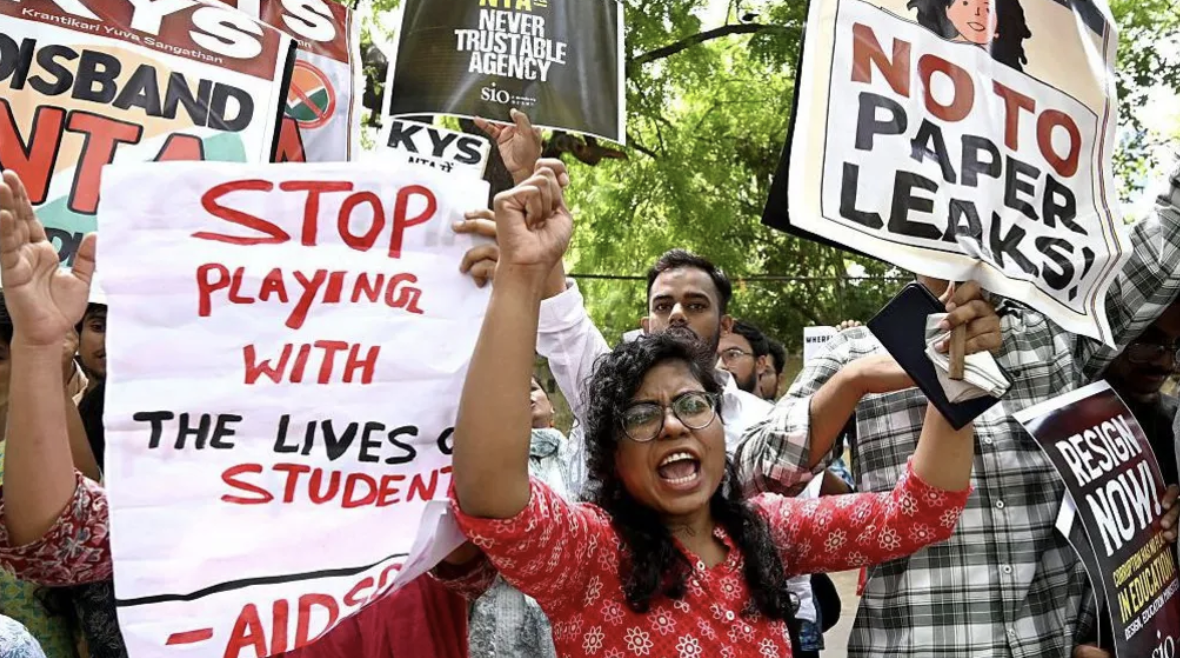
The National Testing Agency cancelled the NEET UG examination after a CBI investigation disclosed a question paper leak in May 2026 for which 2.27 million medical aspirants registered. NEET examination is based on the idea that a standardised and centralised test is the most efficient way to provide seats as well as the fairest. The question paper leak destroys that idea and raises the question of how all public institutions are structured. What should policymakers prioritise, efficiency or fairness? What happens when we assume without even questioning if both are the same thing? This article focuses on the NEET’s administrative efficiency.
Introduction
Exams in India especially like NEET are showcased as tools of merit and equal opportunity. NEET was introduced with the idea of a single entrance examination to increase efficiency and provide a fair system to the candidates. However this did not effectively do what it promised because there have been question paper leaks and lack of access to resources which raised the question of administration’s efficiency. The article argues on the institutional design of the examination and that the system should adopt a different approach with the change in time and educational diversity. The article ends on the note that the system should construct exams in a way to serve the students instead of adapting bureaucratic approaches.
The Fascination of Centralization
Medical examinations were a labyrinth before NEET, as individual states, universities, and private institutions all used to take separate exams, with each of them having its own syllabus and schedule. Capitation fees aided in bribery determined medical school entry at many private universities. Indian policymakers found centralized tests appealing due to these reasons. In the case of Christian Medical College vs Union of India (2020), the Supreme Court upheld NEET majorly on the grounds that a standard centralized exam was a necessity to curb corruption, capitation fees and various other malpractices in admissions.
When looked at through an administrative lens, then this logic seems reasonable, as combining tons of examinations into one reduces costs for testing agencies, helps scheduling and results in a single record. Supporters of centralization argue that it removes the need for students to sit in different state level and private examinations which helps save time, money and effort. The system is efficient for those who are running it but what it sidesteps is the question of whether this system is efficient or fair to the students who are meant to be served by this system.
The Blind Sport within the structure
NEET makers did not fully think about this trade off. A centralized and standardized test cannot result in equal outcomes in an unequal society because it measures aptitude as well as access.
The NEET examination’s syllabus is based on CBSE and NCERT. This immediately puts students from rural and southern areas at a disadvantage because many schools in India like in the state of Jammu and Kashmir have state boards.. The exam’s reliance on a centralized syllabus showcases that it does not take into consideration that the diversity of the education system exists across states. Tamil Nadu, for example, has its own robust school curriculum, and thus students who wish to appear for NEET are required to learn a completely different syllabus, which, on the other hand, is easier for students in urban, private, or CBSE affiliated schools.
This disadvantage is worsened by the rise of the coaching industry. In an exam like NEET in which over 1.6 million aspirants compete for roughly 100000 seats, coaching becomes a necessity for anyone who wants to attain a competitive score. However, not everyone can afford coaching as they are expensive and urban concentrated which makes it inaccessible for students coming from low income or rural families. The NEET 2018 topper who was registered in Bihar but prepared at a coaching institute in Delhi captures this issue as a test which is designed to eliminate inequality of access had made coaching institutions the new gatekeepers.
A committee named the Justice A.K. Rajan Committee was commissioned by the Tamil Nadu government found that NEET has reduced admissions from low income families and increased admissions from high income families. Due to this many backward class groups have faced a reduction in representation after NEET’s introduction. Rural students who don’t come from high income families face major challenges like lack of infrastructure, trained teachers and educational support.
When Efficiency Weakens Itself
The fact that NEET was unfair is not the only issue but it is that over time the administrative efficiency made an institution that failed on its very own terms.
Centralization is considered risky as the damage is not localised, because when a paper leak takes place in a single national exam like NEET then it affects 2.27 million students simultaneously. The 2024 scandal had 67 candidates who scored 720, which is a statistical anomaly, and along with that, grace marks were given to 1500 students for “loss of time”, which brings up questions regarding procedural consistency. The 2026 scandal resulted in the cancellation of the examination after a CBI investigation. The exams, which are made to promote merit, have become a lottery which is plagued by leaks, grace marks and other mysterious score inflations.
This indicates a bigger problem with efficiency, like first institutional design, as it tends to optimize for legibility and administrative control instead of resilience or human context. The assumption that one test could cover a nation of 1.4 billion people having different educational systems and income levels is sociologically brittle.
The False Binary and What Replaces It
OECD research shows that less inequality can go hand in hand with more robust and better performing economies. This is not an idea in the context of medical education, as India has a shortage of rural doctors. NEET also filters out students from rural and low income backgrounds, then the very students, as noted by the A.K. Rajan Committee, will go back to these vulnerable student communities and then the admission system will be making a medical workforce which will not be matched to the needs of public health. In NEET’s case, efficiency and fairness were not traded off, but both were sacrificed.
Now the question comes up to what is a better institution then? Tamil Nadu had a model before NEET which can be the answer to this question. The state abolished entrance exams in 2007 and took admissions based on higher secondary marks after a 2006 expert committee found that entrance exams used to disadvantage rural and poor students. The result of this was that a more diverse medical body and the state argued that there was no decline in the quality of doctors also. This system was not a perfect system as it had its own weaknesses, but it depicts that sometimes a fairer process is better and more reliable because it reduces the structural problems which are created by a single examination.
A single, standard, centralized exam provides formal equality, but when formal equality is applied to structurally unequal points it does not produce equal opportunities instead it produces hierarchies and differences only by dressing them in the idea of meritocracy.
What the Trade-off Actually Demands
Coming back to the original question of what should policymakers prioritize efficiency or fairness? The honest answer to this is that policy makers need to choose a point as both of these are different ends and are pulling against the other. The NEET experience suggests that this framing is not adequate ,as both efficiency and fairness are not just two values ,but instead they both raise different questions. Efficiency asks as to how do we minimize cost and maximize output ,and on the other hand, fairness asks for whom is the output and how can it be measured? A policy that goes efficiently can turn out to be catastrophic for the second.
Conclusion
The most important question to policymakers is not which value to prioritize but for whom are these institutions made and at what scale should it be evaluated. Is an exam like NEET which is efficient for the NTA but inefficient for rural students ,as they have to travel cities to pay for coaching and to navigate syllabus to which they are foreign is, actually efficient? India’s examination system needs reform because it is based on a very narrow and administrative centric idea. The idea to move forward is not to abandon standardised tests but to make institutions that ask about the society they are supposed to serve before creating an assumption that a single exam can serve equality to all. To curb these, there can be support for students who cannot access coachings, data collection on who is being included and excluded, and multiple assessment frameworks.
To achieve this ,policymakers need to resist the fascination of one exam. Complex societies like India cannot fit into these administrative boxes. The institutions that serve the society are supposed to keep that complexity in their mind from the start and not as an afterthought once scandals like these occur.
About the Author
Kamya Sharma is a third year BA LLB student studying in OP Jindal Global University and her interest lies in Constitution law, public policy and sports law.
Image Source : https://www.bbc.com/news/articles/cn074j04l3eo