
By – Poorvanshi Tyagi
Abstract
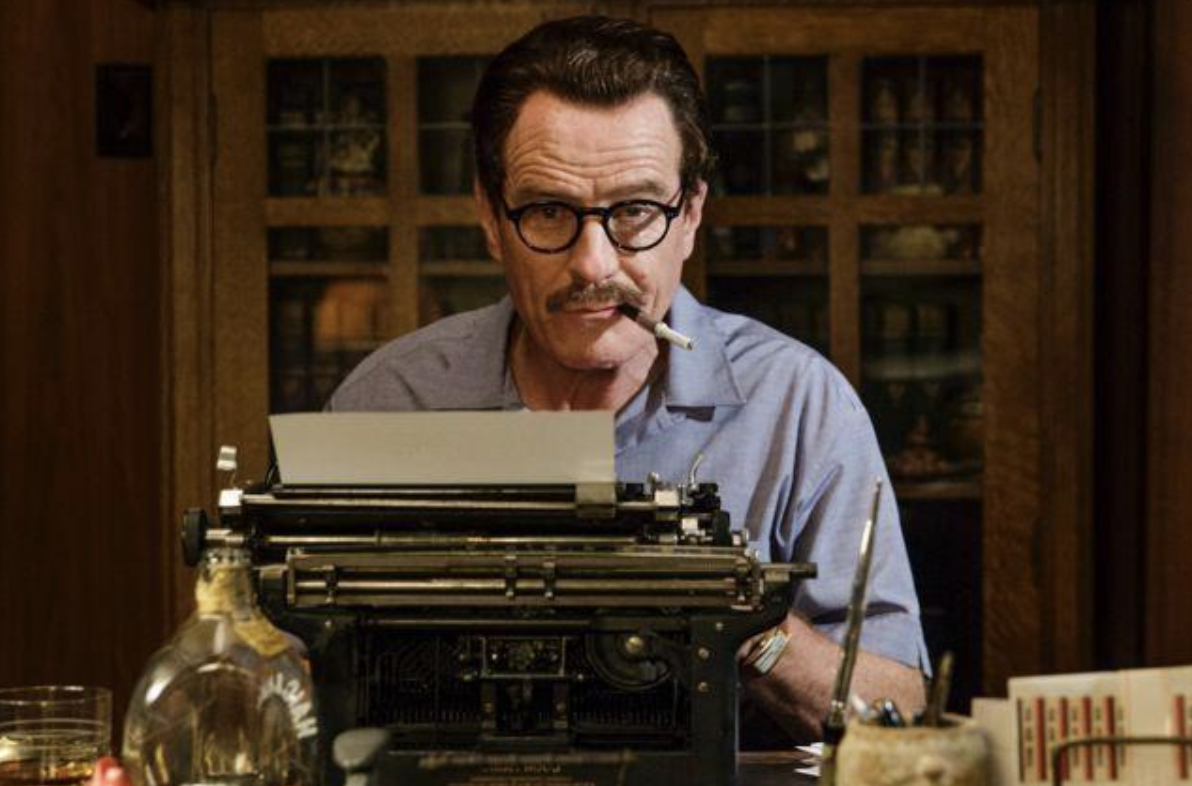
Trumbo (2015) is based on the tumultuous career of Academy Award winning screenwriter Dalton Trumbo. The film examines the life and mind of Trumbo, whose public support for communism in the Cold War era shaped his personal, social and professional life. Through the lens of Trumbo, this article aims to critically examine capitalism as a social power structure which shaped nationalism, identity, and norms in post WWII America.
Introduction
Dalton Trumbo’s screenwriting career was tainted having been blacklisted by Hollywood, undermining his right to pursue his creative endeavours or be offered to write screenplays. The film explores the socio-political layers that confronted not just Trumbo but the American film industry as a whole when it came to political and ideological affiliations. Trumbo’s compromised professional and social life as an advocate of communism in Cold War America gives one a glimpse into the imagination of communism which existed in that space. It not just raises seminal questions on the separation of art and politics, but also diversifies our understanding of capitalism as a power structure, one that goes beyond reductionist economic theories and captures social and ideological hegemonic tendencies within capitalism which guide society, identity politics, and, nationalism.
Bipolarity reigned over the post-WWII global order, concentrating power in the hands of two blocs controlled by the U.S. and the USSR. The Cold War between the two powers was largely a product of an ideological drift, that of Capitalism and Communism. Efforts to assimilate and mobilise populations through state apparatus and civil society institutions to ensure strong ideological alignment was rampant in both democracy led capitalist and the authoritarian communist regimes. In this context, ideology becomes the basis for nationalism, social and political acceptance, as well as a fundamental tool in the formation of norms.
Ideology & National Identities
Amongst other dimensions, Trumbo heavily deals with the intersection of nationalism, national identity, and ideology. The film features the infamous Communist Trials wherein supporters of communism were suspected to have had connections with the Soviet Union, deeming them to be ‘anti-nationalist’, ‘an enemy of the state’, and so on. An infamous committee namely the House Un-American Activities Committee(HUAC) of the U.S. House Of Representatives was formed in 1938 under politician Martin Deis. It conducted several undisputed investigations throughout the 1940s and 50s upon alleged communist activities. Trumbo himself, among others of the Hollywood Ten, a group of screenwriters, directors, and producers who refused to testify before HUAC, was shortly arrested and subsequently blacklisted from Hollywood.

Picture credits : https://behindthelensonline.net/site/reviews/trumbo/
This era of McCarthyism, named so as the era under Senator Joe McCarthy who launched highly publicised probes into alleged communist intrusion into the state, depicts what seemed to have been a process of normalising communist affiliations as foreign to the motherland, establishing a capitalist idea of nationalism. Thus, the Gramscian concept of Common sense as knowledge which we are socialised into believing to be ‘self-evident truths’ loomed large throughout 1950s America as the state began to construct commonsensical ideas of communism and capitalism through persecutions. Communism, thus, was viewed with suspicion and danger, giving rise to the Red Scare Wave, which led several anti-communist campaigns, to raise ‘awareness’ among the public, as also depicted in the film.
The film depicts famous gossip columnist Hedda Hopper as the symbol of American nationality, who treats Trumbo and other blacklisted screenwriters as anti-nationals for having openly supported communism. In the film, Hedda appears to be a fear-mongering character who attempts to unite Hollywood against Trumbo and his communist friends, perceiving him to be a rather dangerous abnormality to the system. A socio-economic and political ideology is thus, transformed into a defining system of normative and non-normative identities necessary for culmination of national identities. In this regard, the formation of the nation-state and the rise of capitalism, at the conjunction of which, lies the rise of nationalism, becomes crucial to our understanding of capitalist nationalism in America. Nationalism, rather arose as a need to homogenise and strengthen ties in a society that prioritises self-interest over other social relations, serving as a balance between market realities and principles of harmony and cooperation. Capitalism, however, did not just serve as a market form. It united Americans against communism and socialism through social and political means, becoming a key component of American nationality, deep-rooted in American identity even today.
Illusions of Democracy & Resistance
Against the backdrop of the Cold War, the USSR was looked upon as an authoritarian regime. On the other hand, America emerged as a pioneer of freedom and fundamental rights. Capitalism, having championed the cause for democracy, helped shape popular perceptions of America, which contradicted the usual dictatorial perception of the Soviet Union. However, the Red Scare wave and its intrusion into popular media, education, and the American society at large, exposes loosening threads of a liberal democracy built on fundamental rights and freedoms.

Picture credits : https://wisconsinhistory.org/Records/Image/IM3677
Through the lens of Dalton Trumbo’s life, the film presents a rather dissonant state of affairs as it cruises through anti-communist sentiment and the state’s infringement on the fundamental freedom of expression, speech, and association. The very idea of HUAC and the infamous Hollywood blacklist demeans all it meant to stand for. Trumbo’s political leaning influences his work, social circle, as well as media perception. The apparent democratic system curtails rights as and how it fits the American imagination. The process of ostracizing communists on account of sedition for it doesn’t align with the socially constructed idea of national sentiment, reducing the concept of American democracy to an illusion.
Resistance to the threats of capitalist democracy is well depicted in the film. Trumbo’s perseverant nature and unwillingness to deny his political values for the sake of submitting to the hegemonic ideas around him convey a form of resistance which questioned the democracy that promised free speech and expression. A dialogue proclaimed, “What they fear isn’t that I’m a Communist. What they fear is the public. They fear the American people. They don’t want to muzzle me; they want to muzzle public opinion.” Trumbo fights off the blacklist by working as a ghostwriter for production houses, and eventually publicly announces his involvement in award winning film screenplays like Spartacus and Roman Holiday. His unwavering support for communism and admittedly normalcy towards a tumultuous public perception shatters the Commonsense of American society which sought to equalise capitalism to a sense of national identity.
Conclusion
The film Trumbo serves as a reminder for the influence of the Cold War sponsored ideologically bifurcated world on dimensions such as identity politics, nationalism, and societal norms. It reminds us also, of the dangers of ideological warfare and its role in shaping perception and life at large. Dalton Trumbo eventually received his deserved Academy Awards for screenplay of The Brave One in 1975, and for Roman Holiday in 1993, much after the long gone days of the Red Scare Wave. The film is also a celebration of his legacy as well as an ode to his resistance amidst a time of grave political suppression in American history. The film helps us revisit communist imagination of post WW-II American society, and its confluence with national identity. Moreover, we observe the changing trajectories of nationalism and national identities, keeping in mind that capitalism was a major component of American nationalism insofar as the Soviet Union existed.
About The Author
Poorvanshi Tyagi is a second year student at Jindal School Of International Affairs, O.P. Jindal Global University, Sonipat. She is currently pursuing a Bachelor’s in Global Affairs and a diploma in Literature. She is a published poet and an avid reader. She is open to research opportunities in the field of education, sociology and cultural anthropology. Besides, she enjoys dancing and music.
Image Source : https://behindthelensonline.net/site/reviews/trumbo/