
By – Anaaya Wahi
Abstract
Long before an app decided what a delivery costs, garment workers in the nineteenth-century tenements were paid by the piece per shirt, per collar, per finished bundle having no floor beneath a bad week. Platform work has renewed this logic at a scale no sweatshop foreman could have ever imagined, except the “piece rate” is no longer fixed at all. It is reassessed per worker, per order, by an algorithm that no one can see. This article argues that gig pay is not merely piecework’s digital cousin but something way more volatile: a wage system stripped of the one thing piece rates historically guaranteed – a known price. Analysing platform pay through this historical lens brings into light why Indian labour law, built for salaried employment cannot fix what is fundamentally a control problem disguised as a payment method.
Introduction
An order notification flashes on a delivery rider’s phone: ₹23 for a 2.6-km trip, expiring in eight seconds. He doesn’t know why it is ₹23 and not the ₹31 his neighbour got for a similar ride an hour earlier. He accepts anyway, because refusing too many orders eventually lowers how many he is offered next. This is the quality of platform income in Indian cities today, determined order by order, on criteria that always remains concealed. It is usually described as a gig-economy problem, a mere byproduct of app-based convenience and worker flexibility. But this per-task, no-fixed-wage arrangement is not new in fact the piece rate is one of the oldest payment methods in industrial history. What has changed is who sets the price and how often it moves. This article traces platform pays back to nineteenth-century piecework to understand why the comparison, although imperfect, is genuinely useful and why the gap between the two is exactly where reform needs to prioritize.
Paid By the Piece, Then and Now
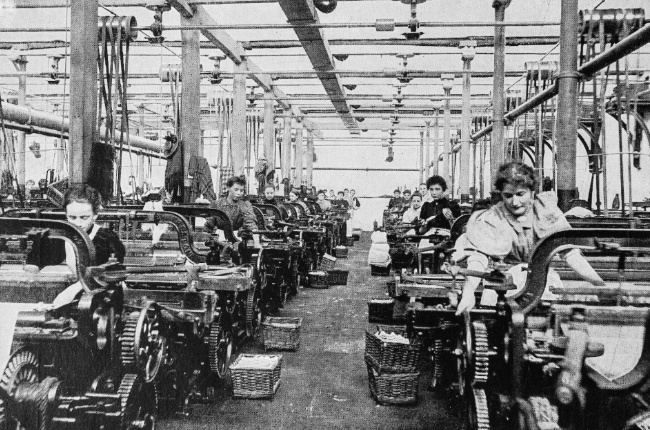
In nineteenth-century garment trades, seamstresses were paid a set amount per finished item and piece-rate abuses were common, with workers consistently putting in sixteen hour days for wages that barely even cleared sustenance. The putting out system that preceded factory production sent precut cloth into home workshops, it was not a voluntary or entrepreneurial choice for most workers but a necessity, since the sheer surplus of seamstresses looking for work meant no individual had any leverage over the rate that was offered. Delivery and ride-hailing platforms mirror this structure almost precisely: work is unbundled into discrete tasks, performed off-site, paid per completed unit and priced by whoever controls demand. A Hyderabad delivery driver described a base rate of roughly ₹5 per order before incentives, which shows how thin the per-unit price becomes once a worker’s own fuel and maintenance costs come out of it. The parallel to the sweated trades ends, however, at the point where the historical piece rate was at the very least a known number. A seamstress could calculate in advance what a dozen shirts would earn her. A gig worker cannot.
A Price That Moves for No One to See
This is where the platform version becomes structurally worse than its nineteenth-century predecessor. Legal scholar Veena Dubal has termed the practice algorithmic wage discrimination: platforms use specific behavioural data like acceptance rates, idle time, location history in order to calculate the minimum a specific worker will accept for a specific job, so two riders doing the same trip at the same time can therefore be offered varied amounts. In contrast to, a factory owner posting a per-piece rate on a wall, no worker in the gig economy can see what determines their price and the price itself keeps changing on data only the platform has. Drivers describe the resulting experience in the language of gambling, chasing an occasional high-paying trip while the app dispenses out just enough orders to keep them logged in. A wage system this opaque does not just replicate the exploitation of the sweated trades, but it eradicates the one piece of information workers in that system had.
India’s Piece-Rate Breaking Point
The repercussions of the opacity of this structure emerged visibly through 2026. In May, gig and platform workers executed a nationwide five-hour strike after a roughly ₹3-per-litre fuel price hike, demanding a minimum rate of ₹20 per kilometre to cover the cost of maintaining their own vehicles, a cost platforms do not absorb. Earlier, in January, sustained protests over unsafe delivery targets pushed the government to restrict ten-minute delivery guarantees that had condensed piece-rate work into even smaller windows. Median monthly earnings for India’s roughly 15 million gig workers cluster around ₹14,000–18,000 after fuel deductions, for a workforce estimated to almost triple to 23.5 million by 2029–30. These are not simple marginal figures, but they describe an emerging employment category, expanding fastest outside our metros, entering the workforce on a payment logic that is explicitly designed to avoid the obligations of an employer.
What the Law Still Treats as an Afterthought
India’s regulatory response so far presume gig work is a temporary, supplementary arrangement rather than a primary livelihood contrary to the reality. The Code on Social Security, whose rules came into force in April 2026, extends welfare benefits only to workers who log at least 90 days with a single platform or 120 days across several, and it is funded through a turnover-based cess that does not treat a platform running dangerous, high-pressure delivery windows not at all differently from one that does not. State laws in Rajasthan, Karnataka and Tamil Nadu add registration boards and levy-funded welfare schemes but none of them gives workers a claim on how their price is calculated. The European Union’s Platform Work Directive, adopted in 2024 with a transposition deadline of December 2026, highlights a different approach which mandates human oversight of algorithmic driven decision like pay and dismissal and shifts the burden on platforms to prove that a worker has been rightly identified as self-employed. It does not bring a solution to algorithmic wage discrimination either but it at least treats the pricing mechanism as something workers are entitled to contest. Indian law has no equivalent provision yet.
Conclusion
The piece rate never disappeared; it shifted into an app and lost its only redeeming feature- a known price. Nineteenth-century seamstresses in the sweated trades could at least calculate what a day’s work was worth to them, even when that worth was unfairly low. A gig worker today cannot do that, because the rate is renewed for each of them, from data only the platform can see and withdrawn just as invisibly the moment their score declines. Calling this “flexibility” describes the worker’s schedule, not their wage. Until Indian labour law treats algorithmic pricing the way industrial-era regulation eventually started treated piece-rate abuse – as a labour condition subject to disclosure and challenge, rather than a private commercial decision, the platform economy will keep repeating a nineteenth-century pattern with twenty-first-century opacity stacked onto it.
About the Author
Anaaya Wahi is a fourth-year B.Sc. (Hons.) Economics student at O.P. Jindal Global University. Her interests lie at the intersection of economics, finance, public policy, AI, technology and digital governance. She is mainly interested in understanding how emerging technologies reshape work, rights and economic institutions.
Image Source: https://19thcentury.us/19th-century-science-and-technology/