
By — Raewa Bharat Parab
Abstract
The algorithm does not provide financial advice; it determines who hears it and how often they should hear it to get convinced. This is a distinct mode through which frauds are also occurring. India’s securities law have been trying to catch up to the era of finfluencers and this article examines if the present framework can hold when the true instrument of harm is not the influencer’s claim but its algorithmic distribution which is invisible, real-time, and entirely outside SEBI’s present statutory vocabulary.
Introduction
Investment must seem daunting for most people, and somewhere between a WhatsApp forward and an Instagram reel sits a genre of financial content that Indian securities law was never built to see promising strong investment returns or a YouTube educator guiding us to invest in which stock market. None of this looks like the investment advice the SEBI Act, 1992 was drafted to regulate. All of it behaves like it. And the mechanism that turns a single misleading post into a market event is not the influencer at all; it is the recommendation algorithm sitting underneath every platform they use, deciding, in real time and without disclosure, who sees what and how often.
The core question that the article examines is whether India’s securities regulatory framework is equipped to address market manipulation and investor fraud when financial advice disseminated by influencers is algorithmically amplified to thousands or millions of investors. The honest answer is that SEBI has moved further and faster on this than most comparable regulators, but the amplification layer itself remains entirely outside its gaze.
The statutory and regulatory base
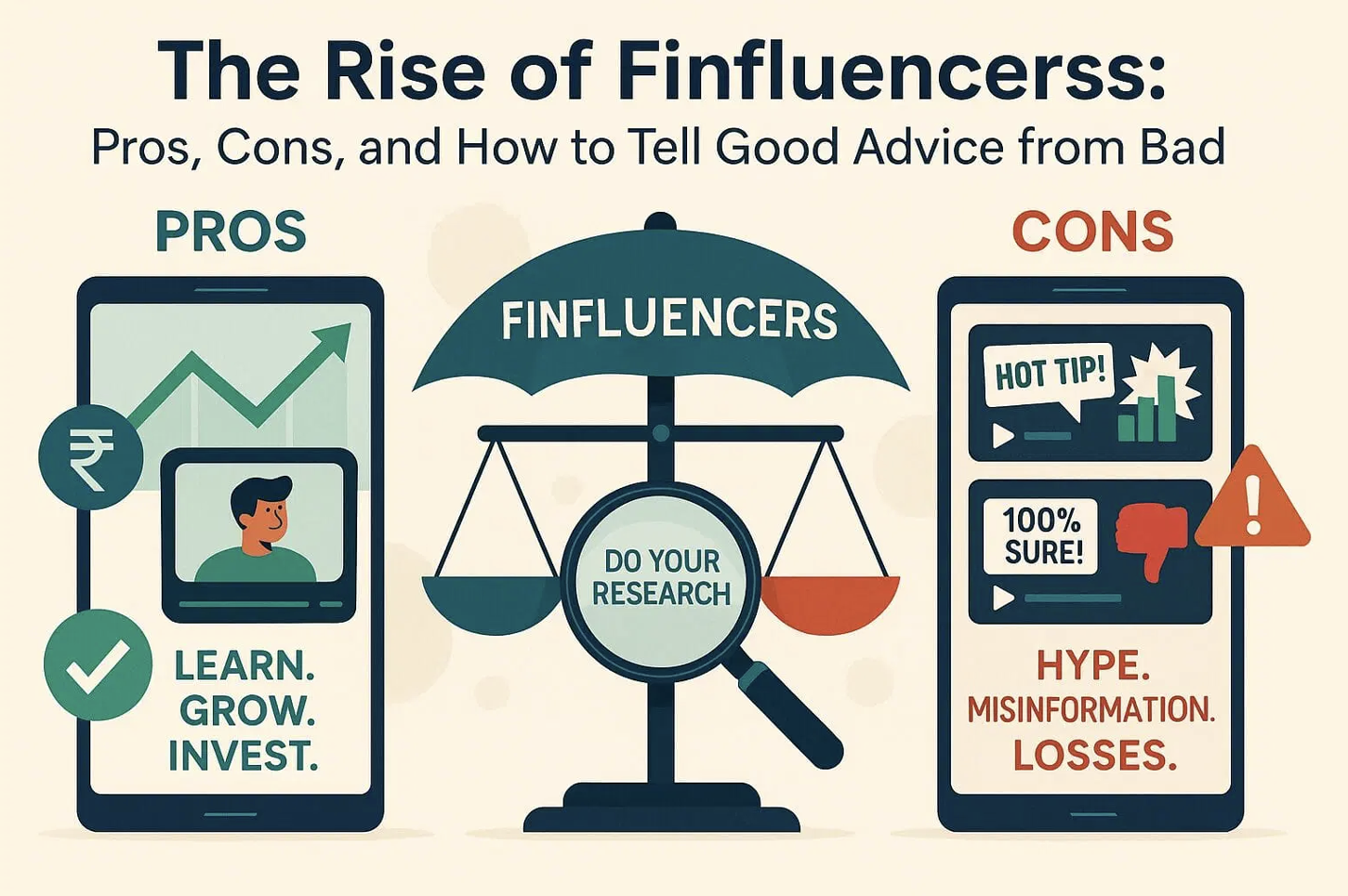
Finfluencers are financial influencers who share financial advice, stock picks, and online investment advice by using platforms like Instagram and YouTube and generate revenue through it. However, a primary issue with this is that, firstly, the credibility of these influencers and secondly, there is no specific regulatory framework for such finfluencers to ensure that they do not encourage fraud and spread misleading information. SEBI’s authority over this conduct arises from the interaction of several instruments. Section 12A of the SEBI Act and the Prohibition of Fraudulent and Unfair Trade Practices Relating to Securities Market (PFUTP) Regulations, 2003 prohibit any person, registered or not, from employing manipulative or deceptive devices in connection with the purchase or sale of securities. The backbone of the provision is that it does not require the wrongdoer to be a SEBI-registered entity, which is precisely why it has been the primary tool used against unregistered finfluencers. Layered on top of this are the SEBI (Investment Advisers) Regulations, 2013 and the SEBI (Research Analysts) Regulations, 2014, which require anyone giving personalised buy/sell recommendations, for consideration, to register and comply with disclosure and conduct norms.
The more targeted intervention came through Regulation 16A of the SEBI (Intermediaries) Regulations, 2008, inserted with effect from 29 August 2024. As commentary on the amendment has noted, Regulation 16A does not purport to regulate finfluencers directly. Instead, it prohibits every SEBI-registered intermediary, such as brokers, mutual funds, portfolio managers, and research analysts, from maintaining any direct or indirect association, monetary or otherwise, with a person who gives unregistered advice or makes performance claims about securities. SEBI operationalised this through a circular of 29 January 2025, which broadened the definition of “association” to cover referral arrangements, marketing tie-ups and digital collaborations, and separately barred financial educators from using live or recent market data, permitting only data with a three-month lag, precisely to prevent real-time trading tips being dressed up as pedagogy.
Enforcement has followed. SEBI’s order in December 2025 against the Avadhut Sathe Trading Academy, impounding over ₹546 crore and barring the entities from the securities market, found that a business modelled as “education” was in substance unregistered advisory and research activity, built on market-linked promises and curated profit screenshots. It sits alongside earlier action against figures such as the self-styled “Baap of Chart.” These are the largest numbers SEBI has attached to individual finfluencer enforcement, and they signal a regulator willing to pierce the “educator” label.
Where the framework runs out
The difficulty is that every instrument above targets the speaker who the person making the claim and not the distribution mechanism that determines whether ten people or ten million see it. In the Regulation 16A framework, the provision only comes into play where a finfluencer has a financial relationship with a registered entity. A creator who sells subscriptions or courses directly to followers sits outside Regulation 16A’s reach and can only be caught after the harm has already occurred, through PFUTP enforcement. A CFA Institute study from March 2025 finds that only around two per cent of finfluencers were SEBI-registered even though roughly a third of them were giving explicit stock recommendations, a scale mismatch that after-the-fact, one-respondent-at-a-time enforcement cannot realistically close.
Algorithmic amplification compounds this scale problem rather than merely accompanying it. A misleading claim that would once have reached a WhatsApp group of two hundred people can now be surfaced by a recommendation system to audiences selected precisely because they are the most likely to act on it. The same engagement-optimisation logic that, as behavioural and platform-governance scholarship has documented, tends to reward emotionally charged, “gamified” content over balanced disclosure. SEBI’s own FY26 annual report data, cited in a recent commentary, found that 62 per cent of retail investors reported being influenced by financial content on social media, which gives some sense of the addressable base. Yet nothing in the PFUTP Regulations, the Intermediaries Regulations, or Regulation 16A speaks to the platform’s role in selecting and amplifying that content. The regulatory object remains the individual influencer; the amplifying infrastructure is legally invisible.
This is not a uniquely Indian gap. Scholarship on “fraud on the social media market”, most notably Sue Guan’s analysis of the doctrinal fallout from United States v. Constantinescu, has argued that established pump-and-dump doctrine assumes a direct transactional link between fraudster and victim that social-media-mediated schemes structurally sever, effectively immunising conduct that reaches thousands of buyers through an intermediate platform rather than a direct solicitation. A recent scholarship specific to India, including work proposing a tiered registration threshold calibrated to audience reach and functional impact rather than formal advisory status, and comparative work examining the investor-redress gap under Sections 11B and 15JA of the SEBI Act, where penalty and disgorgement proceeds flow to the Consolidated Fund of India rather than to the investors actually harmed. Unlike the US Fair Fund mechanism under Sarbanes-Oxley converges on the same diagnosis: registration-based regulation calibrated to who is speaking cannot, by itself, govern a harm that is produced by how widely and to whom the speech travels.
What a functioning framework would need
Three additions to the existing framework would close the gap without requiring wholesale statutory redesign. First, a reach- or engagement-calibrated obligation, rather than a binary registered/unregistered line, so that an account with algorithmically amplified reach into the hundreds of thousands attracts disclosure and record-keeping duties proportionate to that reach, independent of whether it has a formal tie to a registered intermediary, closing exactly the gap Regulation 16A leaves for direct-to-follower operators. Second, platform-level obligations under the IT Rules and SEBI’s coordination with MeitY: SEBI sought expanded authority in February 2025 to access encrypted communications on WhatsApp and Telegram and to order the takedown of misleading financial content, an acknowledgement that closed, algorithmically curated networks are where much of this activity now migrates, beyond the reach of open-platform disclosure norms. Third, an investor restitution mechanism analogous to the US Fair Fund model, so that penalties SEBI already has the power to impose translate into recovery for the retail investors who were the intended targets of the amplification, rather than disappearing into consolidated government revenue.
Conclusion
None of this requires abandoning the intermediary-registration paradigm that has served Indian securities law well for three decades. It requires recognising that “who may give advice” and “how advice travels” are now separable questions, and that a regulator which has shown, in the Sathe order, real appetite to look past the label of “education” to the substance of the conduct, has not yet extended that same scrutiny to the infrastructure carrying the conduct to its audience. Until it does, algorithmic amplification will remain the one actor in every finfluencer scheme that is never named as a respondent.
About The Author
Raewa Bharat Parab is a third-year law student pursuing B.A. L.L.B. (Hons) from Jindal Global Law School. Her interests lie in financial law.
Image Source: https://planetwealth.in/rise-of-finfluencers-pros-and-cons/