
By – Amartya Saldanha
Abstract
Over the last ten years, a single company has laid over 60,000 kilometers of undersea cable, accounting for nearly 20% of global cable manufacturing and installation in the last five years. All on behalf of a state whose name appears nowhere on the invoice. China’s ‘Digital Silk Road’ is not a metaphor; it is fibre optic. It runs along the seabed and is being built faster than the world has noticed. This article examines what is really being constructed beneath the oceans, and what it costs when the infrastructure of global communications falls into the hands of a company funded by a single country’s ambitions.
Introduction
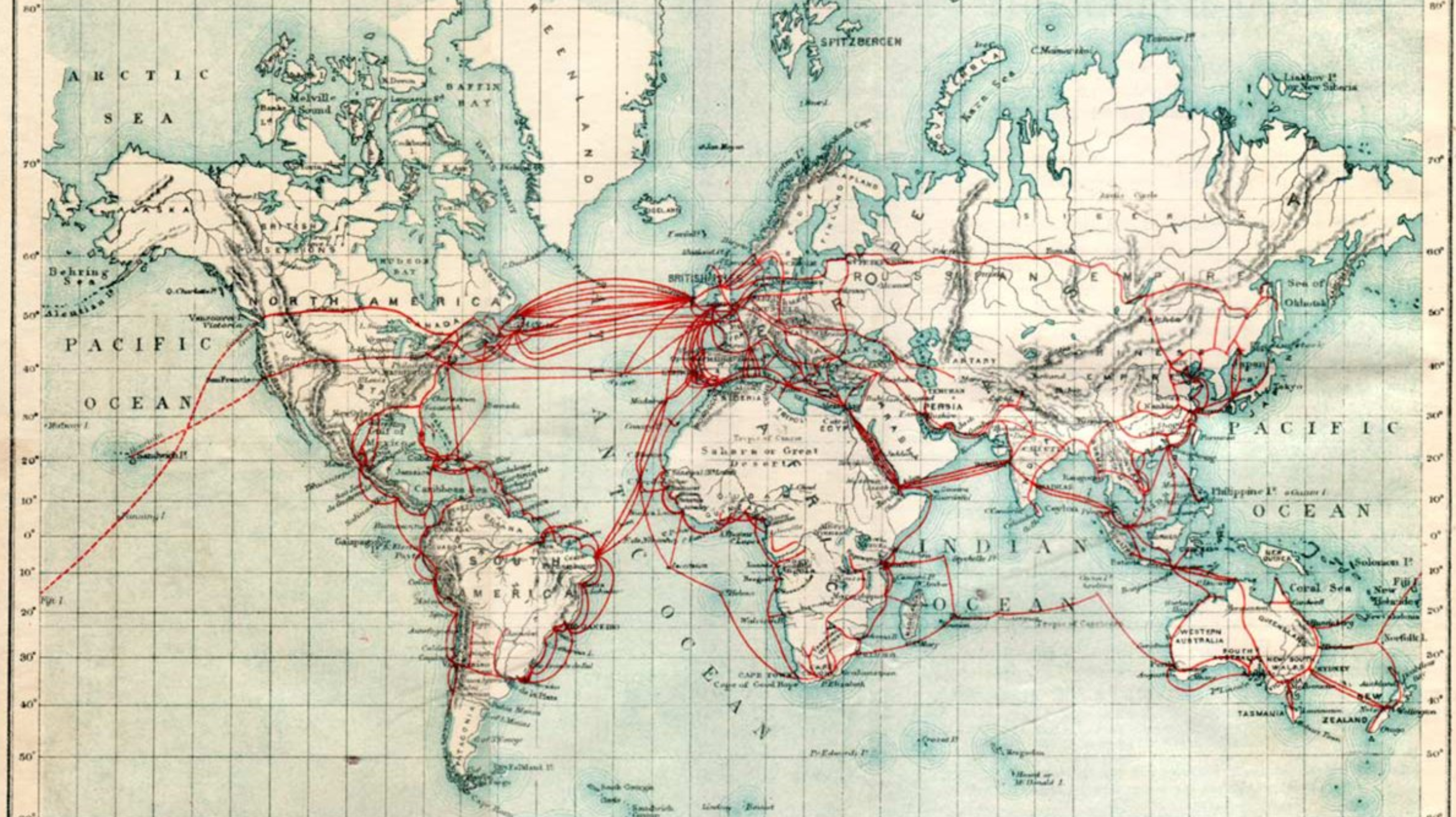
Approximately 95% of all international data, every financial transaction, government communication, and search query travels through a network of undersea cables no thicker than a garden hose. As of today, there are 570 active submarine cable systems in operation, collectively spanning roughly 1.4 to 1.5 million kilometers of seabed, lying largely unguarded on the ocean floor. Most people have never really thought about them; most governments have only recently started to.
China noticed considerably earlier. Since 2015, Beijing has pursued a systematic strategy, formally embedded within its ‘Belt and Road Initiative’ branded the ‘Digital Silk Road’. The aim is to finance, build, and operate undersea cable networks across Asia, Africa, the Middle East and the Pacific. The company solely responsible for its oversight is HMN Technologies, formerly known as Huawei Marine Networks, a state-linked firm that has completed roughly 108 projects in the last decade. China’s aim for HMN is clear: capture 60% of the global subsea cable market. At its current pace, that figure is not completely implausible.
This article argues that China’s ‘Digital Silk Road’ is not simply a commercial infrastructure program. It is the most consequential and least examined exercise in strategic power projection of the 21st century. It exploits the cost vulnerability of developing nations, leveraging geography in ways that mirror the logic of physical chokepoints, while operating beneath a layer of international law too thin to offer meaningful resistance.
The cable that bypasses the map
The clearest single illustration of what the Digital Silk Road is doing is the PEACE cable. The Pakistan and East Africa Connecting Europe cable network is funded, owned, and constructed entirely by Chinese entities. The cable spans from the China-Pakistan Economic Corridor in Gwadar westward through Djibouti, at China’s only overseas naval base, through the Red Sea, Egypt, and onto France. It connects, in a single unbroken line of fiber optic, China’s economic infrastructure on the Pakistani coast to Europe, through a Djiboutian port operated by China deliberately placed to avoid Western jurisdictions.
This is not a cable. It is a geopolitical argument made in fibre optic. Every data packet that travels the PEACE cable does so outside the legal reach of American surveillance frameworks, European data-protection jurisdiction, and any governance architecture the Western-aligned internet order has developed. The route is not incidental. It was designed to be a parallel information corridor, answerable to Beijing solely.
The PEACE cable is one of the 62 subsea telecommunications cables carrying internet traffic through the Middle East and North Africa; 13 are now owned, constructed, or upgraded by Chinese companies. HMN Technologies’ market share in undersea cables has gone from 7% in 2012 to 20% by 2019, while now accounting for roughly 18% of all new cables installed globally.
The Cost Advantage
Globally, there are only 4 companies capable of manufacturing and laying deep-sea submarine cables at scale: SubCom in the United States, Alcatel Submarine Networks in France, NEC in Japan, and HMN Technologies in China. The first three operate on commercial terms in open markets. HMN Technologies operates with the backing of state banks, which eliminates the risk calculus that constrains its competitors. The result is a price differential of 20 to 30 percent below any Western alternative. Now imagine this gap: for cash-strapped governments in the Pacific or sub-Saharan Africa, it’s not a preference. It is a decision made for them by fiscal reality.
Papua New Guinea’s domestic cable was built by Huawei Marine in 2018 using loans provided by the Export-Import Bank of China. The Solomon Islands contract was initially awarded to Huawei Marine before Australian government intervention redirected it. These are not aberrations in a competitive market. They are the market, as it operates, for countries without the strategic weight to attract Western market-funded alternatives or the fiscal capacity to pay Western market rates. The cost advantage is not merely commercial. It is the mechanism through which dependency is created, a dependency through which leverage is held.
The new Digital Chokepoint
The South China Sea carries military standoffs, water cannon exchanges and coast guard confrontations as its daily headlines. What goes unreported is that it is also the most efficient route connecting the powerhouse economies of East Asia with Africa and Europe for undersea cable traffic, making it, simultaneously, a physical and a digital chokepoint.
China has the highest number of cables landing on its shores compared to any other claimant in the region. HMN Technologies has a structural and operational advantage in deploying cables within these contested waters, therefore in effect creating a Chinese monopoly over subsea cables in the South China Sea area. In March 2025, China unveiled a deep-sea cable-cutting ship capable of severing reinforced cables to a depth of 4,000 metres, meaning previously inaccessible infrastructure is no longer safe. The same month, disruptions between Taiwan and its offshore islands were linked to Chinese vessels operating under deceptive identities.
Researchers Henry Farrell and Abraham Newman have a term for what this creates: “weaponised interdependence”, the condition in which a state uses a system that everyone relies upon to coerce or surveil rivals. China is not merely a participant in the global cable network. In the South China Sea, it is the gatekeeper of it.
Who pays for the Wires they cannot see
In September 2025, multiple major undersea cable systems, including SEA-ME-WE 4 and the India-Middle East-Western Europe cable, were severed near Jeddah, degrading internet performance across India, Pakistan, and the UAE simultaneously. The disruption was localised, and consequences were regional. Thus is the nature of this type of infrastructure, designed around concentration, which is precisely what the Digital Silk Road provides.
The nations absorbing these disruptions most severely are those that accept Chinese cable contracts because they have no other financial option. Countries in Europe and the US both maintain enough cable redundancy and domestic infrastructure to weather individual outages. Economies across South Asia, Southeast Asia, and sub-Saharan Africa are the ones most affected. They now transmit their economic, governmental and civilian data through infrastructure built, maintained and in some cases repairable only by Chinese state-linked companies. This dependency is not incidental to the strategy; it is the strategy.
Conclusion
China did not set out to sabotage the global internet. It set out to build it, in enough places, at low enough prices, through enough state-backed financing, that the question of who the internet answers to gradually shifts in its favour. The Digital Silk Road does not announce itself as a geopolitical project. It presents as development assistance, as connectivity for unserved markets, as fibre optic progress. The infrastructure is real. The connection is genuine. The leverage they create is both.
HMN Technologies has now laid cable totalling one and a half times the circumference of the Earth. At the bottom of those oceans sits the architecture of a parallel information order, routed to avoid Western jurisdiction, priced to exclude Western competition, and protected by an international legal framework still operating on a convention written in 1884. The world’s most critical infrastructure is being rebuilt beneath the surface, by a single state, with a strategy most governments noticed too late. The question now is not whether China is rewiring who controls the world’s data. It is whether anyone else has a plan to do anything about it.
About the Author
Amartya Saldanha is a second year B.Sc Economics student at the Jindal School of Government and Public Policy.
Image Source : https://www.csis.org/analysis/war-and-peace-chinas-digital-silk-road