
By — Kamya Sharma
Abstract
The Foreign Contribution (Regulation) Act 2010 (as amended in 2020) has emerged as the main law for regulating the inflow of foreign funds into non-governmental organisations, charitable trusts and religious institutions in India. The law has come at a time when thousands of registrations have been cancelled, and foreign inflows have been reported to have declined, packaged in the context of national security, transparency and preventing forced religious conversions. The purpose of this article is to outline the legal structure, its implications for civil society, and the conflicting public interest arguments between sovereignty/accountability and associational freedom/service delivery. This implies that any future modification to the framework will have to balance. Balance what?
Introduction
Foreign funding regulation is in an awkward place in India’s public arena. It involves sovereignty, religious freedom and the daily activities of non-profit organisations, schools and shelters. The FCRA was first enacted during the Emergency in 1976 and subsequently re-legislated in 2010, with its one purpose being to ensure that foreign funds do not compromise India’s sovereignty, security or public order; but in recent years, the law has been used in much more than a narrow security context, instead acting as a tool of control over civil society and religious institutions and thus one of the most important and controversial governance debates in the country.
The Legal Architecture
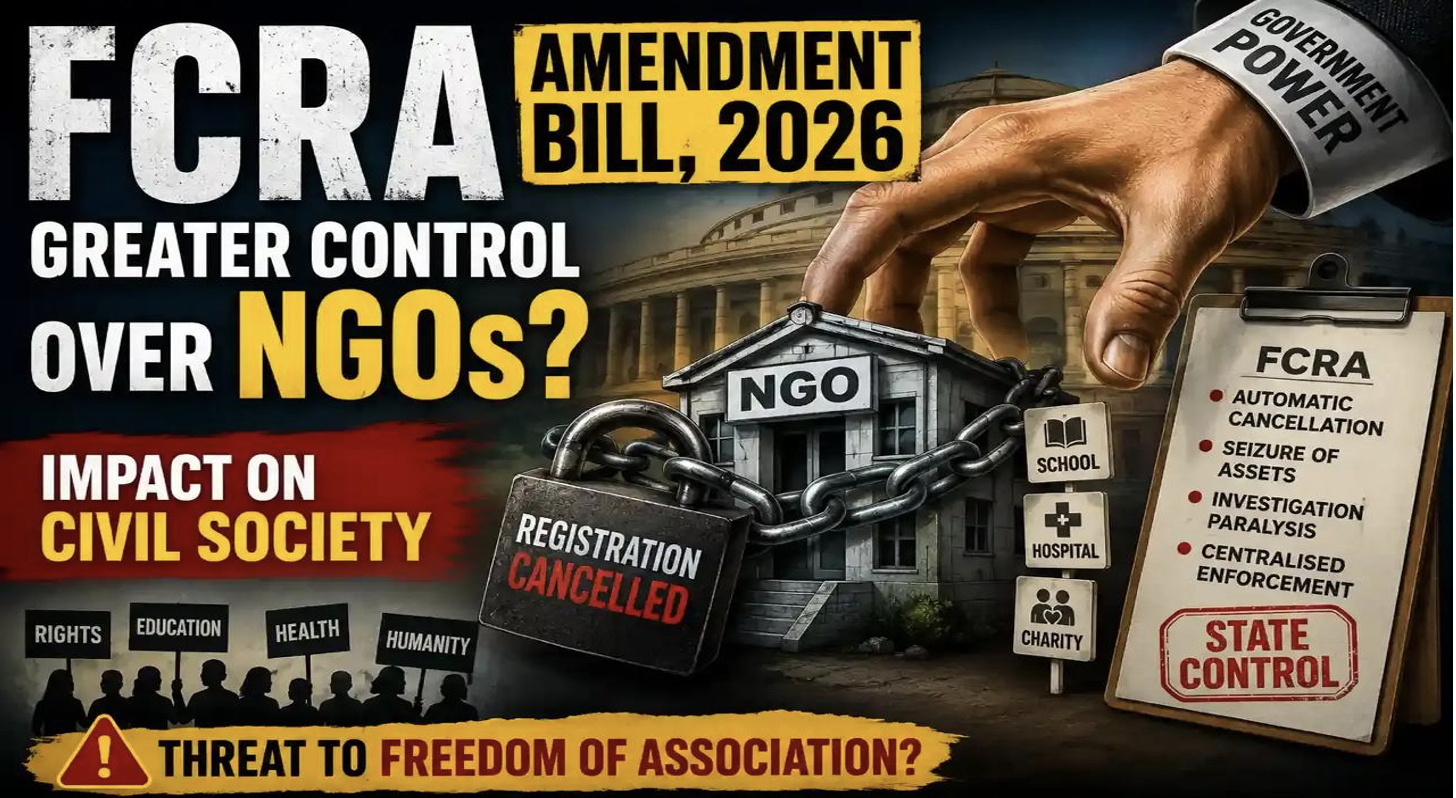
This was a significant ratcheting up of the regime in the 2020 amendment. It mandated all FCRA-registered entities to have a single designated account at the SBI in the main office in New Delhi, prohibited sub-granting or transferring foreign funds among FCRA-registered entities, reduced the administrative expenses ceiling and made Aadhaar mandatory for all office bearers. The change also allowed governments to freeze the funds or assets of an organisation not used for its business, even while it was under investigation. This was based on a KPMG analysis of the amendment, allowing this for up to one year without having to complete an investigation. Smaller organisations feared that such power would effectively put them out of business while authorities continued to investigate them. Rules notified in 2026 were even more sweeping, including the establishment of a Designated Authority which may take provisional control of an organisation’s assets if the organisation is cancelled or surrenders its registration, and including a specific prohibition against using foreign funds for activities related to religious conversion, even though it was still permitted to fund a government-approved schedule of religious activities.
This structure was broadly accepted by the Supreme Court in Noel Harper v. Union of India (2022). The Supreme Court Observer’s case summary states that the three-judge bench upheld almost all of the provisions of 2020, saying that the constitutional right to association cannot include an unregulated right to receive foreign funds, and even went so far as to recommend that NGOs seek domestic philanthropy. In that instance, the government had pointed to Intelligence Bureau inputs and said that about 19,000 NGOs have had their licences cancelled due to compliance issues since 2010 and foreign money has been involved in the Naxalite work. The Leaflet was among those who have criticised the judgment, and makes detailed points about the fact that the Court have taken too light a view of the proportionality of restrictions that disproportionately affect legitimate welfare work.
Enforcement in Practice: NGOs and Faith-Based Institutions
The extent of enforcement has been significant. In recent reporting, government officials estimated that cancellations totalled approximately 22,000 registrations in the last ten years, while there are approximately 14,000 organisations that have active registrations. In December 2021, the Ministry of Home Affairs refused to renew the FCRA licence for the Missionaries of Charity, Kolkata-based order of Mother Teresa, with a reason that it did not want to accept “adverse inputs”, which is the most obvious example of the clash between enforcement and humanitarian and religious work. The decision, made with some 6,000 other NGOs whose registrations were due to expire at the same time, including Oxfam India and some public research institutes, was condemned by opposition politicians and even discussed in the House of Lords in the UK without any explanation given to the public, before being rescinded thirteen days later.
Other organisations that are related to faith or rights issues have been left with more enduring effects. Compassion International was once India’s biggest recipient of foreign charitable money, which was around $45 million annually, but was put on a prior scrutiny watch list and shuttered operations in India in 2017. The Ministry cancelled the registration of World Vision India, the Church’s Auxiliary for Social Action and Evangelical Fellowship of India in 2024. Amnesty International, India, meanwhile, shut down operations entirely in 2020, after the accounts of its human rights reporting arm were frozen in the wake of a money-laundering probe under the Prevention of Money Laundering Act, which the organisation said was a “witch hunt” because of its human rights reporting. The Home Ministry, however, said the characterisation was “exaggerated” and that human rights advocacy could not be used as a “legitimate defence” to defy the law. The money-laundering proceedings against Amnesty and its former director remain suspended, pending the further hearing before the Karnataka High Court in April 2025 in the underlying case.
Much of the enforcement is focused on the “religious conversion” question. Over a dozen states now have anti-conversion laws, and the 2026 FCRA rules formally make it illegal to use foreign funds to engage in conversion activity after what the government refers to as a ‘documented pattern of misuse ‘. But Christian groups and advocacy organisations argue that the rules and their implementation are disproportionately affecting a community of about 2.3 per cent of India’s population and point to the FCRA as one of the laws they believe are targeting religious minorities. The US Commission on International Religious Freedom has recommended that India be classified as a country of particular concern, accusing the nation of “intolerant and discriminatory laws and practices” that target religious minorities.
Sustainability, Independence, and the Numbers
The financial effect is so that it can be measured. According to data from the Ministry of Home Affairs, foreign funding to NGOs amounted to approximately Rs 16,940 crore in 2017-18, but dropped dramatically to about Rs 2,190 crore in 2019-20 when the new compliance regime came into effect, with the number of NGOs reporting receipts falling from around 18,300 in 2017-18 to less than 3,500 in 2019-20. Annual receipts by 2022-23 were just about getting back to pre-amendment levels, which were around Rs 905 crore. The contraction has led to reduced programming, staff reductions and, in some instances, complete shutdown for health care, disaster and education providers in underserved areas, regardless of any misconduct that might have been found.
International organisations, too, have taken a dim view. A UN Special Rapporteur on freedom of peaceful assembly and association has called on India to rethink the provisions of the FCRA that restrict non-governmental organisations’ access to foreign funding, while the Financial Action Task Force has raised concerns about widely broadened laws such as the FCRA and UAPA being enforced in a manner that is disproportionate to the threat posed by non-profits to money-laundering or terror-financing. The government’s response, which has been echoed in recent policy debates, is that the amount of funding received from foreign NGOs is tiny compared to the amount spent on welfare in India, and that most terminations have been due to basic filing and compliance issues and not a campaign of targeted attacks.
Conclusion
It cannot be argued that the FCRA debate is simply a clash between a security-minded state and a persecuted civil society or simply a battle between an old regime that is too soft and the clean-up that has to happen. Both descriptions are true. The law has certainly filled in some cracks in the system through which the relatively unchecked flow of foreign money could pass, and the state has a right to know the source of money flowing through its territory and why. Meanwhile, the combined impact of licence cancellations, asset-control measures and account freezes, imposed on organisations from a Nobel Prize-winning charity to major relief agencies to a leading human rights group, has significantly diminished the amount of foreign aid available for educational, health and community development programs and particularly impacted Christian-affiliated organisations embroiled in the conversion debate. The main issue that will arise in the future for the public policy community is not whether foreign funds should be regulated, as nearly every jurisdiction in the world does regulate foreign funds in some way, but whether the current policy in India distinguishes between legitimate security or conversion concerns and the normal, lawful activities of the Indian non-profit and faith community.
About The Author
Kamya Sharma is a third-year BA LLB student studying at OP Jindal Global University, and her interest lies in constitutional law, public policy and sports law.
Image link: https://upsczone.in/current-affairs/2026-06-12/what-impact-does-the-fcra-bill-have-on-indian-civil-society