
By – Aarushi Ghosh Choudhury
Abstract
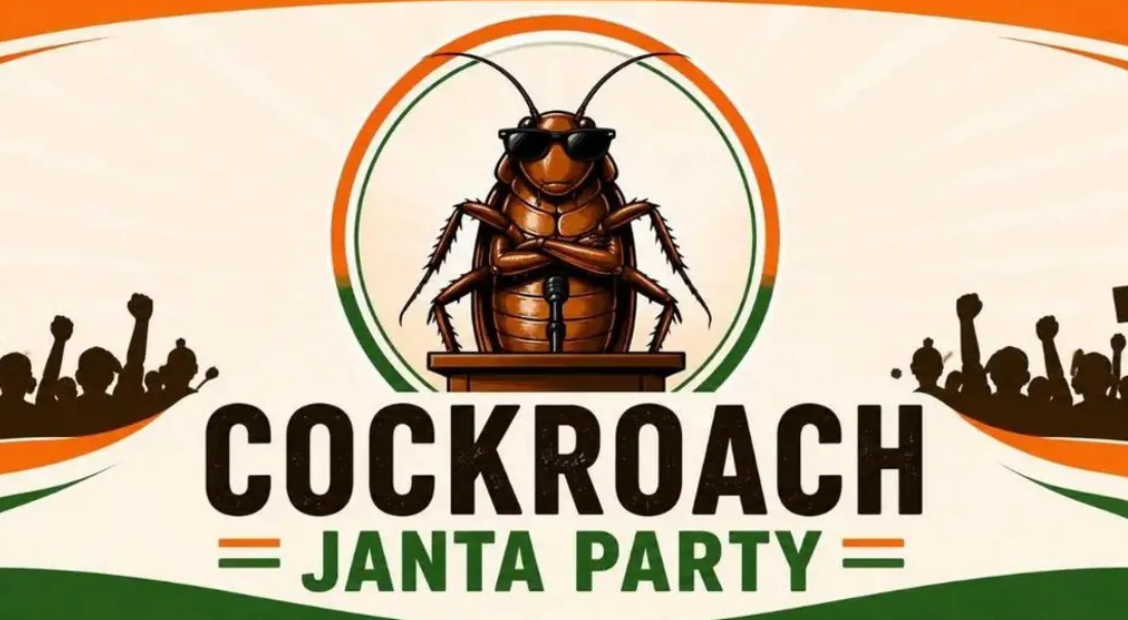
In May 2026, thousands of young Indians dressed up as cockroaches and paraded in a state election claiming that they were part of the Cockroach Janta Party. This article examines how an insult, used for decades to dehumanize the poor, the migrant, and the radical rebel, became the symbol of Gen-Z politics and more importantly a distrust in institutions, within just a few weeks. By invoking concepts from Insect Surrealism and Protest (Ali, 2026) and The Satirical Meme Revolution (Pulla, 2026), this article contextualizes the emergence of the CJP within a broader literary history of insect metaphors and questions whether memes can ever substitute for movements.
Introduction : The Slur that Learned to Walk
Calling someone a cockroach has never been a neutral gesture. It is one of the oldest tactics of authoritarians by reducing the adversary to a vermin status and turning the discourse about rights into one about pest elimination. Biopolitical scholars have followed the trajectory of this, from broadcasts of genocidal regimes to the everyday language of modern xenophobia where the immigrant and the unemployed graduate become a part of the “infestation”, that the state is simply cleaning up. The events that occurred in India in May 2026 reversed this logic in action in public, and through the medium designed specifically for fast and massive publicity. Abhijeet Dipke, a former media employee of the Aam Aadmi Party and currently a communications student in Boston started the Instagram page of the Cockroach Janta Party twelve days after the 2026 state election results and managed to gather 22 million followers within a fortnight period, which is more than the digital presence of India’s oldest political parties.
Membership in the party was based on the requirement to be “unemployed, lazy, chronically online, and capable of ranting professionally,” which is a self-mocking statement that came true as statistics show that about 40 percent of Indian graduates under 25 do not have employment. In the offline mode, this self-mockery puts on gloves, and volunteers dressed as cockroaches organize clean-up campaigns from Kolkata to Bhopal, collecting the remains of electoral propaganda such as torn posters and flyers from the recently ended elections. This self-mockery allows the movement to reclaim an insult while simultaneously creating a sense of collective identity through public solidarity, mutual recognition and shared humour.
From Slur to Signifier: The Mechanics of Reversal
The CJP’s re-inscription of “cockroach” did not create a new political language, it only helped in speeding up a language that was already being tested in literary fiction since two decades ago. What started as an online joke gained momentum after a statement made by the CJI, who compared unemployed youth to ‘cockroaches and parasites’ became the satirical Cockroach Janta Party’whose overwhelming response against Modi’s ruling Bharatiya Janata Party came through mobilising support from students, mainly individuals facing the brunt of leaked entrance exams. This is similar to Ian McEwan’s The Cockroach, where there is a vision of an insect waking up as the British Prime Minister; in Rawi Hage’s Cockroach, the protagonist appropriates the insect identity as protection against the Canadian immigration system that already sees him as a vermin. Raghavendra Rao’s The Cockroach Man, the protagonist becomes a small insect-like creature to survive in the Indian system. In all the cases above, the insect is not a sign of shame but an unflushable tactic, capable of going into the crack in the wall, impossible to kill by targeting a particular leader or office. What the CJP did was to remove the fictional frame from this literary device and perform it as street theatre, that is , a metaphor turned into costume, costume into meme, meme into movement, all within one election cycle.
This is the pattern of what we may refer to as decentred organisation: a movement that does not have a headquarters that can be raided, nor a face that can be discredited because it works with units of transmission rather than cadres. It is the same WhatsApp network that political parties have professionalized in the form of “meme factories”, with strategists and influencers. This was appropriated by the CJP with a message mocking those meme factories themselves. The insult used by the rhetoric of authoritarian and majoritarian governments in the form of turning the dissenter into a public-hygiene problem is answered by the CJP not with a denial but a costume, a much harder rhetorical answer, as agreeing with an insult in performance empties the insult of its meaning.
Why the Cockroach and Not Another Animal?
A cockroach is not a majestic animal like the lion or the eagle; it is a creature that survives not by virtue of its might but by perseverance, cunningness, and its evolutionarily developed lack of concern over being loathed. This is exactly what the image the Generation Z protesters wanted to project to the world was all about. While traditional Indian protest symbolism such as the raised fist, the tricolour, or a martyr’s photograph was all about demanding recognition, the cockroach costume was all about the personal. As one poster stated during one of the clean-up protests: “You can ban us. Mock us. Silence us. But we return stronger.” What was demanded was resilience itself rather than any particular outcome of it, which is why the movement was able to mobilize people across regions and languages that a conventional manifesto would not have been able to unite.
Limits of a Meme
The true reading of the CJP, however, does not consist of triumphalist rhetoric. The CJP did not influence the result of the 2026 elections in West Bengal or Assam which triggered the formation of the group; instead, it came about almost two weeks after the election results were announced, and the 22 million supporters of the platform tend to be mostly urban, digitally savvy young people rather than the indigenous people of Upper Assam whose support determined the election margins of the ruling party. In case of West Bengal, the election success of the BJP was based on grassroots activism carried out during the past five years and the contestation of the electoral rolls; there was no way the CJP’s meme war about cockroaches could change the structural reality of the past five years. Even the most sympathetic opponents of the ruling party, such as Congress parliamentarian Shashi Tharoor, saw the CJP more as a lesson not learned in time by the existing parties than as a challenge to them.
Indeed, this is the ongoing problem with meme-based political campaigns highlighted in the literature about digital campaigning in India: humor is a highly effective means for diagnosing a problem, but it is quite ineffective for establishing the institutional structure necessary to transform the feeling into action. One can share a cockroach meme today but vote tomorrow based on practical considerations of how well a particular area is developing rather than the online identity formed through memes, not out of cynicism but the regular survival tactics of an electorate used to institutions that fail to keep their promises. The imitation of the CJP itself provides the very same example: an initiative involving a cockroach meme on behalf of the Indian National Congress took place just a few days later, implying that the very party mocked by the CJP understood the importance of the form and quickly adapted it.
Conclusion
What the CJP shows is that the oldest rhetorical tactic of authoritarian rule, to turn the citizen into a pest, contains the possibility of being turned against itself. An insect that can’t be exterminated through focusing on one individual or closing down one office is, ipso facto, an insect that can’t be suppressed through any one election cycle’s disenchantment. Through the costumes and clean-ups of the CJP, a disunified, underemployed generation found its voice in a language of resilience, even if, unbeknown to its founders, it was drawing upon a literary tradition wherein the cockroach has symbolised subaltern obstinacy. Resilience, however, is different from power; a movement of velocity needn’t necessarily become the movement of patience that structural change requires. Whether or not the cockroach proves to be the real catalyst for accountability or, as one critic puts it, a “diagnostic instrument rather than a political one” will depend less on how many places the meme makes its way than on whether the anger that it has named can ever be translated into the tedious process of organisation. Before that, though, all that the cockroach might have achieved is linguistic: the word, once used as a weapon in Indian public discourse, is now difficult to wield without getting a laugh thrown back at you in costume.
About the Author
Aarushi Ghosh Choudhury is a third year student at Jindal Global Law School, O.P. Jindal Global University, Sonipat. She is currently pursuing a Bachelor of Arts and Bachelor of Legislative Law. She is exploring the diverse field of law while simultaneously developing the skills required to thrive in the legal profession.
Image Source : https://www.bbc.com/news/articles/cz72y11jjq1o