
By – Vridhi Parakh
“If anyone intentionally spoils the water of another, let him not only pay damages but purify the stream or cistern which contains the water.” – Plato
Abstract
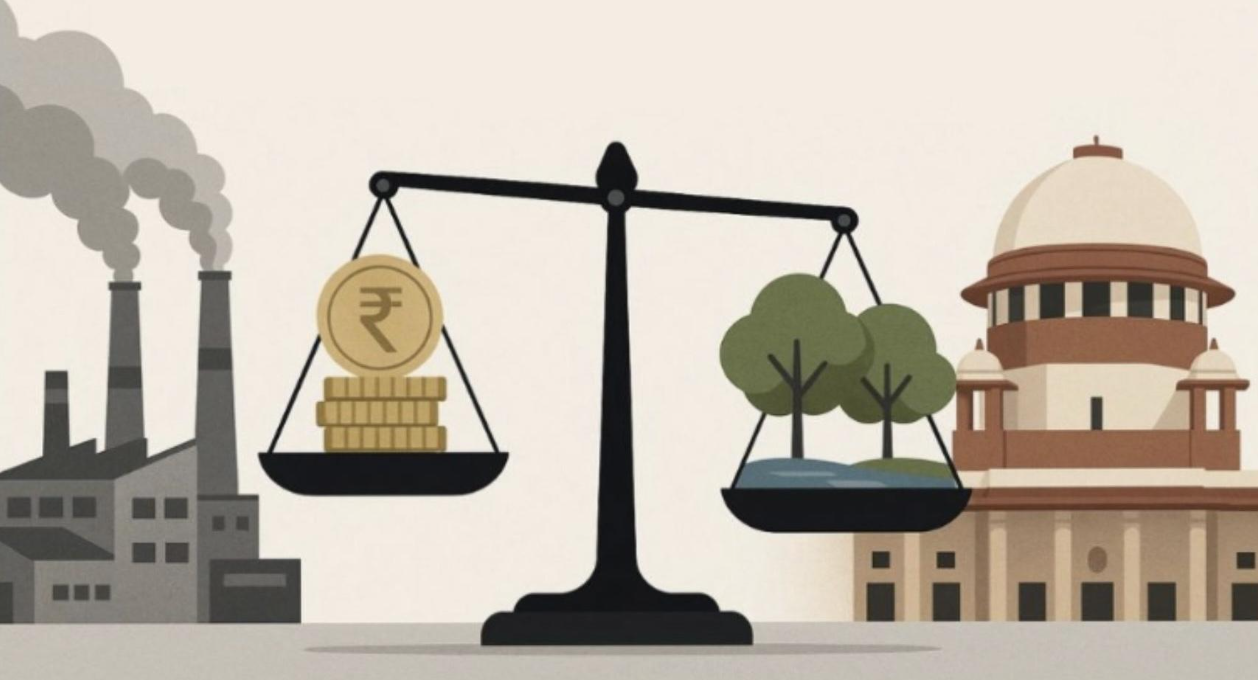
Environmental damage in India rarely announces its arrival in a single dramatic event. It builds slowly over years of effluent waste discharged into water bodies and emissions released through smokestacks. By the time a court intervenes, the pollutants are dispersed. Indian Environmental jurisprudence is deeply influenced by the Polluter Pays principle, implying that the value of pollution should be borne by the polluter and not by the authorities. In practice, delayed enforcement and weak recovery mechanisms allow corporations to treat environmental liability as an ordinary cost of doing business.
This raises a central question: why does a principle designed to deter pollution so often operate merely as a mechanism for compensating it? This paper traces the jurisprudence behind the establishment of the Polluter Pays principle and aims to argue that it’s a ‘red-tape’ principle rather than a deterrent one. It argues that the principal weakness lies not in the judicial recognition of the principle, but in an enforcement structure that frequently makes non-compliance economically viable.
Introduction
This article examines this enforcement gap through three dimensions: the evolution of the Polluter Pays Principle in Indian environmental jurisprudence, the economic consequences of delayed and inadequate penalties, and the implications of weak environmental accountability for corporate governance.
Historical Jurisprudence
The principle of Polluter Pays is based on the economic theory of internalisation of externalities, which imposes on the polluters the cost of social damage borne by the public as a result of hazardous involvement by a select few developers. In the case of M.C. Mehta v. Union of India (1986) (Oleum Gas Leak Case), the Supreme Court developed the rule of absolute liability for enterprises engaged in hazardous activities thereby establishing a strong foundation for placing the liability upon the industry that engages in inherently dangerous acts. Drawing from this principle, the Court in Enviro-Legal Action v. Union of India (1996), expressly articulated Polluter Pays to require polluting industries to bear the cost of remedial measures for harming the environment; extending it to compensating the affected people and restoring the environment to its original phase. In Vellore Citizens’ Welfare Forum (1996), the polluter pays and precautionary principles were held to be part of the law of the land. In the case of MC Mehta v. Kamal Nath (1996), the Court held that the “one who pollutes the environment must pay to reverse the damage caused by his acts”. The Parliament, in 2010, enacted Section 20 of the National Green Tribunal Act, which commands the Tribunal to apply the Polluter Pays Principle in every order it passes.
Corporate governance: liability without a face
The Jan Vishwas (Amendment of Provisions) Act, 2023, replaced custodial punishment with pecuniary penalties in the Environment (Protection) Act. Under the amended Act, a company that contravenes the statute faces between one lakh and fifteen lakh rupees, plus one lakh for each continuing day. This amendment is termed to be quasi- decriminalisation, as it makes deterrence contingent upon whether the cost of non-compliance exceeds pollution-control. When the sanction was imprisonment, environmental protection was a personal risk for the officer in charge, and personal risk travels upward through an organisation. Once the sanction became a penalty payable by the company, the risk moved to the finance department. Boards therefore have no structural reason to treat pollution as a governance question. Penalties do not trigger disqualification, or appear as red flags in succession planning. If the only remaining deterrent is reputational damage, then deterrence depends on whether a journalist happens to be looking, which is a weak foundation for public policy. Accountability has to be attached to identifiable people, with consequences that survive a change of quarter.
Discount if you Delay: The After- Process
In Subhash Kumar v State of Bihar (1991), the Supreme Court read the right to a clean environment into Article 21 of the Indian Constitution. The statement of the following cases is to analyse the influential value of imposing costs on a company whose Cost-Benefit analysis, unless it makes compliance more favourable than simply paying “costs” To defeat the Business- ideology, one must look into incorporating a negative cost-benefit analysis for the sake of environmental protection.
Consider what happens after a court finds against a polluter. Enforcement of the Bichhri judgement dragged on until 2011, when the Court finally dismissed the string of applications and added compound interest for fifteen years of non-compliance. In Sterlite Industries v. Union of India (2013), the Supreme Court set aside the High Court’s closure order and directed the company instead to deposit one hundred crore rupees with the District Collector, Thoothukudi, covering pollution from 1997 to 2012. The plant continued. In Alembic Pharmaceuticals v. Rohit Prajapati (2020), the Court held that ex post facto environmental clearance is impermissible, then declined to close the three units and ordered ten crore rupees each instead. And in the Span Motelssequel (2002), exemplary damages for gutting a riverbed came to ten lakh rupees. A company that pollutes for fifteen years and pays once at the end has effectively obtained an interest-free loan from the environment.
Problem of Parity
The NGT ordered the Delhi Jal Board and its plant operator to pay ten lakh rupees in July 2024, and, as Down To Earth reported, the amount stayed undeposited. Where funds are collected, they have been diverted: the Tribunal criticised the CPCB for spending environmental compensation on municipal road work. Moreover, the underlying condition has not improved, with the CPCB’s 2025 assessment counting 296 polluted river stretches across 271 rivers.
Any discourse on this principle would be incomplete without a Marxist analysis of parity. When big industrials like Adani, who can afford to dismiss environmental costs as a business expense and afford litigation costs, face no real deterrent to invest in the furtherance of pollution control, and regulatory inspections remain inconsistent, environmental litigation often drags on for years, thus being redundant in application. Large corporations can absorb lakhs worth of penalty and continue. A small fabricator or dyeing unit facing the same order, without in-house counsel and without the cash to litigate, shuts down or settles informally. The result inverts the principle. The firms with the largest environmental footprint find compliance optional, while the firms with the smallest footprint bear the enforcement pressure. The costs that nobody pays do not disappear. They transfer to the next generation as contaminated aquifers, silted riverbeds and shortened lives, which is precisely the transfer that inter-generational equity exists to prevent.
The Polluter Pays Principle loses much of its deterrent force when factories can reduce their operating costs simply by foregoing pollution-control measures and later paying the penalty imposed upon it by the Court. Environmental law can deter pollution only when compliance is economically preferable to violation. The problem is therefore not simply whether compensation is imposed, but whether the expected cost of non-compliance is sufficiently high and sufficiently certain to alter corporate behaviour. Although industrialists make social and environmental commitments for the ‘public eye’, their preference for compliance always remains secondary to short-term profitability. Unless directors, investors and insurers view repeated environmental violations as material governance failures, companies will continue to calculate pollution as a manageable commercial risk. The effectiveness of the Polluter Pays Principle thus consequently depends on the quantum of compensation imposed and the institutional mechanisms through which environmental risks are priced.
Conclusion
The Polluter Pays Principle represents one of the Supreme Court’s greatest contributions to Indian environmental law. Yet its effectiveness ultimately depends not on judicial creativity but on regulatory capacity. As long as corporations can anticipate modest penalties, delayed enforcement, and limited commercial consequences, pollution will remain economically attractive.
The following are my four cents on the problem: First, link penalties to turnover or to the profit derived from the violating operation, so that the sanction scales with the offender, exactly as the Oleum judgment intended. Second, require restoration bonds or bank guarantees before clearance, so that money for remediation exists before the damage does. Third, publish a live public register of compensation imposed, recovered and spent, with recovery placed on a statutory clock. Fourth, restore personal accountability for the officers who sign off, because organisations respond to consequences that individuals feel. The true success of the principle will not be measured by the number of landmark judgments but by whether polluting becomes more expensive than preventing pollution. Until that happens, environmental liability will continue to function as a business expense instead of a meaningful deterrent, and the burden of environmental degradation will continue to fall upon communities and future generations rather than those who caused it.
Author’s Bio
Vridhi Parakh is a second-year student currently pursuing B.A LL.B (Hons) at O.P Jindal Global University. Her interest lies in exploring the various facets of criminal law.
Image Source : https://clatalogue.com/polluter-pays-principle-india-laws-judgments