
By – Jayesh Sharma
Abstract
The 131st Constitutional Amendment Bill proposed expanding the Lok Sabha from 543 to 850 seats using the 2011 Census to operationalise women’s reservation, yet it introduced significant structural liabilities. This article examines those impacts, arguing that the expansion carries prohibitive fiscal opportunity costs, severe transaction costs that degrade legislative deliberation, and a federal distortion that penalises states for successful population stabilisation. As an alternative to inflating the national legislature, the article advocates decoupling women’s reservation from delimitation entirely by applying rotational quotas within existing constituencies.
Additionally, it is analysed how this asymmetrical expansion distorts India’s bicameral balance, weakening the Upper House’s ability to act as an impartial federal check during legislative deadlocks. By demonstrating how political upkeep diverts resources from human development, the article concludes that robust democratic governance depends on fiscal responsibility and inter-state equity rather than institutional expansion.
Introduction
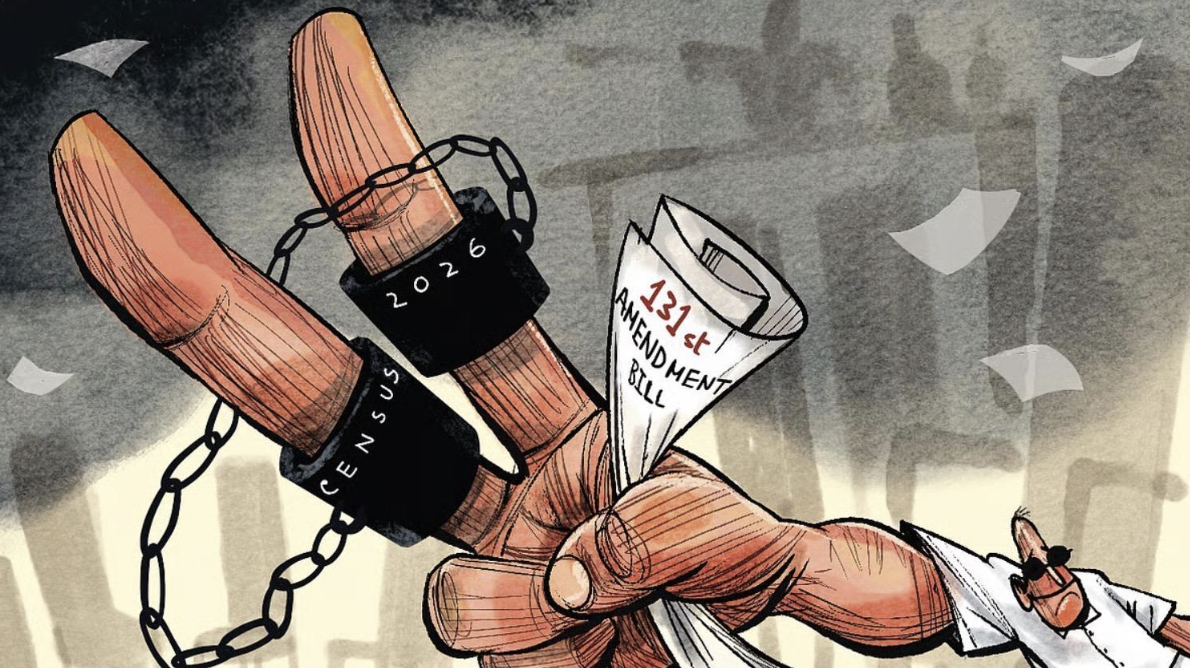
India stands at an unprecedented institutional crossroads following the introduction and subsequent legislative defeat of the Constitution’s 131st Amendment Bill. Formally packaged to operationalise the 106th Constitutional Amendment which guarantees a one-third reservation for women in legislative bodies. This ambitious legislation sought to shatter a decade’s old constitutional freeze. Aimed at fixing a widening representation gap, the legislation proposed expanding the Lok Sabha from 543 to 850 seats based on the 2011 Census. Yet, wrapped inside the objective of women’s reservation were significant institutional challenges.
The national debate triggered by this effort transcends partisan politics, forcing a re-examination of how a developing democracy balances demographic mapping with fiscal discipline, institutional efficiency, and federal equity. Moving past superficial rhetoric, what is established is that expanding the Lok Sabha introduces severe trade-offs: prohibitive fiscal opportunity costs that divert capital away from human development, ballooning transaction costs that degrade legislative deliberation, and a regressive federal distortion penalising states for historical population stabilisation.
Economic Rationale Behind Scaling Representation
To understand the economic weight of the 131st Amendment, one must trace the historical architecture of Indian parliamentary representation. Since the 42nd Constitutional Amendment in 1976 froze boundaries based on the 1971 Census, India chose stability over strict demographic proportionality. This freeze was deliberately designed as an economic incentive, ensuring states invested heavily in family planning were not penalised with a loss of national seats. Over decades, however, this policy created massive disparities in the citizen to representative ratio. While MPs in northern powerhouses like Uttar Pradesh or Bihar represent well over three million citizens, southern representatives manage smaller constituencies, sparking long-standing debates on administrative reach.
From a purely neoclassical public administration perspective, proponents of expansion argue that lowering the citizen to MP ratio reduces informational asymmetries between voters and lawmakers, theoretically enhancing the responsiveness of the state. A smaller constituency size should, in theory, allow a representative to better diagnose local economic bottlenecks, target public goods more accurately, and ensure superior grievance redressal. However, in a developing economy, tying seat expansion to a contentious census baseline without structural safeguards risks severe institutional dysfunctions.
Political Superstructure vs. Human Capital
The most quantifiable critique of the 131st Amendment lies in public finance and fiscal opportunity cost. Scaling a national legislature by roughly 50 percent and adding over 270 new elected representatives and their administrative apparatus triggers a monumental fiscal footprint. Even with modern spatial capacities, running a bloated political superstructure scales operational expenditure exponentially. Running an expanded parliament means funding more staff, secure housing, local offices, and pensions. These recurring bills quickly add up, trapping public funds in political upkeep rather than national development.
When analysed through public choice economics, this capital allocation presents a zero-sum dilemma meaning that fiscal space is finite, and budgets operate under strict deficit frameworks. In short, every rupee spent on a larger political class is money taken away from areas that actually grow the economy. Rather than funding 270 extra parliamentary offices for minimal political gain, that same money could build digital infrastructure, boost basic education, improve rural healthcare, or fund agricultural research.
This expansion also triggers Article 75 which limits the cabinet to 15 percent of the Lok Sabha. Pushing past 815 seats would raise the maximum number of ministers from 81 to 122.
Creating an executive wing of over 120 ministers risks an oversized, patronage driven government that dilutes accountability and inflates administrative waste. Dismissing these concerns by claiming “democracy has no price” misunderstands public finance; institutional efficiency dictates deploying capital where societal returns are maximised.
Institutional Economics and the Death of Good Debate
Beyond fiscal expenditures, legislative expansion must account for transaction costs and collective decision-making dynamics. Drawing on public choice theory, as active participants in a deliberative assembly scale linearly, transaction costs of reaching consensus scale non linearly. In a chamber housing over 800 MPs, floor constraints create severe bottlenecks. Critical accountability instruments such as zero-hour interventions, starred questions, and private member bills are heavily rationed, driving the probability of individual backbencher participation toward zero.
This procedural compression triggers a behavioural shift among legislators. When floor time becomes scarce and media visibility fractures, the rational incentive for an MP changes. Instead of meticulous clause by clause scrutiny of dense economic legislation, lawmakers gravitate toward loud grandstanding, theatrical walkouts, and soundbites engineered for local constituency optics. The floor ceases to be a workshop of rigorous deliberation and becomes an arena for theater.
Paradoxically, the historical and economic irony of legislative expansion is that as assemblies become too unwieldy for open debate, functional power does not become more democratic; rather, it evacuates the open floor entirely. Real lawmaking migrates behind closed doors into party whip rooms, opaque committee substructures, or executive fiat. Additionally, specialised parliamentary committees suffer from dilution when the expert talent pool is spread too thin across an oversized house, compounding the loss of rigorous legislative oversight. Ordinary backbenchers are reduced to passive, rubber stamping voting fodder, while the executive branch deepens its dominance. From an institutional economics standpoint, an expanded parliament thus exhibits sharply diminishing marginal returns: higher costs, lower deliberative quality, and degraded legislative output.
The Economic and Demographic Penalty Paradox
The roadblock facing the 131st Amendment in April 2026 stems directly from India’s north-south population divide. While southern and western states like Kerala, Tamil Nadu, and Maharashtra spent decades successfully reining in population growth dropping fertility rates to 1.3–1.5 while northern states like Bihar and Uttar Pradesh stayed on a much steeper growth path.
Utilising the 2011 Census as a baseline reward states that grew rapidly while penalising those executing successful family planning. Southern stakeholders argued that redrawing constituencies based on raw population counts dilutes their relative economic and political weight. While the Union government emphasised that absolute southern seats would technically climb from 129 to 195 under a 50 percent expansion, regional leaders remained skeptical.
In a federal compact, trust requires hard statutory guarantees entrenched in constitutional text rather than transient ministerial speeches. The failure of the amendment highlights a fundamental lesson: policies undermining inter-state equity create deep systemic friction, turning national integration initiatives into zero sum regional turf wars.
Bicameral Math and the Executive Sledgehammer
An under-explored dimension is the amendment’s mechanical distortion of India’s bicameral equilibrium. While the Lok Sabha was slated to expand by 50 percent to over 815 state seats, the Rajya Sabha ceiling under Article 80 remained frozen at 250 members. This structural asymmetry shifts the inter-house ratio from approximately 2.2:1 to a staggering 3.3:1.
This shift has profound implications for joint sittings under Article 108. When deadlocks occur over critical economic bills, joint sessions decide outcomes by a simple majority. With a bloated Lok Sabha, a ruling party commanding a solid majority in the Lower House can easily steamroll an opposition dominated Upper House. For example, a government holding roughly 56 percent of an expanded Lok Sabha can comfortably override a two-thirds opposition majority in the Rajya Sabha.
The Rajya Sabha was conceived to act as the primary guardian of states’ rights, checking majoritarian impulses. Expanding the Lok Sabha to this extreme degree distorts that balance, giving population heavy states an irresistible hammer in joint mechanisms and blunting the Upper House’s ability to serve as an impartial federal check against executive overreach.
Conclusion & Alternative Pathways
The defeat of the 131st Amendment highlighted a major conflict: trying to pair a popular goal like women’s reservation with a massive, controversial shake-up of national populations, budgets, and federal power. The bill didn’t fail because people oppose women’s empowerment, but because tying it to an oversized parliament and a disputed census risked public funds, smooth governance, and trust between states.
Fixing our institutions doesn’t require bloating the national parliament or using a contested census. A simpler, smarter solution is to completely separate women’s reservation from the delimitation process. Experts and regional leaders have long suggested enacting the 33 percent quota right away within current constituencies through a rotational system which is an approach already proven to work in local councils across the country.
In the end, expanding a democracy isn’t just a math problem. A healthy republic depends on carefully balancing fair representation, equity between states, financial common sense, and the federal bonds that hold a diverse country together.
About the Author
Jayesh Sharma is a third-year law student at Jindal Global Law School and a columnist for the Economics & Finance cluster of Nickeled & Dimed. He is an avid reader who follows global markets and enjoys tracking global trends and large-scale investments.
Image Source: https://www.newindianexpress.com/opinion/2026/Apr/21/constitutional-clocks-that-just-start-ticking