
By — Aarushi Ghosh Choudhury
Abstract
In this article, the Mughal and Colonial era will be examined through the metaphor of animation of two royal Muslim women in the history of India, Empress Nur Jahan and Shah Jahan Begum. They were brought to life through painting, coinage, architecture, and texts in a culture where women remained veiled. These modes of representation evolved over time. Through Ruby Lal’s biography of Nur Jahan and Barbara Metcalf’s research on Shah Jahan Begum, the article argues that while the image of Nur Jahan existed in an era where pictures were produced by others for her, that of Shah Jahan Begum was an era where she could create her own picture.As the women’s image grew over time, there emerged another challenge where critics found ways to counter and deconstruct the woman’s image and through it, her agency.
Introduction
Two queens in the Muslim tradition separated by more than two hundred years who ruled in very dissimilar systems, there was a transition from being invisible to being made visible through the process of visual and textual animation. In this regard, Ruby Lal and Barbara Metcalf illustrate how these royal Muslim women were transformed into becoming visible through literary texts, architecture, coinage, and images. With the end of the Mughal period and beginning of the colonial period, the power to animate the image of a royal woman shifted from court artists and chroniclers to the queen herself. It is crucial to recognize the transformation of agency in this respect by using the metaphor of animation. However, this process was not perfect as the transition throughout history from one age to another also brought new means for criticizing the image of these royal women.
Portrayal of Nur Jahan in the Mughal Era: Image crafted by others
Nur Jahan’s historical image has largely been constructed through the representations of others. Abul Hasan’s “Portrait of Nur Jahan” is rightly described as one painting that has broke away from the convention of its time. According to Lal, Mughal paintings depicted women in two categories; ideal young women and matured advisers. Neither of these could portray Nur Jahan, a woman hunter and administrator. What made the painting of Nur Jahan exceptional was how it painted her as an Empress dressed for a hunt, wearing trousers and a turban, ruby and diamond earrings, and loading a musket. This particular aspect of the painting captured the dominating and assertive nature of the woman, portraying her success. However, the break away from conventionalism was the painter’s personal decision and there is nothing to indicate that Nur Jahan chose what would be included in the painting. Moreover, it is known that Jahangir gave his approval to this painting and hence its display depended on Jahangir’s approval.
This is also true about the coins minted in 1617 where Lal points out that the name of a woman was inscribed for the very first time on Mughal coins, however, the right to do so was one of the three fixed signifiers of Islamic rulership defined even before the arrival of Nur Jahan. Thus, she became a part of the system that already existed, rather than creating a new one. Also, the use of the term “Nur Jahan Padshah Begum” in signing official commands meant that she adopted the royal title which belonged to her husband in the first place. Analogously, when Nur Jahan received more gifts from Khurram than anyone else, she simply won within the preexisting system of hierarchy and rewards. However, by breaking the patriarchal rules and empowering women she truly became the first Mughal feminist icon, By using and employing different forms of animation, she became a beacon of power at a time when her power could have been taken away very easily.Nur Jahan’s image brought together feministic art and animation together by subverting gender roles through deliberate cross-dressing to show military and political power while simultaneously excluding the norms of the harem. That truly symbolises her confidence and talent as to who she was, embodying a feministic personality. In other words, Nur Jahan obtained a unique public image in the Mughal era which was ground-breaking yet existed because of the space created by other people.
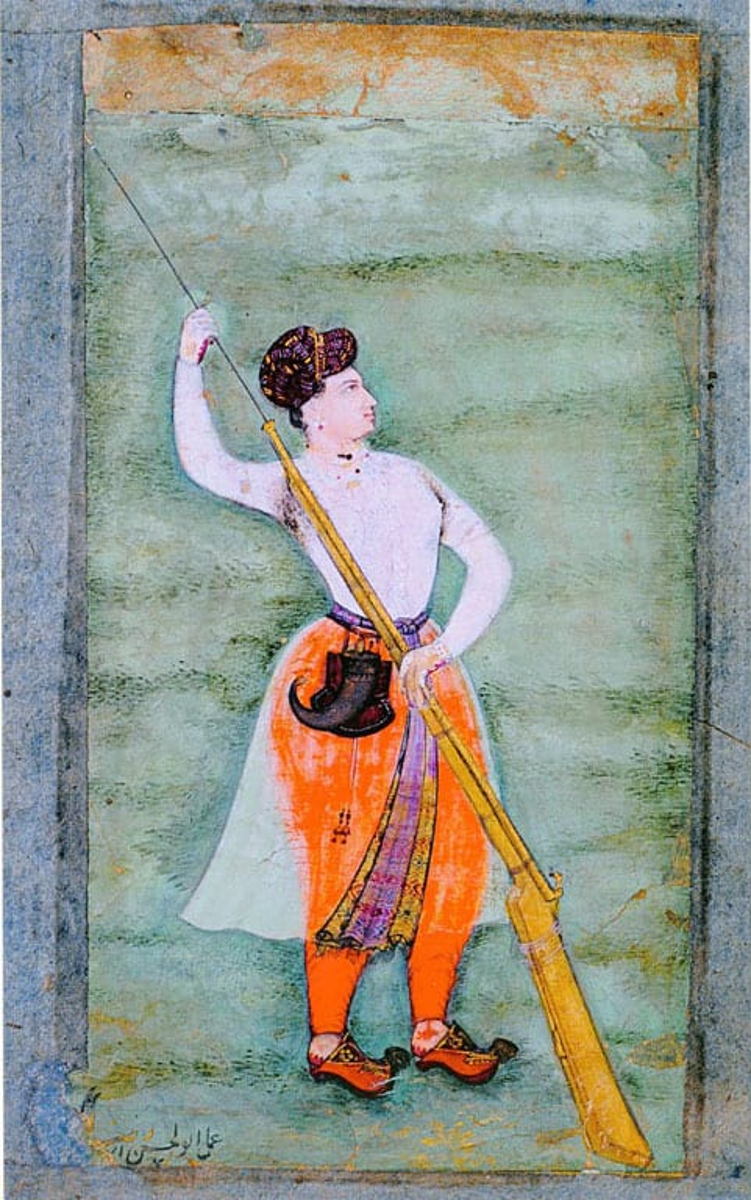
Image Source: https://www.theheritagelab.in/nur-jahan-holding-gun/
Shah Jahan Begum in the colonial period: Creating her self-image
Unlike Nur Jahan, Shah Jahan Begum’s image was animated in a markedly different historical and political context. While Nur Jahan exercised power primarily as Jahangir’s co-sovereign, Shah Jahan Begum was the ruler of Bhopal in her own right. It is for this reason that her choice of agency could help her in choosing her image in a conscious manner. It is not just a mere photo taken of her that Metcalf talks about in 1872, but one that she created herself through objects like a book, a vase and also wearing English style boots to convey the fact that she was fit to rule the way she did before her British rulers. This is the same idea conveyed through her painting which shows her sitting with a clock, a pen, some paper and an inkwell.
Most crucially, Shah Jahan Begum wrote her own books; another kind of animation that could not have been possible to a woman like Nur Jahan. “Taj-ul Ikbal Tarikh Bhopal” is both a historical chronicle, a travel book and memoir, all written in her own voice. ‘Tahzibun Niswan Wa Tarbiyatul Insan’ was an entirely new type of book for any female author to write in Urdu. Shah Jahan Begum’s architecture tells a similar story. In the Tajul Masajid Mosque, there is a unique section designated for women, something that had never happened in the design of mosques in South Asia before, because she believed that women must participate in collective prayers in mosques, unlike the practice of praying at home, which is incorporated in her building itself. Thus, while Mughal period marked the presence of Nur Jahan within the system created by someone else, Colonial period made it possible for Shah Jahan Begum to create her own system and leave her name within it.
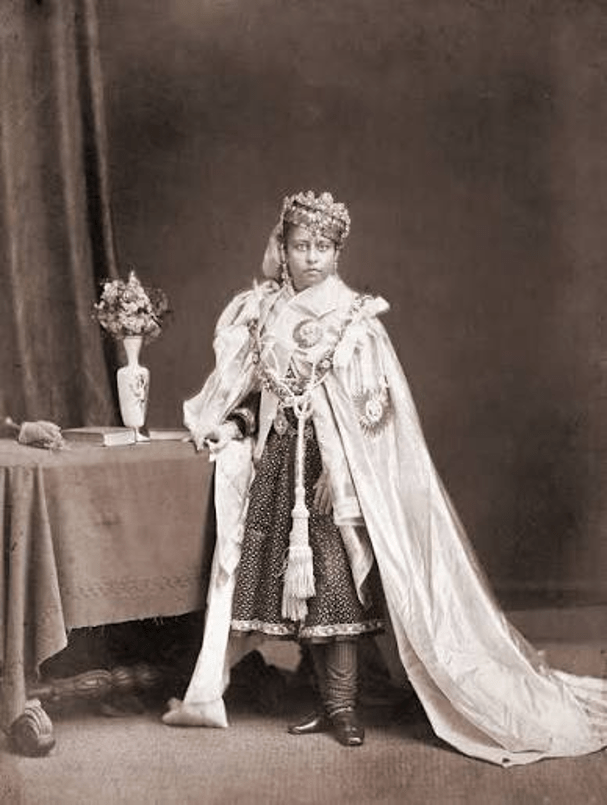
Image Source: METCALF-IslamPowerColonial-2011.pdf
Animation through time: A larger battle on both fronts
The evolution of personal power through ages did not ease the burden of Shah Jahan Begum. The downfall of Nur Jahan, after the demise of Jahangir, was brought about by competing family members who operated through the very same system of status and marriages that had helped her gain prominence in the first place. Shah Jahan Begum had to deal with something altogether new and unfamiliar. A foreign culture that would transform the very image that she had selected into its total opposite within just a matter of years by means of techniques beyond imagination in all previous ages. This was done through an illustration drawn in 1875 in The Indian Charivari. In this animation every single symbol of hers, the book, the parasol, the boots, the gloves was stripped off to be replaced with an entirely mocking counterpart such as a male disguise and a fictional map of “Barataria” thrown over a chair.
This cartoon was using the same strategy employed by Shah Jahan Begum to construct her image, but employing it on her without giving her any chance to speak out and without making up any rules for her audience. There was nothing like this when Nur Jahan lived. There were no newspaper publications and colonial individual who could strip people of their titles before the public eye. The conclusion that can be drawn from the above two eras is not about the increasing freedom that the royal women enjoyed with the passage of time. The truth is that both sides became stronger with each passing era.
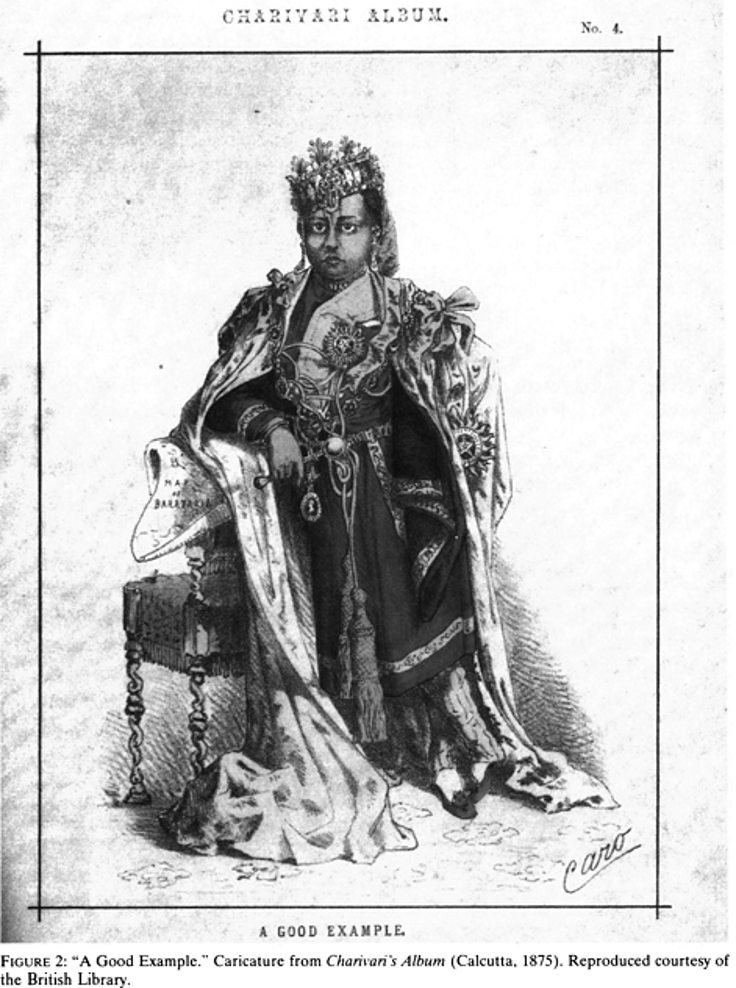
Image Source: METCALF-IslamPowerColonial-2011.pdf
Conclusion
Examining the historical experiences of Nur Jahan and Shah Jahan Begum reveals that both of these women have participated in different episodes in the same long process of animation. The real progress in the power of personal agency is reflected through a portrait that was painted by someone else and a name inscribed on a coin, to a book written and a building designed by oneself. However, the cartoon that ridiculed the created photograph of Shah Jahan Begum is clear evidence of the fact that the increasing power of personal agency went along with increasing means for fighting against this agency. The history of the two women discussed through the prism of animation does not reveal a smooth progress towards empowerment. Instead, it uncovers the increasing competition between women who were trying to control their images and their opponents who tried to destroy it.
About the Author
Aarushi Ghosh Choudhury is a third year student at Jindal Global Law School, O.P. Jindal Global University, Sonipat. She is currently pursuing a Bachelor of Arts and Bachelor of Legislative Law. She is exploring the diverse field of law while simultaneously developing the skills required to thrive in the legal profession. She loves reading about history and biographies while simultaneously is also enthusiastic about classical dance.