
By — Dhruvi Solanki
Abstract
Global financial centres have become important aspects of countries’ national economic strategies due to globalization. Gujarat International Finance Tec-City (GIFT City) serves as an example of such an ambitious step taken by India in order to create an international financial service centre that would be able to attract investments from all over the world. Despite all the progress made in the development of GIFT City since its emergence as the International Financial Services Centre (IFSC), it still operates in the shadow of some more advanced financial centres such as Singapore and Dubai. In this article, development and competitiveness of GIFT City will be analysed through comparing the regulatory environment, market depth, talent pool, and international connectivity of GIFT City with Singapore and Dubai.
Introduction: Why Financial Centres Matter
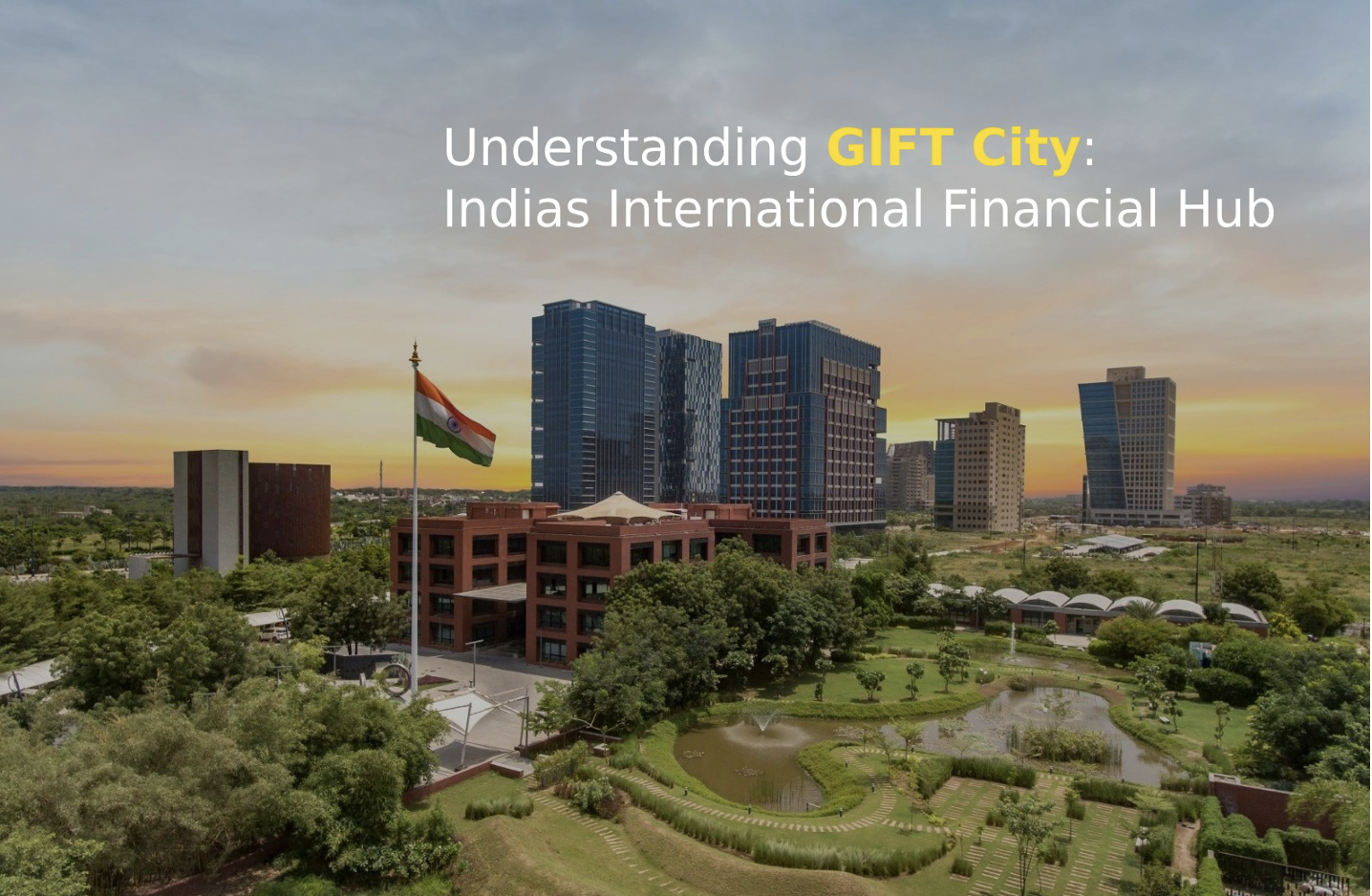
The financial centres play an important role in the world economy and help facilitate cross border movement of capital. They provide access to international banking and investment facilities and are the links that connect the global network of production, trading, and finance. Countries like Singapore and Dubai have effectively capitalized on this strength to become regional gateways for investment and finance management. The reason why India desires to have a financial centre is because of the historical problem faced by it, which is that a considerable amount of international financial business related to Indian entities was conducted in foreign financial centres, especially Singapore and Dubai. This is the reason why the Indian Government has set up the GIFT City in Gujarat as the first IFSC of India. Today, GIFT City has emerged as one of India’s most important financial infrastructure projects and is increasingly viewed as a potential competitor to regional financial hubs.
GIFT City: Building India’s International Financial Gateway
In recent years, there has been substantial institutional development in GIFT City. According to India’s Economic Survey, 1,034 companies, both domestic and foreign, were registered at the IFSC by the end of 2025. In addition, the city ranked 43rd on the list of Global Financial Centres Index (GFCI). There was also a surge in the banking assets that totalled over $100 billion as well as an expansion of activities related to derivatives trading, debt listings, aircraft leasing, and fund management. A significant driver of development was the establishment of the International Financial Services Centres Authority (IFSCA), a unified regulator of banking, insurance, capital markets, and fintech activity within the IFSC. As opposed to India’s existing system of regulation, which includes several regulatory bodies, the unified one aims at reducing complexity and facilitating doing business in IFSC for international companies. Apart from this, there have been tax benefits, opportunities for conducting operations using foreign currency, and special sectors such as aircraft leasing and offshore fund management introduced into the city to attract foreign investors. Financial centres, however, gain strength not only due to regulatory benefits but also due to network effects.. This is where Singapore and Dubai continue to possess substantial advantages.
Dubai: The Power of Strategic Positioning
The case of Dubai is an excellent example of the way geography, regulation, and international connectivity can help to create an effective financial ecosystem. Dubai has been able to become the main financial centre for connecting the Middle East, Africa, and South Asia via the Dubai International Financial Centre (DIFC). The size of the Dubai financial ecosystem is much larger than the one of GIFT City. As of 2025, DIFC has already had more than 8,800 operational enterprises and more than 1,050 financial firms, which included many banks, asset management companies, insurance firms, hedge funds, and family offices. The English common law-based legal system of the DIFC offers a familiar and predictable regulatory environment for international investors. Besides that, the immigration policies and globally oriented lifestyle of Dubai have allowed the Emirate to attract highly qualified financial professionals from different countries of the world. The most important thing is that Dubai has gained its international reputation over the last two decades, and financial organizations see not only tax benefits but also opportunities for access to international and regional markets.
Singapore: The Gold Standard of Asian Financial Centres
While Dubai demonstrates the importance of strategic positioning, Singapore illustrates the power of institutions. The city-state achieved the reputation of one of the leading financial centres in the world due to regularity, political stability, and efficient rule of law during many years. There are several reasons behind the success of the financial system in Singapore. Firstly, the city-state boasts well-developed capital markets, wealth management products, fintech infrastructure, and a wide range of international trade links. MAS is known for its reliability of regulation worldwide, and the government has implemented a number of programs in order to improve the financial sector, such as the development of equity markets and attracting global asset managers to the country. More than 100 international corporations have shown their interest to participate in such programs initiated by MAS. In contrast to emerging financial centres, Singapore has a strong institution-based trust built up during many decades. Investors, multinational corporations and financial intermediaries regard the country as a reliable jurisdiction for conducting business. This kind of trust cannot be built only by means of incentive programs; it requires consistent policies and legal reliability.
Comparing GIFT City with Dubai and Singapore
Comparison of all three cities puts the success and failures of GIFT City into perspective. Regarding regulatory innovation, GIFT City benefits from a unified regulator in the form of the International Financial Services Centres Authority (IFSCA). However, it continues to compete with more established international financial centres that have developed regulatory credibility over decades, including the Monetary Authority of Singapore and the Dubai Financial Services Authority. Another feature is the market depth. Capital markets in both Singapore and Dubai are highly liquid with global institutional investors’ participation. The value of banking assets in GIFT City has already reached the mark of $100 billion, which is great success for the relatively young financial centre; however, the volume of trade and liquidity of the market are much lower than the volume of trades in other financial centres. The last challenge in building up a financial centre is talent. India has a substantial pool of financial and technological professionals, however, the attraction of foreign talent is about more than just job opportunities. Take for example, the case of Singapore where in addition to the thriving financial industry, there are immigration policies like the Overseas Networks & Expertise (ONE) Pass that allow talented individuals the ability to live and work in the country with ease. Another example could be that of the United Arab Emirates where the introduction of Golden Visa allows investors, entrepreneurs, and highly talented professionals the ability to live and operate in the country without any problem. GIFT City tried to overcome this issue through working together with international universities.
Opportunities and Challenges Ahead
However, in spite of all the obstacles, there are still some features making GIFT City special. In general, India can be ranked as one of the most rapidly developing countries globally; hence, there is a high level of demand for international financial services connected with transactions in India. As a result, with the expansion of Indian firms in the international arena and growth of local capital markets, there appear opportunities to provide such services as offshore banking, wealth management, aircraft leasing, insurance, and fund administration. Apart from that, there are some other competitive advantages of GIFT City, it provides an environment with a relatively low cost in comparison with Dubai and Singapore. It is because of low cost of operation, labor and infrastructure and makes the environment quite interesting for those firms, which want to gain fast access to Indian markets. More experts believe that GIFT City can become a relatively cheap variant of providing financial services associated with India-based transactions.
Conclusion: A Future Competitor, Not Yet a Rival
It is safe to say that the development of GIFT City has progressed well past the phase where it was merely an ambitious infrastructural project. The increase in registered firms, the accumulation of banking assets, and international engagement show that it is gradually becoming a significant part of India’s financial framework. However, comparing it to other financial hubs such as Singapore and Dubai shows that being a global financial centre entails more than providing tax benefits and modern infrastructure. Singapore’s advantage consists of its institutional credibility, while Dubai relies on being flexible yet globally connected and attractive enough. This is what GIFT City lacks. At present, it is highly unlikely that it will be able to displace any of the two financial centres as the leading ones in the coming years. However, it is not necessary to do so since its greatest potential may consist in becoming the ideal gateway for international capital and investments related to the Indian economy. GIFT City may become a regional financial centre and, ultimately, the Indian equivalent of Singapore and Dubai provided it undergoes consistent development and transformation.
About the Author
Dhruvi Solanki is a third-year Economics and Finance student at Symbiosis School of Economics and a member of the Economics and Finance Cluster of Nickeled & Dimed. She is an avid student of economic policy and market behaviour, with a strong interest in fiscal policy, consumer economics, and the real-world impact of taxation on markets and households.
Image Source: https://www.kaavyaratna.com/blogs/understanding-gift-city-indias-international-financial-hub