
By — Chandril Ray Chaudhuri
Abstract
This essay provides a critical analysis of the construction of the Ram Mandir in Ayodhya as the largest example of ‘restorative nostalgia’ harnessed to serve political change. Exploring the cultural and political events leading to the temple’s construction, such as the mass circulation of Ramanand Sagar’s televised Ramayan, L. K. Advani’s 1990 rath yatra, and the subsequent destruction of the Babri Masjid, this essay argues that Hindutva nationalist mobilisation gives more importance to mythological memory over historical evidence in constructing political claims around Ayodhya, contributing to the re articulation of Indian nationhood through a more explicitly majoritarian and ethnonationalist framework.
Introduction: The Return of the King
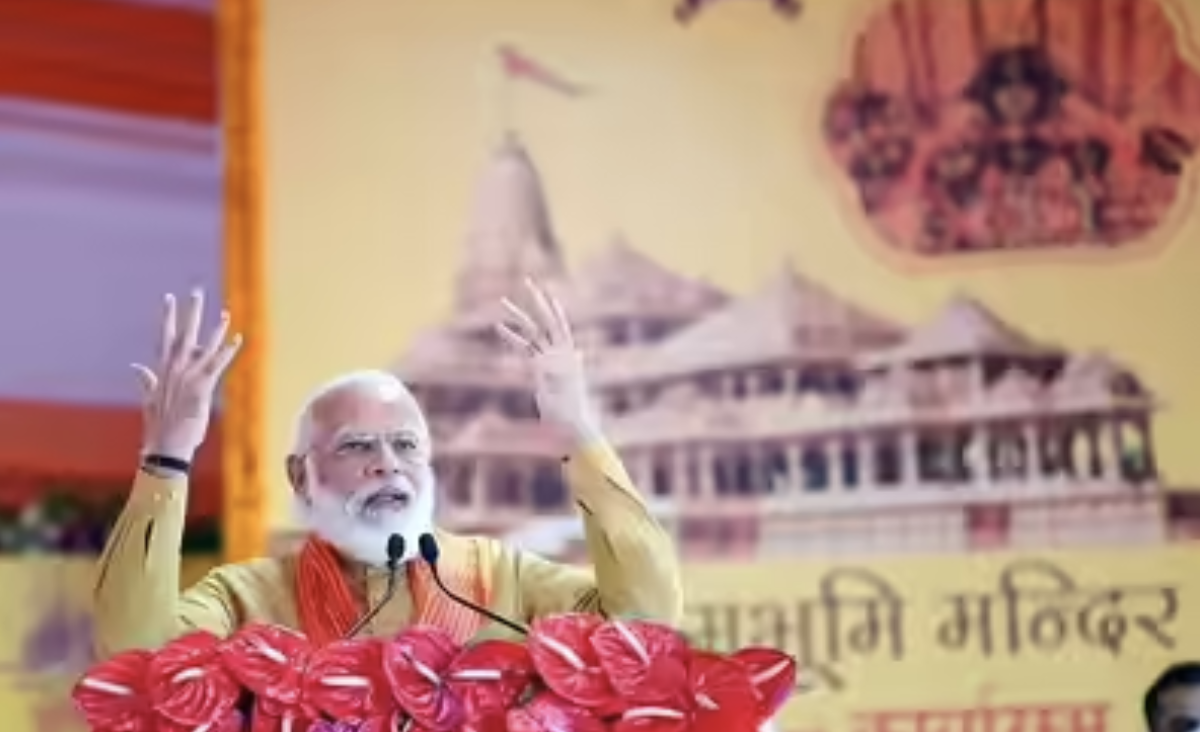
On January 22, 2024, Prime Minister Narendra Modi led the pran-pratishtha, the consecration ceremony of the Ram Mandir in Ayodhya. Seven thousand guests gathered for the event. Millions more watched the live broadcast from their homes. It was framed as a monumental shift in history, and in some ways, it was. The Prime Minister of the secular republic of India told the crowd that the date marked the beginning of a new era and declared that Lord Ram was the faith, foundation, thought, and constitution of Bharat.
Mohan Bhagwat, the leader of the Rashtriya Swayamsevak Sangh, echoed this from the same stage. He proclaimed that India’s “true independence” had returned to Ayodhya alongside Lord Ram. Rakesh Sinha, a BJP Member of Parliament, called the effort a project of civilisational resurrection of the “Golden Age of Ancient India”. These words were calculated political statements. Building the Ram Mandir fulfills a long-standing agenda to replace historical fact with mythological memory. This pattern, a nation imagined as fallen and reborn through purification, is what Roger Griffin calls ‘palingenetic ultranationalism,’ the mythic core of fascism. The Ram Mandir full fills a long-standing political project that elevates mythological memory above historical evidence in the construction of national identity for the far-right Indian audience.
Nostalgia as a Political Weapon
Scholar Svetlana Boym explored the idea of restorative nostalgia in her 2001 book, The Future of Nostalgia, where she mentions that reflective nostalgia misses a past that is gone forever, but restorative nostalgia is entirely different. It treats the past as a strict blueprint for today. It is an active desire to rebuild a ‘lost home’ of sorts. Hindu nationalist politics thrives on this exact sentiment. Supporters promote the mythological concept of Ram Rajya as a practical model for modern governance. The BJP regularly erases the boundary between history and myth. There is no archaeological proof of Ram’s exact birthplace, or if he was truly a historical figure rather than a myth, and yet, the Supreme Court’s 2019 judgment ultimately accepted the longstanding Hindu belief that the disputed site was Ram Janmabhoomi, awarding the land for the construction of a temple while directing that Muslims be granted an alternative five-acre site elsewhere in Ayodhya. The decision thus raised difficult questions about the relationship between faith, historical evidence, and judicial reasoning in a secular constitutional order. Ram Rajya is often cited as an era of the ultimate welfare state, a model which all Hindutva Nationalists aim to recreate. However, this concept originates in the Valmiki Ramayana as a mythology, not a factual historical period. Researchers Priya Chacko and Maggie Paul observe that this nostalgia fuels this process of ‘saffronisation’ – described as a longing for an archetypal past and future, promising citizens a revived ‘Hindu’ kingdom, where everyone will be treated fairly, equally, and Hindus will be ‘revived’. The glaring issue with this worldview is its inherent exclusion. It elevates upper-caste Hindus while all others, not deemed ‘Hindu’ are marginalised.
Sagar’s Ramayan (1987-1988)
The origins of this nostalgic civilizational identity are complex, but it is clear that state television has propelled it. Ramayan, the television serial created by Ramanand Sagar, was broadcast on Doordarshan every Sunday morning from January 1987 to July 1988 and attracted nearly 650 million viewers. Viewing was almost a ritual affair for Indian families, with individuals taking baths prior to viewing and placing offerings on the television set. The government may not have intended any political angle in displaying the acclaimed show, but this move was politically effective regardless. It was one of the key aspects that gave validity to the Bajrang Dal and the Ram Janmabhoomi movement, while validating the idea of a “Ram Janmabhoomi”. The BJP was quick to pick up on this shift in the Indian socio-political narrative. In his book Politics After Television, Arvind Rajagopal analysed the phenomenon, stating that with the Congress government breaking its long-held tradition of not politicising public broadcasting, an unparalleled advantage appeared to Hindu nationalists. Television broadcasting in this context created space for Hindutva narrativisation, in turn cementing myths as facts of truth. The BJP went from having two members in parliament to eighty-eight after this broadcast.
The Rath Yatra (1990)
If the television helped forge the emotional connection between Hindus and the Ram temple cause, then L.K. Advani’s 1990 rath yatra solidified it into tangible political action. The BJP president began his ‘chariot journey’ from the historic Hindu temple town of Somnath on September 25, 1990, with the express intent to reach Ayodhya. Advani chose Somnath specifically for its historical significance as a symbol of “Islamic aggression against Hinduism”. Advani’s autobiography My Country My Life, published in 2008, elaborates on the history of Somnath as a site that represents “centuries of past grievances.” The purpose of the Rath Yatra was to transform a grievance from a distant past that stretched over 500 years into an urgent present reality. As the procession snaked its way through North India, crowds chanted ‘Garv se kaho, hum Hindu hain’ (“Say it proudly, we are Hindus!”) and presented Advani with weapons including swords, bows, arrows, tridents, and maces. The rhetoric had deadly consequences, sparking riots across the country, with Muslims being disproportionately affected and hundreds killed. The Yatra was ultimately halted by the Bihar Chief Minister, Lalu Prasad Yadav, who had Advani arrested, a decision the BJP spun as an attack on the entire Hindu nation. This ultimately paved the way for the demolition of the 16th century Babri Masjid on December 6, 1992 by kar sevaks, a mobilisation which triggered further riots that claimed over two thousand lives throughout the country, transforming a political slogan into an undeniable reality.
A Monument to grievance
The newly constructed Ram Mandir is a monumental edifice built upon a highly contentious version of history. The Babri Masjid was built by the Mughal Emperor Babur in the 16th century, proponents of the Ram Mandir claim the Mosque was constructed over a pre-existing temple dedicated to Ram. The archeological evidence for this claim has not been consistently conclusive, but the BJP decided in its 1989 Palampur national executive meeting to make the construction of the Ram Mandir a part of its manifesto, effectively turning a religious site into a political promise. The legal proceedings that concluded in 2019 saw the Supreme Court ruling in favour of building the temple based on continuous claim to the site by Hindu groups, over any archaeological proof of an earlier structure; however, it was noted by the court that the mosque’s demolition was an illegal act. The consecration ceremony, held just 4 months prior to the upcoming Lok Sabha General Elections in 2024, was used as an opportunity by the BJP to mobilize voters through rectifying a perceived historical injustice. Although many Hindus sincerely regarded the construction of the temple as the fulfilment of a long-standing religious aspiration and an act of cultural restoration. These sentiments are neither invented nor inherently illegitimate. However, the political significance of the temple does not lie in the existence of those beliefs but in the way they are incorporated into a broader narrative of civilisational rebirth. By presenting the restoration of one community’s sacred space as synonymous with the restoration of the nation itself, the project privileges a singular religious identity as the defining marker of Indian nationhood, thereby advancing a majoritarian political vision.
Civilisational Revival as Discourse
Central to the temple endeavor is a civilizational resurgence. While inaugurating the site, the PM spoke about moving away from a mentality of subjugation; for the next thousand years, he declared that they were building the foundations. This argument is premised upon an extremely shortened version of history as the BJP equates the period of Muslim rule directly with the period of British colonialism; they are presented as the only force able to complete the decolonization process that the independent India of 1947 had begun. The problem, however, is that the colonizer they seem to be battling is an internal religious minority, forcing the dominant community into a position of eternal victims who require perpetual and celebratory victory.
This is the most common and globally familiar political playbook for an ethnonationalist movement; Yogi Adityanath, chief minister of UP described the temple as ‘reawakening of culture’, implying it had previously been dormant or oppressed. The problem is that the political ideal of Ram Rajya (first spoken of in the Valmiki Ramayana) is not a neutral idea of good governance. Although it is often presented as a kingdom of justice, morality, and welfare, it also emerges from a social imagination in which order is tied to hierarchy, duty, and inherited social location. A critical reading must therefore ask whose order is being restored.
What Restoration Erases
Civilizational nostalgia only works if people agree to forget certain things or omit them. Narendra Modi did not utter the word ‘Muslim’ in his consecration speech. He completely omitted the Babri Masjid and the destruction it faced in 1992. The monumental temple built on top of a ruined mosque is a site of trauma and sorrow for the Indian Muslim community. The thousands killed in the aftermath of its demolition have no presence in the narrative of reclamation. Dr. B.R. Ambedkar gave an excoriating indictment of the story of Rama in his posthumous 1987 text, Riddles in Hinduism. Ambedkar cited a story in Valmiki’s Ramayana where Rama executes Shambuka. Shambuka was a Shudra ascetic punished with death for doing penance over his prescribed caste status. The BJP is championing a heavily sanitized, abstracted version of Ram, focusing on the king-warrior figure while sidestepping the caste reinforcing stories, to project a universal icon to the Dalits that the original narratives never intended him to be. There’s a geographical divide to this cultural project too; the aggressive, North-Indian Hindu calls to build a temple don’t have the same resonances in the South, where Rama is worshipped according to an entirely different array of regional practices. Asserting a singular upper-caste North-Indian form of Hinduism as the only default national religion is an act of cultural assault.
Conclusion: The Temple and the Mirror
The durability of the narrative, that the BJP is the political face of all Hindus and Hindu interests, is perhaps best illustrated by the response to the recent allegations of embezzlement involving devotees’ donations. Rather than prompting a broader re-evaluation of the political project surrounding the temple, much of the public discourse shifted towards attributing blame to opposition parties such as the Samajwadi Party, portraying criticism as an attack on Hinduism itself, or dismissing the controversy on the grounds that the funds were merely “Hindus’ money in Hindu hands.” Even as the alleged misconduct drew investigations and calls for accountability, the temple’s symbolic status as a civilizational achievement remained largely insulated from criticism.
The Ayodhya temple is not the end of the story. It is the beginning of a brand-new political era. The mythological Ram Rajya never existed in history, and it is not returning now. The structure in Ayodhya is not a restoration of the past. It is a modern construction built to satisfy a manufactured civilizational longing amongst the masses, and in return, maintain a political hold in India. The true price of this project is the forced silence and buried grief of every community left out of the frame.
About the Author
Chandril Ray Chaudhuri is an undergraduate student of law at O.P. Jindal Global University with a strong interest in critical theory, media studies, and economic politics, global and domestic. His work often deals with understanding class and resistance. He researches the morality and politics of law and its intersection with economics.
Image Source : https://timesofindia.indiatimes.com/india/ram-mandir-bhumi-pujan-pm-modis-diplomatic-outreach-from-ayodhya/articleshow/77394404.cms