
By — Varsha M
Abstract
This article argues that the failure to clean the Yamuna is not due to a lack of effort but a fundamental misdiagnosis of the problem. While governments prioritise visible, short-term interventions, the river continues to receive untreated sewage from a broken urban system defined by poor drainage design, inadequate infrastructure, and fragmented governance. The piece contends that without shifting focus from optics to systemic reform, the Yamuna will remain a site of political performance rather than ecological recovery.
Introduction
The Yamuna River has significant cultural as well as religious values in India and is often regarded as sacred in Hindu mythology. Once the lifeline of Delhi, along whose banks the Mughals built the Red Fort and the city of Shahjahanabad (Old Delhi), it is now one of the most polluted rivers in the country.
The successive governments have been trying to clean the river for at least three decades, where, with every election cycle in Delhi, there arrive promises and photographs. Politicians stand at the banks of the Yamuna, gesturing toward its grey, froth-covered surface, and vow that this time, something will change. The numbers grow with each announcement, with around ₹6,800 crore spent between 2017 and 2021 alone, and successive governments have set ambitious timelines for restoration. And yet, the river remains what it has been for decades: one of the most polluted urban rivers in the world, flowing through the capital of the world’s largest democracy.
The question is not whether people care. They do; ecologically, politically, and spiritually. The question is why this concern has produced so little transformation. The answer lies in a fundamental misdiagnosis: the Yamuna is treated as a river to be cleaned, rather than a system to be repaired.
What is the Yamuna Problem?
To understand the Yamuna crisis, one must begin with a simple but striking fact: nearly 80% of the river’s pollution comes from untreated sewage (more than 800 million litres each day), most of it entering within the Delhi stretch. Despite constituting only a small fraction of the river’s total length, this segment bears a disproportionate burden of contamination.
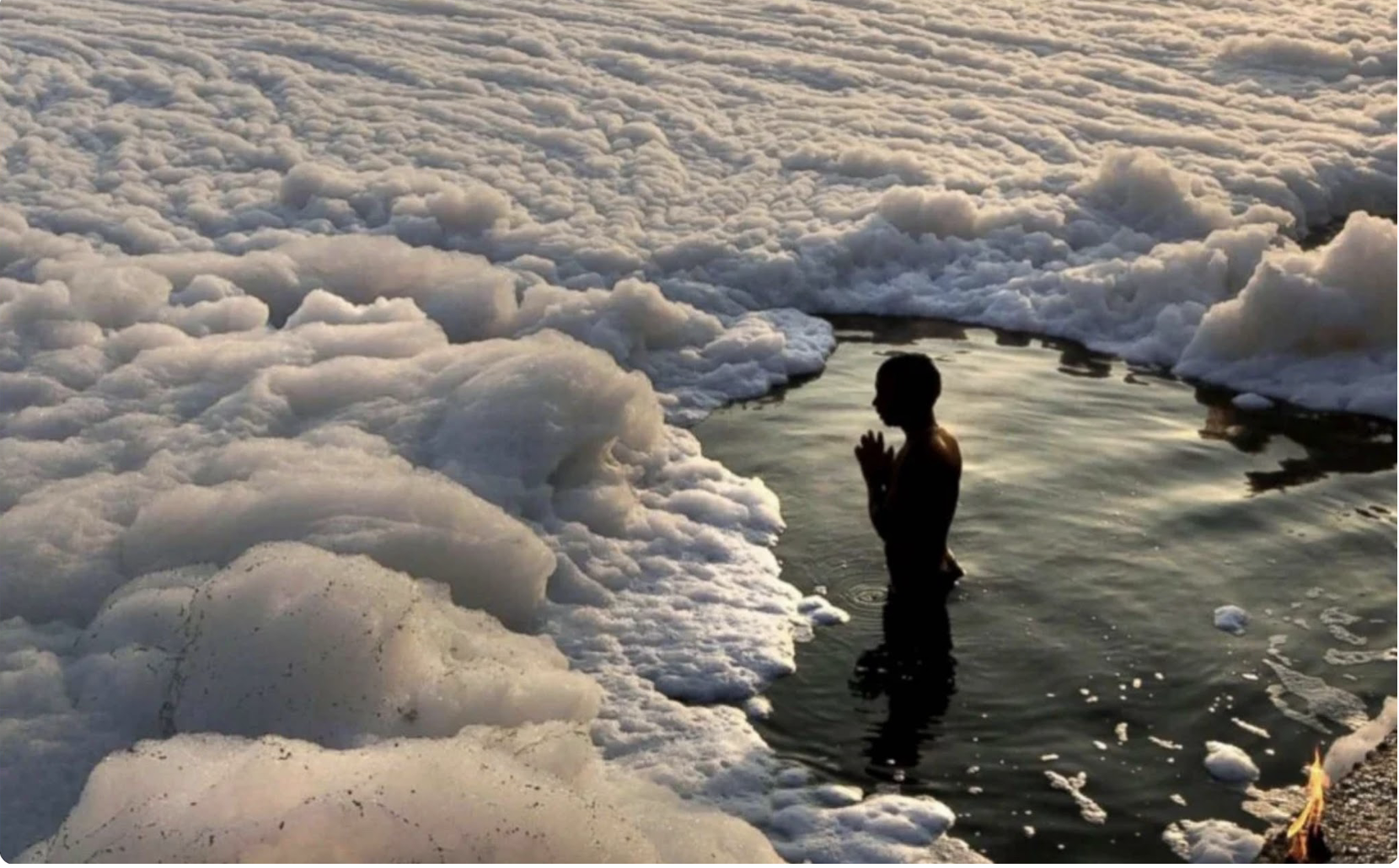
Indicators of water quality reveal the severity. Dissolved oxygen (DO), essential for aquatic life, frequently falls below sustainable levels, while Total Dissolved Solids (TDS) remain high in several stretches. The toxic foam that periodically blankets the river’s surface is not merely a visual anomaly; it is a symptom of excessive detergents, phosphates, and industrial effluents accumulating in stagnant, low-flow conditions. In policy discourse, this has often been framed as a failure of river cleaning. In reality, it is a failure of urban waste management, infrastructure planning, and governance.
The Drain Is the Problem
The most important thing to understand about the Yamuna in Delhi is that its pollution is not primarily a river problem; it is a drainage problem. Delhi’s natural topography slopes from west to east. Historically, water moved across this gradient through natural channels. As urbanisation accelerated, this flow was redirected into a network of drains designed, on paper, to carry rainwater. Over time, however, the distinction between stormwater drains and sewage systems collapsed.
Unauthorised colonies, now home to millions, were built without adequate sewer connections. Their waste entered nearby drains, which began carrying sewage year-round. What were once seasonal rainwater channels became permanent conduits of untreated waste, flowing directly into the Yamuna. This is not an isolated administrative failure but a systemic one. The river does not generate pollution; it merely receives what the city’s infrastructure fails to process.
Geography, Basins, and the Limits of Governance
The Yamuna’s pollution cannot be understood without examining its basin structure. Delhi is divided into three major drainage basins, namely the Najafgarh, Barapullah, and Trans-Yamuna drains, which feed into the river in distinct ways.
The Najafgarh basin, the largest, extends beyond Delhi into Haryana and Rajasthan, making the river’s condition a function of regional, not just local, activity. The Barapullah basin runs through some of the city’s most planned and powerful zones, yet lies within the Yamuna’s natural floodplains, areas that have been heavily urbanised. The Trans-Yamuna basin, densely populated and closest to the river, becomes the immediate recipient of accumulated pollution.
The critical insight here is that basins do not follow political boundaries. Rivers respond to geography, while governance operates within jurisdictions. When policy interventions are designed within administrative limits without accounting for entire catchments, they displace rather than resolve the problem.
The Sewage Treatment Illusion
Delhi does possess significant sewage treatment capacity. The Okhla Sewage Treatment Plant, among the largest in Asia, symbolises this infrastructure ambition. Yet the presence of treatment plants has not translated into effective pollution control.
The issue is not merely capacity, but integration. Treated water often re-enters drains that continue to carry untreated sewage from unconnected areas. Manu Bhatnagar, principal director of the natural heritage division of the Indian National Trust for Art and Cultural Heritage, highlights the role of migration in contributing to pollution in Delhi. Since the 1970s, many migrant workers have settled in unauthorised colonies along the banks of the Yamuna River. These settlements lack proper sewage systems, causing waste to flow into small drains and eventually into the Yamuna. Additionally, unregulated industries have contributed untreated effluents to the river.
As a result, water that leaves treatment facilities in a cleaner state is re-contaminated before reaching the river. Field observations reflect this contradiction. While some upstream points show marginal improvement in dissolved oxygen levels, downstream confluences, particularly where major drains meet the river, continue to record high TDS levels and low oxygen content. These patterns suggest that infrastructure, in isolation, cannot solve a system-wide failure.
Optics, Religion, and Political Incentives
The persistence of the Yamuna crisis is also shaped by political incentives. River cleaning is uniquely suited to visual politics: it offers images of action, visible progress, and symbolic commitment. Surface cleaning drives, chemical treatments to suppress toxic foam, and beautification of select riverfront stretches create the appearance of intervention. These measures are often timed around festivals or political milestones, reinforcing a narrative of progress without addressing underlying causes.
The river’s religious significance further complicates this dynamic. As a sacred river associated with major festivals and devotional practices, the Yamuna occupies a powerful symbolic space. Political actors invoke this symbolism to frame clean-up efforts as cultural restoration, while avoiding difficult conversations about structural reform, including the role of waste generation, urban planning, and enforcement.Religious waste, from flowers to idols, continues to be dumped into the Yamuna, despite readily available solutions like collection systems and immersion tanks. This gap underscores a failure of administrative will rather than capability.
In 2025–26, the Delhi Jal Board used over 48,000 kilograms of defoaming chemicals to suppress toxic froth along stretches of the Yamuna, spending nearly ₹80 lakh in the process. Yet, the foam returns within weeks, underscoring what environmental experts have long argued: such measures address the symptom, not the cause. This use of silicone-based defoamers has also raised ecological concerns as continuous spraying causes oxygen depletion and disruption of natural microbial activity, particularly when deployed over extended periods without transparent environmental assessment.
What emerges is a pattern of performative governance, where what is visible is prioritised over what is effective.
What Does the Future Look Like?
There are indications of limited progress. Certain stretches show improvements in water quality indicators, and investments in sewage infrastructure have increased. However, these gains remain fragile. Without systemic reform,improvements risk being temporary. The core issues, incomplete sewer connectivity, overlapping drainage systems, outdated infrastructure, and fragmented governance, continue to undermine progress. Of Delhi’s roughly 1,700 unauthorised colonies housing around 40 lakh people, only 345 have sewer connections; in the rest, sewage flows through drains directly into the Yamuna.
For a sustainable future of the Yamuna, it is essential to ensure an integration of treatment infrastructure with drainage networks and clear institutional accountability across agencies, where the focus is not on expansion but on redesign. Rather than continuing to build additional sewage treatment capacity, our policies must focus on intercepting waste before it enters the drainage network. This means prioritising last-mile connectivity in unsewered areas and restructuring key drains so that untreated flows are diverted to treatment facilities at the source, rather than after they have already entered the river system.
Additionally, we must also address the question of responsibility. At present, the multiplicity of agencies involved allows the systematic failure to be diffused across institutions. Hence, effective governance would require assigning outcome-based responsibility to specific agencies, where improvements in water quality, rather than infrastructure creation, become the primary measure of their performance.
Absent these changes, policy will continue to address symptoms rather than causes, with responsibility diffused and no institution answerable for outcomes.
Conclusion
The Yamuna is not merely polluted; it is misunderstood. It is treated as a river that needs cleaning, when in fact it is a system that needs restructuring. Until governance shifts from managing what is visible to fixing what is structural, the cycle of promises, spending, and limited results will continue. The river will remain a site of political performance rather than ecological recovery. The Yamuna cannot be cleaned where it flows if it is polluted long before it arrives.
About the Author
Varsha M is a third-year law student at Jindal Global Law School and a columnist in the Environment & Social Issues cluster at Nickled & Dimed. Her interests lie in environmental governance and climate justice.
Image Source: https://earth5r.org/yamuna-river-pollution-and-sustainable-solutions-for-the-future/