
By Aditi Lazarus
Abstract
This article examines the 1987 Meerut riots, focusing on the systematic erasure of the massacre through state complicity and narrative manipulation. It explores how communal tensions, political interests, and biased investigations contributed to reframing the violence as a “riot” rather than a state-enabled massacre. By analyzing institutional failures, selective violence, and the withholding of justice, the article highlights the enduring impact of silenced histories on communal conflict and the marginalization of Muslim victims in India’s public memory.
Introduction:
Silences — the erasure of selective moments in history — are more organized than we often realize. Michel-Rolph Trouillot, in his seminal work, Silencing the Past: Power and the Production of History, argues that “Power does not enter the story once and for all, but at different times and from different angles. It precedes the narrative proper, contributes to its creation and to its interpretation. Power begins at the source.” This source determines historical scholarship by first altering the creation of facts, then the assembly of these facts into narratives, and ultimately the retrospective significance of the moment that is later registered as history. The 1987 Meerut riots, marked by widespread communal violence and state complicity, stand as a powerful example of how such moments are systematically pushed to the margins of public memory. This article examines how the silencing of the Meerut riots reflects broader mechanisms through which history is shaped, controlled, and forgotten.
Understanding Meerut: Communal Tensions at the Epicenter
Meerut is an important town located in Uttar Pradesh, India, and is approximately 60 km away from Delhi. Around the 1980s, its population was about one million, of which Muslims constituted about 45%. The town, renowned for its weaving, brass band and scissor industries, which are controlled by both Hindus and Muslims. However, the Muslims, primarily the Ansaris who control the city’s prosperous power looms, had begun to become prosperous by extending their branches to other economic activities like the printing center, repair workshops, etc. For Hindus, economic prosperity among Muslims, coupled with Muslims’ numerical strength (45% of Meerut’s population), exacerbated feelings of threat and resentment. The violent destruction of Muslim economic establishments during the riots demonstrated how economic rivalries were reframed as communal antagonisms. Meanwhile, symbolic events like the Babri Masjid-Ram Janmabhoomi controversy in 1986 and the subsequent appeasement of the Shah Bano case — cynically manipulated by both Hindu and Muslim political leaders — further polarized communities.
The 1987 riots in Meerut were not isolated or spontaneous outbreaks of violence but rather the outcome of a long-standing, institutionalized system of riot production that has historically shaped Hindu-Muslim relations in the city. Even before independence, Meerut had witnessed recurrent communal riots — in 1939, 1946, and repeatedly after independence — establishing a persistent backdrop of mistrust and hostility. This history of tension has been systematically manipulated through the Institutionalized Riot System (IRS), where riots were deliberately orchestrated through recruitment, provocation, and escalation by vested interests. Critically, the 1984 violence must be understood within the broader pattern where communal tensions are strategically activated during periods of political mobilization, particularly around elections. Political actors have consistently exploited religious divisions to consolidate electoral gains, as seen in earlier riots like those in 1961 and 1982. Thus, the 1984 riots were where all these dynamics coalesced: political ambition, economic competition, and communal mobilization fused to ignite a brutal episode of violence.
Narrative Manipulation: Reframing Massacre as Riots
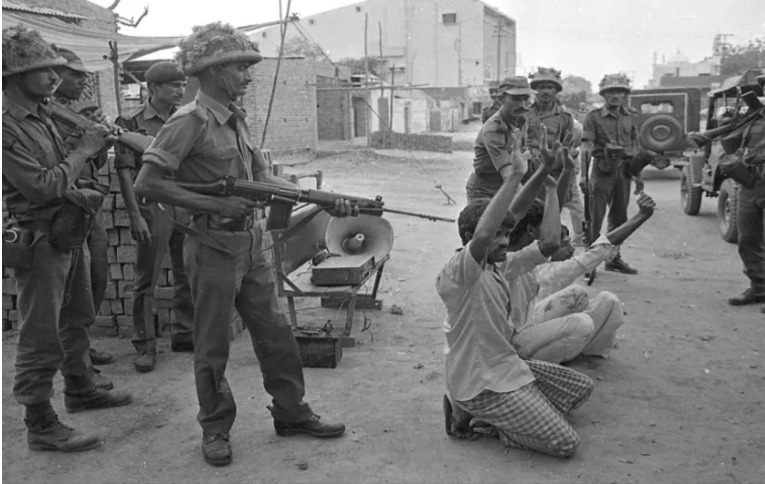
The riots in Meerut began on the night of May 18, 1987, in Hashimpura, a predominantly Muslim neighborhood of weavers. Initial violence was triggered by the burning of a Muslim-owned stall and a sudden power outage, which created conditions of panic and distrust. The Provincial Armed Constabulary (PAC) intervened by demanding house-to-house searches, and when residents hesitated, returned in greater numbers after midnight. Over three thousand individuals, including women and children, were forced out and made to assemble near the Imliyan mosque. Amid restored electricity, the PAC conducted raids, during which two Muslim men were killed and allegations emerged of a police jeep running over a girl. These events catalyzed further violence; on May 19, retaliatory attacks by Muslim groups targeted Hindu shops and factories at Pillokhdi.
However, the state’s response escalated beyond mere containment. Under curfew, the PAC, in collaboration with Hindu mobs that included both the upper class and members of the Scheduled Castes (Dalits), perpetrated widespread and selective violence throughout Meerut. Muslim localities such as Miyan Mohammad Nagar and Shastri Nagar faced systematic looting, arson, and killings. The Hashimpura massacre on May 22 marked a critical breakdown of institutional accountability: PAC forces extrajudicially detained and executed nearly one hundred Muslim men at the Ganga canal. A day later, the Maliana massacre witnessed 78 deaths, where similar patterns of state-enabled violence emerged with Muslim residents being shot or burnt within their homes.
The official death toll stood at slightly over one hundred, but independent estimates suggest a figure larger than that. The majority of arrests targeted Muslim civilians, while Hindu perpetrators largely escaped accountability. The Meerut riots exposed structural failures: the communalization of security forces, the erosion of administrative neutrality, and the use of communal tensions for political gain. Moreover, the act of minimizing or reclassifying the massacre as a “communal riot” serves not only to obscure the scale of violence but also to reframe the event as a mutual conflict rather than state-enabled persecution. Additionally, the event demonstrated how law enforcement could be weaponized in service of sectarian interests, setting troubling precedents for future Hindu-Muslim communal conflicts in India.
Neglect, Complicity & Bias
In the aftermath, the Gian Prakash Committee was tasked with investigating the riots, which compounded this erasure. Despite extensive oral and documentary evidence, the committee failed to establish a clear account of how the violence began, indulging in vague generalities and contradictions. It ignored facts such as the political decision to withdraw security forces shortly before the outbreak of violence and the active participation of the PAC in the killings. The report’s evasions, particularly its silence on the role of political leaders and law enforcement, were not mere administrative failures but deliberate political choices. By sanitizing the narrative, the committee ensured that the structural violence underpinning the riots would remain unaddressed. Thus, while it would be inaccurate to claim that the 1987 Meerut riots have been completely erased from historical memory, the riots, however, constituted silencing Muslim-victimhood, state-complicity in enabling violence, and the plight to jail the perpetrators.
First, one must acknowledge the discrepancy in the official death toll that the government admitted. The recordings of the death toll are based upon the number of post-mortems performed. But bodies continued to be discovered in the days after the massacre in the crooked nooks of the town–– wells, nullahs and obscured corners. Underestimating this figure, the state effectively minimized the scale of the violence and created a false sense of containment. Moreover, this underreporting of casualties can be seen as part of a broader strategy to downplay the role of the state apparatus in perpetrating or enabling the violence.
The strategic omission of the PAC’s direct role in the killings, coupled with the selective attribution of guilt, facilitated the presentation of the state as a neutral actor merely responding to disturbances, rather than as an active participant in exacerbating the violence. This strategic omission plays a crucial role in shaping public perception and historical memory. By framing the event as a “riot” and excusing the role of state forces, the government contributed to the creation of a distorted historical record, one that obscures the targeted nature of the violence and the institutional failures that allowed it to occur. The portrayal of the PAC’s actions as mere crowd control, rather than extrajudicial killings and deliberate executions, contributes to a narrative that obscures the state’s role in fostering and enabling communal violence.
The arbitrary arrests following the 1987 Meerut riots reveal the profound biases embedded within the structures of justice. Most of those arrested were Muslims with no prior criminal records, and were detained not because of evidence, but because of who they were. The state’s response was not just flawed—it was fundamentally communal. The investigation initiated by Prime Minister Rajiv Gandhi quickly became a mockery of due process, where the FIR filed named only civilians, deliberately omitting the Provincial Armed Constabulary (PAC) personnel directly implicated in the killings. Reports of coercion, such as the brutal beating of Yaqub Ali to force a false confession, show how fear and manipulation replaced any genuine pursuit of justice. For over three decades, survivors and families lived with not just loss, but with the betrayal of the institutions meant to protect them. The 2023 Meerut court verdict, which acquitted all 39 accused due to “lack of evidence” after more than 800 hearings, signifies that the machinery of the state can erase even the most brutal crimes through systematic delay and procedural failure. In this case, silence was not a passive forgetting, but an active erasure, a way to bury the memory of violence and protect the perpetrators from accountability.
Conclusion:
Therefore, the 1987 Meerut riots represent a haunting chapter in India’s communal history, where state complicity shaped a narrative that minimized the scale of violence and obscured the role of law enforcement. The strategic silencing of the massacre through institutionalized erasure, biased investigations, and underreporting of casualties highlights a deliberate attempt to shield perpetrators and deny justice to the victims. It has left the survivors with a painful legacy of betrayal and unaddressed trauma. Like many episodes of communal violence in India, Meerut has become part of a collective amnesia. But this silence around Meerut is not accidental—it is authored. As power shapes what is recorded and remembered, it begins not at the margins, but at the very source of history itself.
About the Author: Aditi Lazarus is a second year B.A. Diplomacy and Foreign Policy student at O. P. Jindal Global University. She has a strong affinity for researching art, literature, politics and economics.
Image Source: No justice 28 years after massacre of Indian Muslims | Human Rights | Al Jazeera