
By -Ishita Sharma
Abstract
Protective labour rights are only as strong as the measurements that make them usable. India’s Social Security Code bars work likely to interfere with a pregnancy, but the recodification of labour law dissolved the one standard that could say when heat crosses that line, replacing enforceable local temperature limits with a central discretion exercised so far in adjectives. Using new Indian evidence on heat and birth outcomes, this piece argues that the threshold belongs in the general workplace safety standard, since group-specific protection tends to price the protected group out of work.
Introduction
Indian law protects pregnant workers from dangerous work. Section 59(3) of the Code on Social Security, 2020 says that if a pregnant woman asks, her employer cannot make her do work that is likely to interfere with her pregnancy or harm the development of the foetus. The wording is broad enough to cover heat.But to use it she has to show today’s conditions are likely to interfere and somebody has to say how hot is too hot. As of November 2025 no Indian law does.
This piece argues that the missing number should be written into the general workplace safety standard. Barring a pregnant woman from hot work gives every employer a reason not to hire her; stopping the workplace from getting hot does not.
Protective rights can be disabled without being touched, so the question worth asking of any such right is not whether it has been narrowed but whether anyone can still measure what it turns on. And where a threshold is missing, writing it for everyone protects the vulnerable group better than writing it for them alone.
There used to be a number
The Factories Act, 1948 let each State set its own workplace temperature limit and several did. Rule 22-A of the Maharashtra Factories Rules, 1963 caps the wet-bulb temperature in a workroom at 30°C, measured a metre and a half above the floor, and requires a minimum rate of air movement. Gujarat has its own version. These are enforceable numbers, and they have been on the books since the 1960s. The Factories Act also let a factory inspector who thought a particular shed was too hot order the occupier to fix it, specifying the measures and a deadline.
The Occupational Safety, Health and Working Conditions Code, 2020 came into force on 21 November 2025 and replaced both. Under section 23, temperature is now for the Central Government to prescribe. This point has already been made in LiveLaw: the power moved from the States to the Centre, but two things follow.
First, the state numbers are now orphans. Section 143 keeps old rules alive so far as they are “not contrary to” the Code, so Maharashtra’s 30°C limit probably survives. But it was made under a power the new statute does not contain, Maharashtra cannot amend it without the Centre’s approval, and whether it survives at all depends on an unlitigated question nobody has answered. A number in that condition is not something a worker can rely on or an employer can plan around.
Second, inspectors lost the power to order a small fix. Under the old law an inspector could tell one occupier to insulate a roof or install fans, and set a date for it. The Code has no such order. Section 38 lets an inspector act only where conditions may cause “serious hazard or imminent danger by way of injury or death”, and all it permits is stopping the work. Heat rarely gets that bad, so between ignoring a hot shed and shutting it there is now nothing.
Why the missing number matters for pregnancy
Heat harms pregnancy, and the evidence is now specific enough to write a rule from.
Lakhoo and others, pooling 198 studies from 66 countries, found preterm birth to be the best-supported outcome. 78 of 84 effect estimates pointed the same way, with the odds rising about four per cent for each additional degree Celsius in the weeks before birth. The authors are candid that other outcomes were less consistent and that low-income countries were barely represented.
The Indian study is more useful for drafting. Vincent and others matched 209,266 births from the National Family Health Survey, to heat at each household. Instead of using a single national temperature, they counted consecutive days on which the India Heat Index passed the ninetieth percentile for that place’s own climate. Three to four such days in a row produced a significant rise in low birth weight and heat in the first trimester was linked to preterm birth.
The India Meteorological Department declares a heatwave only at 6.5°C above normal and over 40°C in the plains. But the heat that damages a pregnancy arrives well before the state notices anything is wrong. The International Labour Organization makes the general version of the point that nine in ten worker exposures to excessive heat happen outside declared heatwaves.
So the number this law needs has two features. It has to be set against each district’s own climate, because bodies acclimatise. And it has to run all the time, not only during a declared emergency.
Section 59 has a second problem, it protects a woman only for the seven weeks before delivery. The evidence points at the first trimester, when many women do not yet know they are pregnant and so cannot make the request the section requires. Extending the window helps once she knows but it cannot help before, which is the strongest reason to put the fix in a general standard that protects her whether or not anyone knows.
The Centre has written a heat rule. It reaches the mills that humidify their air.
On 8 May 2026 the Ministry of Labour notified the Central Rules under the Code. Rule 25 is a piece of heat regulation. It requires a risk assessment where workers face extreme heat and humidity, a work-and-rest cycle in a shaded or cooled space, drinking water with electrolytes, supervision so that anyone showing symptoms is taken out of the heat, training to recognise those symptoms, and instruments to measure and record temperature.
Rule 25 is headed “Artificial humidification“. It opens: employer of every factory in which humidity of the air is artificially increased. The class covers spinning and weaving in cotton, synthetic and wool, jute mills, and tobacco processing, etc. What these have in common is that dry fibre breaks under tension, so the air is humidified to protect the yarn. A garment factory stitching that yarn does not qualify.
For an ordinary factory, Rule 23 applies instead. It requires a temperature “suitable for the type of work performed”. It does require protection from extreme weather by shifting working hours and supplying protective clothing free of charge, but it sets no threshold at which any of that is triggered, and it imposes no duty to measure anything. Mines and construction sites must take readings, so they get a partial version of the Rule 25 regime. The ordinary factory is the only workplace in these Rules with no obligation to regulate its own temperature.
One caveat
Section 59 assumes there is an employer to make the request to. Most women working in India are not in that kind of relationship. They farm their own land, take casual work, or roll beedis at home. A factory temperature standard does not reach them either.
The Code does cover construction, which is where much of India’s occupational heat research has been done. A number can travel in a way that an employer’s duty cannot. Heat action plans, municipal orders and MGNREGA worksite rules can all borrow a threshold.
The cost of having no threshold is already visible as the Centre for Policy Research reviewed 37 heat action plans, nearly naming all pregnant and lactating women as vulnerable. Two backed that up with a vulnerability assessment, and ten set a local temperature threshold rather than relying on the national heatwave definition. None of the plans is notified under any statute, so none can be funded or enforced as law.
Conclusion
The Central Government should declare a real temperature standard. Section 18(1) requires the Centre to declare occupational safety and health standards, and requires those standards to address physical hazards “on the basis of the best available evidence”. Heat is a physical hazard and the evidence above is the best available. The standard should be expressed as a percentile of each district’s own heat index, and Rule 25’s protocol should be lifted out of the humidification heading and attached to it, measurement duty included. The graduated inspector’s power should come back and Section 59’s window should cover the whole pregnancy. The standard should sit in the general safety rules, not in a special provision for pregnant women.
In Anuj Garg v Hotel Association of India, the Supreme Court held that protective legislation aimed at women potentially works as a double-edged sword, and must be judged by its effects rather than its stated aims. A rule barring a pregnant woman from working above a given temperature gives every employer a reason not to hire her, but a rule stopping the workplace from reaching that temperature does not.
Parliament has already made this choice inside this very Code. The 2019 Bill would have let the government prohibit women from dangerous operations. Sections 43 and 44 as enacted reversed that: women are entitled to work in all establishments at all types of work, and where an operation is dangerous the employer must provide adequate safeguards. Fix the hazard, do not remove the woman.
About the Author
Ishita Sharma is a fifth-year law student at Jindal Global Law School, India. She is passionate about gender justice and social equity. Her research interests span across law, social work, and public policy, with a commitment to advocating for systemic change and helping those in need.
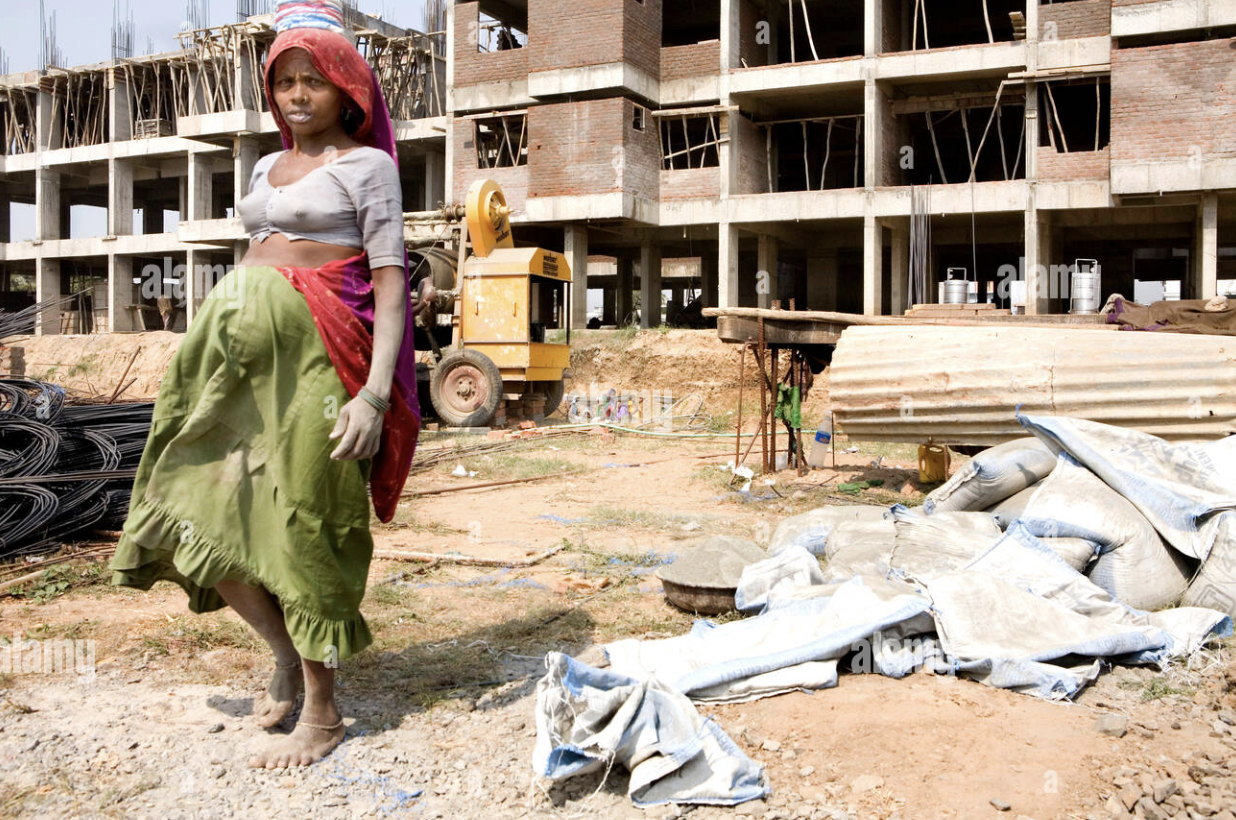
Image Source : https://www.alamy.com/stock-photo-pregnant-women-worker-at-construction-site-with-her-hands-and-legs-88261761.html