
By – Saanvi Nanda
Abstract
This article argues that the air pollution in Delhi is not merely because of degradation caused by the environment. It is also catalysed by the fragmented policy solutions, uneven developmental schemes and political blame shifting. It explores how access to clean shared air has surprisingly evolved into a symbol of privilege where wealthier citizens are much better equipped to protect themselves from the pollution whereas the lower sections of the society are constantly exposed to its exposure. The article aims to question whether the air pollution in Delhi is truly because of environmental degradation or is as much a question of democratic accountability that prioritises environmental protection and public health.
Introduction
Every winter’s arrival blurs the horizons of Delhi. Despite there being flight delays, surge in hospital patients reporting breathlessness, suspension of schools, the Delhi crisis always returns with predictability. The air pollution in Delhi has become a matter of grave concern concerning public health with particulate matter (PM 2.5 and PM 10), vehicular dust and emissions, fossil fuel and biomass burning and several other factors that pose severe health risks. Across India, Delhi reports some of the worst levels of pollution seen in the territory. The Indian government has time and again categorised Delhi’s air quality index into the “severe plus” and “severe” categories where readings cross 400, indicating a level where fit, healthy adults are suggested to stay indoors. All of these average figures hide the real truth. Numerous studies have measured how outdoor and indoor pollution are unequally spread and experienced in poorer Delhi neighbourhoods as compared to the richer ones. This article discusses how almost no one in the territory has access to “clean, breathable air”. The only thing that differs is the capacity to hold the right factors accountable.
The air we don’t share
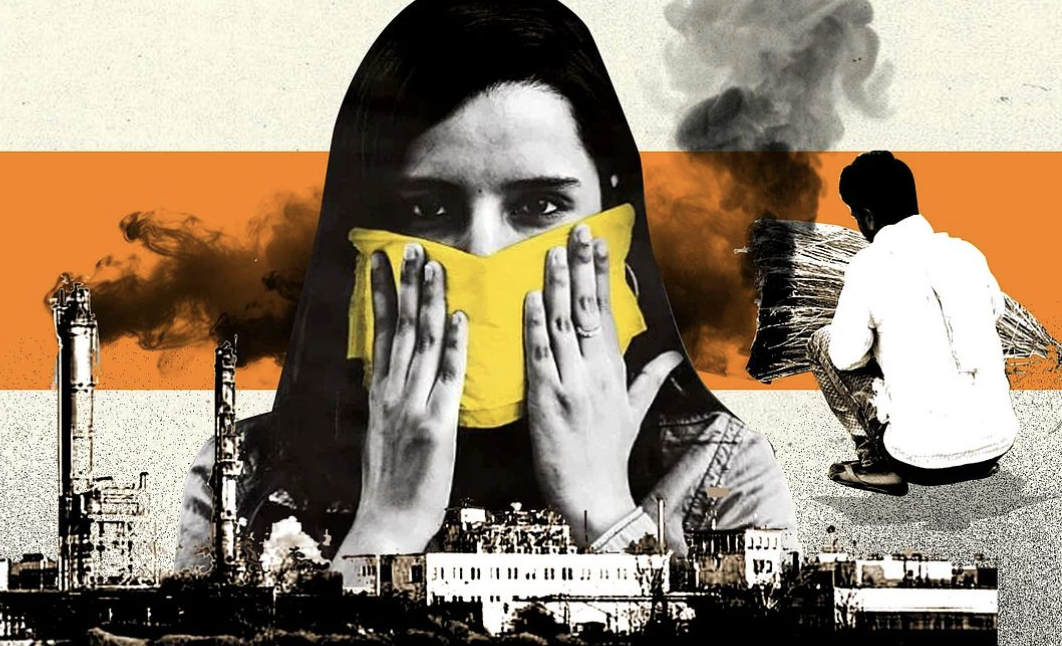
Let’s consider two Delhi residents on any random winter morning. Resident (R1) steps inside his warm, cozy car with a purifier inside. Resident (R1) has the luxury of not stepping outside his car or his house when the AQI levels cross the safety limit, whereas resident (R2), the lower sections of society, a “rickshaw driver”, “a street vendor”, do not have the same privilege. Their job often exposes them to the outdoors, during which they inhale more toxic and polluted air than the person who has the option to simply choose to work from home, sitting indoors. The human cost of this huge hole is measured in a 2020 New York Times feature that tracked two Delhi children for a day. One of these lived in a slum near Yamuna, and the other one in a much more sophisticated area. As the day went by, the child living in the slum inhaled four times as much pollution, which would cost him years of his life. The same illustration helps us understand how pollution in the territory is heavily influenced by income, the house you live in, and your access to technology. It is simply not dependent on geography alone.
Technological advancements have certainly helped curb this to an extent that only a select few can access. Instances where a snug filtering mask that helps get rid of particulate matter can be too costly for “low-wage” workers. “Air purifiers,” which help, are one of the most effective tools to filter out impure air, can remain out of reach for the majority of the working-class population. This inequality has a compounding effect where a lot of “low-income” Delhi households rely on coal, wood, and kerosene for cooking inside “enclosed spaces”, with “PM 2.5” and the presence of “carbon monoxide”, which are far beyond the permissible levels. The food cooked inside houses puts females at a much higher risk of being exposed. The data shows that a major chunk of Delhi houses comprises five or more family members inside “one single room”, leaving no space for ventilation for the smog to escape.
The politics of civic rights
The exposure to pollution is not equal, and so is the responsibility for it. Delhi’s political stance has turned this air crisis into a game of blame-shifting instead of collective responsibility. The moment AQI puts the territory into the “severe category”, the Aam Aadmi Party (AAP) and the “(BJP)” Bharatiya Janata Party (BJP)” start shifting blame instead of finding solutions. With the BJP government now ruling Delhi, nothing seems to have changed. The Lieutenant Governor of Delhi has publicly passed the blame onto the AAP government for the history of Delhi’s pollution. Each party accuses the other of manipulation and monitoring the “public data”, spending money on measures such as artificial rain instead of solutions that actually work.
The authorities in Delhi have officially categorised 13 “hotspots” that register pollution levels higher than the rest of the city. Areas like Anand Vihar, Narela, Okhla, Punjabi Bagh, Rohini, R.K. Puram and Dwarka have recorded higher levels of toxic air. All these areas are dense industrial areas, where heavy traffic sits, all of this being right next to where people live. Areas such as Lodhi Road, which is surrounded by broad herb, “tree-lined avenues”, have recorded lower readings of toxic air quality. Wealthy areas or people do not escape pollution, no. But places that are covered with greenery and have some distance from industrial areas do not suffer as much as other areas that are not.
The human cost of the divide
There is clear evidence that shows how this gap compounds and spreads across different parts of the city. A survey concerning respiratory health revealed how 1800 schoolchildren from Delhi were split across Chandni Chowk, Mayapuri and the residential area Sarojini Nagar. 66% of kids who were split across Chandni Chowk recorded breathing problems as compared to 59% in “Mayapuri”, which is an industrial area, and 46% in Sarojini. One in five children in commercial areas shows signs of respiratory illness as compared to one in seven in residential areas. There is a rise in hospital admission surges, suggesting irreversible lung damage caused by “Delhi’s air”, where children under the age of five are considered the most vulnerable group. This happens because “lower-income families” usually live in the commercial or industrial areas of the territory where their children are most exposed, and they have no capacity to do anything about it. All of these examples show how where you live, where you work, and what kind of work you do have an influence on how safe you are. The geography of Delhi pollution casts a heavy shadow over the geography of Delhi poverty.
Conclusion
Individual action such as the use of purifiers, masks, and facilities such as working from home is in itself a form of luxury and privilege that only a few can afford. Delhi’s air crisis should be seen and treated as a public health emergency that does not concern a particular job, gender or class but the whole territory. It should not be viewed as a seasonal news item to be taken care of with the help of sprinklers and blame games. Delhi’s smog reveals something uncomfortable but instructive. Pollution is never seen as something that necessarily differentiates between people, but the lived experience of it reveals something different. The wealthier sections have the privilege to isolate themselves and buy distance from this air crisis at their convenience when they are usually the section who contribute to disproportionately polluting the territory through their use of cars, heavy trucks, and construction-heavy ambitions. The helpless lower class cannot buy the same distance from the crisis they did far less to give rise to. As long as politicians keep shifting blame instead of finding workable solutions, Delhi winters will continue coming in a similar manner, thick with smog and still thicker with the huge gap between people who can close their doors and windows and those who have never really had that choice.
Author’s bio
Saanvi Nanda is a second-year law student at Jindal Global Law School with a strong interest in arbitration. Her research interests are drawn to environmental governance, public policy, and questions of social justice.
Image source:https://www.thequint.com/climate-change/air-pollution-india-delhi-action-plan-stubble-burning-vehicles