
By — Chandril Ray Chaudhuri
Abstract
Tracing the history of Qawwali, from thirteenth-century Chishti Sufism through the language politics of Amir Khusrau, the resistant poetry of Bulleh Shah and Faiz, the political geography of South Asian shrines, and the commodification driven by globalisation, this article argues that Qawwali has always been a site where power, faith, and cultural memory are contested and encoded.
Introduction
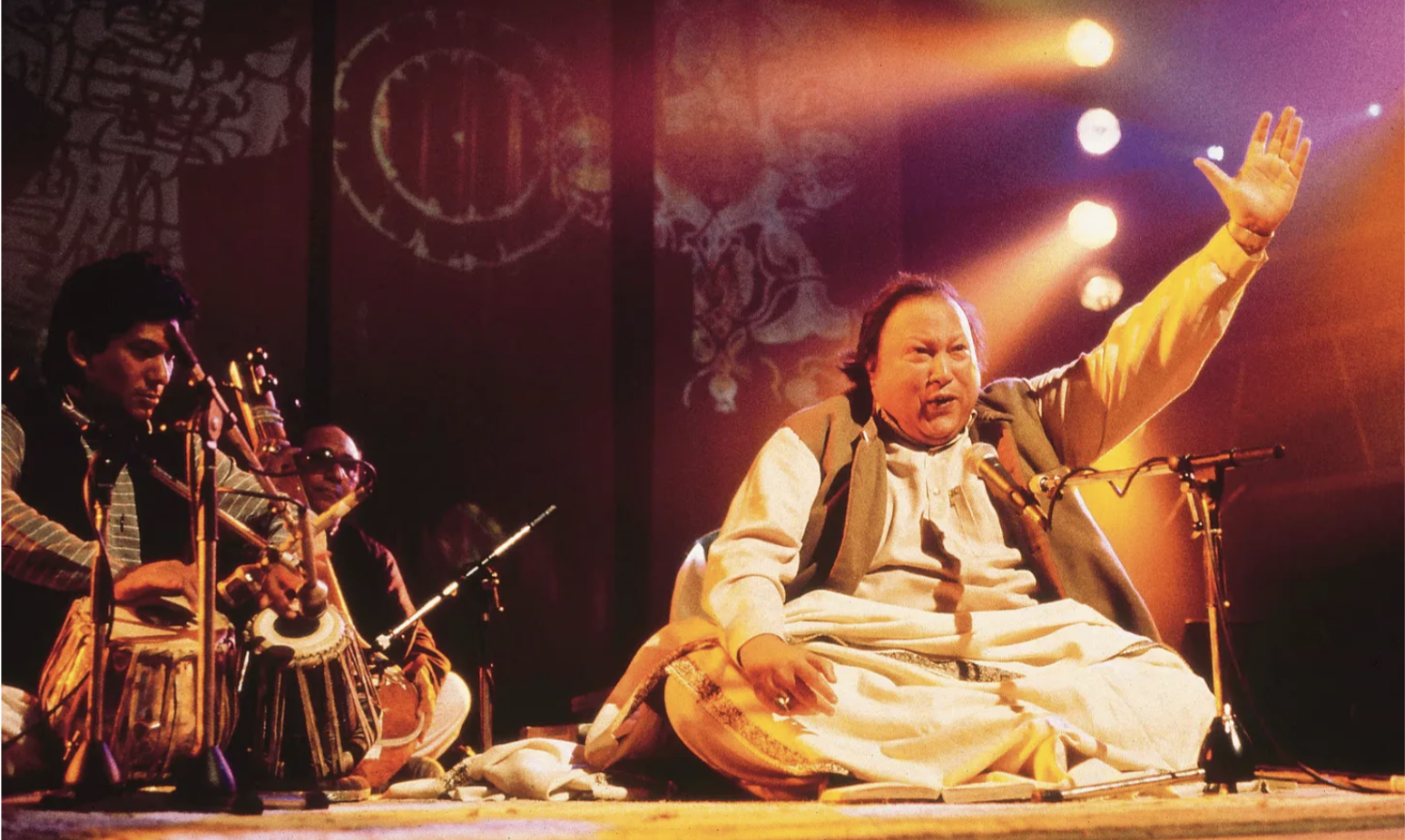
Close your eyes and imagine a dargah in old Delhi, or in the living room where your family sits on a Friday evening watching Coke Studio, and you’re sure to hear it; the urgent, repetitive build-up of the harmonium, the skillful tapping of the tabla, voices building in measured yet uncaring ecstasy, hands clapping in a regular, pulsating rhythm, a poem in Urdu or Punjabi building towards the promise of something that feels just out of reach in your daily life.
Qawwali is nearly omnipresent in South Asia, in dargahs, in weddings, in Bollywood films, and even in international concerts. Most people would instantly recognize the sound, though few would think to consider how it came to be, or what has kept it so inextricably tied to South Asian society.
This article argues that Qawwali is not only religious music but also a historically produced practice inflected by issues of power, resistance, language politics, and cultural change over eight centuries of history. To listen to Qawwali is to listen to history in motion; so that, in its metaphors and music, one might hear the interplay of religion and power, of margin and center, of sacred and profane.
The politics of sound is not a metaphor; this music carries history, ideology, and power within it.
Origins: Sufism, Authority, and the Birth of Qawwali
The origins of Qawwali as a form of expression are rooted in thirteenth-century Delhi in association with the musician-poet Amir Khusrau and the mystic Nizamuddin Auliya. Khusrau, a man of many talents, served in the courts of several rulers of the Delhi Sultanate, is credited with bringing together Persian, Hindavi, and indigenous musical elements to form the recognizable qawwali form, though it is recognized that the exact degree to which any individual contributed to the form is uncertain. Nizamuddin Auliya, who was associated with a dargah in Delhi that remains a place of pilgrimage today, eight centuries on, provided the primary context for its use, namely the sama, or Sufi listening session, in which music was used to access the mystical experience.
The birth of qawwali, however, was also a political event, for the Chishti Sufis operated in ambiguity to protect themselves and their relations with the formal religious establishment of the Delhi Sultanate. While the orthodox ulema claimed that there was a necessity for mediation between the individual Muslim and God through the use of religious learning, the Chishti Sufis offered an alternative through devotion, love, and music. It was not a direct challenge, but it was structurally subversive, for as Digby has shown, the spiritual authority of the Chishti shaykhs was challenged by both the ulema and the sultan, but the dargah remained a place of legitimate practice, beyond the control of either.
From the very beginning, there was an element of inclusivity in qawwali, for the Chishti Sufis’ emphasis on the importance of sulh-i-kul, universal peace and compassion, meant that the mehfil-e-sama was beyond the boundaries of the social hierarchy of medieval Indian society. Sufi shrines, in contrast to more regulated religious places, were places of inclusivity, for the poor, the low caste, and the spiritually seeking could access the sacred without any formal permission, as evidenced by Ernst’s writings on the Nizamuddin Dargah. Thus, the origins of qawwali are inextricably linked with an understanding of inclusivity, which, in the medieval period, was quietly subversive.
Language and Identity: Breaking Hierarchies
The language of Qawwali itself appears to be a political statement. Persian was the language of power in the medieval Persianate empire of the Delhi Sultanate. Persian functioned as the language of power, administration, and elite culture. The local languages of northern India, Hindavi, Braj Bhasha, Punjabi, were the languages of the common man, of the streets, of the villages. They were unlettered languages, with no claim to any institutional prestige as of the Persian tongue.
Khusrau’s enduring legacy was to complicate this hierarchy. He wrote in Persian, the language of the Muslim ruling elite of the Sultanate period, and in Hindavi, the local language of the Delhi region. Khusrau is often credited with the shaping of the music we call Qawwali, by bringing Persian and Hindavi together. His “macaronic verses,” which combined Persian and Hindavi in the space of a single verse, were not merely an exercise in form; they were an assertion of the linguistic equality of the two languages in the context of devotion to God.
This legacy continues. The very mixture of Persian and Hindavi that Khusrau popularized contributed to the evolution of Urdu, a language that itself represents a composite identity. The undermining of the elite monopoly on sacred language was part of the construction of a common Indo-Islamic identity that transcended rigid communal boundaries. Yet, in the legacy of this language, there was a divide. The Hindi-Urdu debate of 1867 underscored the linguistic and cultural divide between Hindus and Muslims in colonial India, and Urdu was to emerge as a badge of linguistic pride for Muslims: an issue that contributed to Partition and continues to shape nationalist politics in India and Pakistan. Qawwali, carrying this legacy in the very words of its songs, has always been implicated in this debate.
Qawwali as Resistance: Poetry, Mysticism, and Subversion
Qawwali has functioned as a devotional form of music since its inception. It allows dissent to be expressed indirectly, through what may first appear to be mystical dialogue. The poetry of Bulleh Shah and Faiz Ahmed Faiz illustrates this clearly.
Bulleh Shah’s verses, which qawwali singers frequently perform, challenge the social and religious boundaries of identity. The protagonist in “Bulleya ki jaana main kaun” rejects religious, caste, and social identifiers which society wants him to adopt. The act of rejecting spiritual practices which society considers necessary for his development actually functions as a political statement in a hierarchical society. The mystical language allows the critique to remain fluid and deniable, even as it unsettles established norms.
Faiz Ahmed Faiz uses a similar approach in his poetic works. Faiz draws on Sufi themes of love, longing, and separation to express his political views about colonialism and state repression in his modern writing. These metaphors enable his work to move between registers. A poem addressed to a beloved can simultaneously be read as a critique of authoritarianism or an expression of collective struggle.
Qawwali functions as a medium which enables poetry to reach non-elite audiences in both instances. The communal nature of the performance allows these concepts to reach larger audiences while their political intensity decreases. Mysticism and qawwali work as tools which enable protest, rather than weakening it.
Shrines, Space, and Political Legitimacy
Qawwali cannot be separated from the spaces in which it is performed. Dargahs such as Ajmer Sharif Dargah and Nizamuddin Dargah are not only sites of spiritual devotion but also arenas where social and political meanings are produced and negotiated. The performance of qawwali within these spaces ties sound to place, and place to authority.
The defining feature of these shrines is their accessibility.
People from various faiths and social backgrounds visit these sites, creating a shared space that cuts across social divisions. Dargahs have obtained their historical moral authority because people from different faiths visit these sites, which are historically positioned outside direct state control and official religious organizations. Qawwali performance in these environments supports this value system through its ability to bring people together for shared emotional responses.
The open access of dargahs establishes them as important political sites. Rulers in the precolonial period, and politicians in the present, have sought association with shrines to draw upon their symbolic capital. Acts such as chadar offerings demonstrate people’s religious devotion while authenticating their connection to popular faith and culture.
A persistent conflict emerges from this situation. Sufi traditions promote inclusive behavior but Sufi spaces face transformation through political support which continues from politicians. Qawwali becomes part of this negotiation between spiritual authority and political power, which spiritual principles and government entities use to establish their respective authority.
Globalization and Commodification
Nusrat Fateh Ali Khan has been instrumental in popularizing the Qawwali genre among the international audience. The Qawwali tradition in the Khan family has been around for centuries, and the musician has been able to carry the legacy forward in countries where the Qawwali tradition has been somewhat less popular. His performance at the WOMAD music festival in England in 1985 can be regarded as an important milestone in the global popularization of Qawwali, as it marked the first instance when the Qawwali genre was introduced to the Western audience. Subsequently, Khan signed a recording contract with Peter Gabriel’s Real World Records, which, along with the musician’s association with international films, has been instrumental in popularizing Qawwali on a global platform. This can be regarded as an important transition in the cultural landscape of Qawwali music. This change is characterized by a shift from the traditional ritualistic nature of qawwali music to a more cultural and commodity-based understanding of the music.
This change is not a negation of the traditional significance of qawwali music but a change in the manner in which the music is experienced and perceived. According to Peter Manuel, a significant change was observed in India with the advent of the 1990s with the appearance of a ‘Sufi vogue’ in which qawwali music and similar other Sufi music traditions increasingly came to be perceived and experienced as aesthetic phenomena among the middle classes of India. The launch of Coke Studio in 2008 hastened the process. The music is now accessible worldwide through digital media and recontextualizes Sufi and folk music in an upscale, modern form, representing them as the embodiment of the country’s culture. Artists like Abida Parveen have positioned their performances in these venues as an expression of cultural representation on the global stage.
Conclusion
Sound carries layered histories. Long after the conditions that produced a piece of music have changed beyond recognition, the music persists, carrying within its form the residue of old negotiations, old resistances, old meanings. This is what makes Qawwali both analytically inexhaustible and politically significant, even in its most apparently commercial iterations.
Consider Dila Teer Bija, composed in 1987 as a campaign anthem for Benazir Bhutto and the Pakistan People’s Party. By the time it crossed the border into Hyderabad, India, it had shed its political skin entirely and become a standard wedding song in the marfa tradition, played at Hindu and Muslim celebrations alike, its dancers unaware that they were moving to a partisan Pakistani election anthem. Today, Qawwali is more of an aesthetic and performance experience than a spiritual practice that people can take part in.
This change has made things more aesthetic, with sonic intensity taking center stage and devotional and subversive meanings becoming less obvious. At the same time, it has taken on new meanings as a sign of cultural identity, soft power, and belonging to a diaspora.
Original context fades; sound survives; politics becomes hidden but not erased. Qawwali has moved through the same logic across eight centuries, at a far greater scale and with far greater consequence.
About the Author
Chandril Ray Chaudhuri is a second year undergraduate student of law at O.P. Jindal Global University.
Image source: https://brownhistory.substack.com/p/from-the-shrine-to-spotify-how-has