
By – Aditi Lazarus
Abstract
Catherine the Great’s reign (1762–1796) was marked by significant political, social, and cultural transformations in Russia. Ascending the throne through a coup, she implemented reforms inspired by Enlightenment ideals, modernized governance, and expanded Russia’s territorial influence. While her rule balanced progressive reforms with political pragmatism, it also reflected the contradictions of enlightened absolutism, securing Russia’s imperial dominance while maintaining its feudal structures.
Introduction
“Power is a magnet, alternately attracting and repelling women. When power is held by a woman, the ambivalence and complexities become heightened.” Throughout history, women have either been glorified, vilified or invisibilized. Such characterizations are not entirely founded on the presence of virtue–both physical and emotional–in women but rather serve as instruments of social control, dictating her status and role within the societal hierarchy. Thus, delving into Catherine the Great’s story offers a compelling exploration of a woman who defied the norms in late 18th-century Russia—a ruler who consolidated power, a reformer who modernized institutions, and a strategist who expanded and strengthened the empire.
A Diadem Defied: Catherine’s Rise to Power
Originally, Czarina Catherine was born as Princess Sophie Auguste Friederike of Anhalt-Zerbst in an impoverished Prussian family with noble connections. That led to her engagement with Peter, the nephew of the reigning empress, Elizabeth, and the heir to the Russian throne. The teenage princess arrived in Russia in 1744 with her mother, converted from Lutheranism to Russian Orthodoxy, and adopted the name Ekaterina Alekseevna to be eligible to wed the heir to the throne of the Romanovs. Some journals like The Yearbooks for the History of Eastern Europe note that Catherine’s religious and philosophical outlook was more erudite than it seemed. She was influenced by her father, Christian August, a gouverneur whose religious beliefs drew a nexus between religious convictions and pragmatism. In addition, the mentorship she received from Pastor Wagner and Simon Todorskij strengthened her belief in God and moral teachings like pietism that were central to both Lutheranism and Orthodoxy. Thus, while some may assess her decision to convert through the lens of 18th-century politics; it is essential to acknowledge that her conversion was not merely symbolic; her religious identity became a meaningful aspect of her assimilation into Russian culture and her commitment to serving the Russian people.
In 1745, the pair got married in the Russian Church. However, the match was unhappy due to differing interests. Peter felt a stronger allegiance to his home country of Prussia than Russia and indulged in vices that distracted him from painting himself as an effective military commander. As both parties sought intimacy elsewhere, it also later raised a question about the paternity of their son, Paul I. Isolated in the palace, Catherine immersed herself in intellectual pursuits, diligently learning the Russian language and studying the works of Enlightenment thinkers, ultimately, deepening her connection with the Russian homeland. Although Peter ascended the Russian throne upon Elizabeth I’s death in January 1762, his reign remained short-lived. Author Isabel de Madariaga notes that Peter’s actions were “totally lacking in common sense”. His military campaign in Denmark was of little value to Russia, and the seizure of church lands in the country made him an extremely unpopular Tsar amongst the people, driving away key factions at the court. In hindsight, Catherine bided her time. In July 1762, Catherine, a true Russian patriot, accompanied by the Orlov brothers and her cadre of 14,000 supporters, arrived at the Winter Palace to declare Catherine II as the sole ruler of Russia whilst Peter was on a vacation in St. Petersburg. As soon as he returned, he was imprisoned and forced to sign a statement of abdication, solidifying Catherine’s great rule to come.
Various historical sources note the list of men who decorated her harem, men like Potemkin who fed her sensuality and aided her in the coup d’etat. When upgraded to her favorites, they believed they could dominate her and the crown. Sensuality, for women rulers in the 18th Century, became a premiere opportunity to be grabbed through the “permissive power of the throne”. And female ambition was considered degraded enough to be eventually surrendered to the domination of powerful lovers. Ad essentiam, whilst her sensual and political pursuits persisted, Catherine refused to submit throughout her reign.
Legacy of a Modernizer: Reform and Controversy
Catherine’s legacy is a complex blend of ambition, pragmatism, and contradiction. While she adhered to the classical policies of her predecessors, particularly Peter the Great, she left her unmistakable mark on Russian diplomacy and governance. She was not an original thinker, as she borrowed from the traditions of her predecessors in state reforms, but her commitment to modernisation, however slow and uneven, was significant. At home, she championed Western Enlightenment ideals, fostering a culture of intellectualism among the elite. These ideas led to the establishment of the 1775 Provincial Statute and the 1785 Municipal Charter, laying the foundation for local governance and eventually contributing to Russia’s 19th-century legal and administrative evolution. However, the vastness of Russia and the rigid social structure meant that these ideas could barely reach the lower classes. Some critics argue that she failed to bring meaningful change to the majority of her people, but given the challenges she faced—the entrenched power of the nobility, the limitations of the era, and Russia’s sheer size—her efforts were hardly insignificant.
She sought to be an “enlightened despot” like her European counterparts, but she was ultimately constrained by the very system she ruled. Despite these contradictions, Catherine’s patronage of arts and education elevated Russia’s cultural status. She expanded the Academy of Sciences, founded the Smolny Institute for noblewomen, and amassed the art collection that formed the Hermitage Museum. Her cultural policies projected Russia as a sophisticated European power, commissioning neoclassical architecture and fostering literary growth.
While she reduced the power of the Church, her reforms in governance were aimed more at strengthening state control rather than empowering the people. Her administrative policies reorganised Russia’s vast provinces, perhaps with some hope of encouraging local self-rule, but in reality, they served to tighten central authority. She may have sympathised with the plight of the serfs, but she did little to improve their condition, knowing that alienating the nobility would threaten her own rule. In some ways, she made things worse, expanding serfdom by transferring crown peasants into private hands. For instance, her economic policies treated the peasantry as both a workforce and a factor in national growth rather than just a moral concern. Her governance encouraged trade by reducing state restrictions on merchants and enterprising peasants, fostering economic expansion. However, while Russia saw notable wealth accumulation, this prosperity was unevenly distributed, leaving many still struggling. However, it is important to assess her domestic moves in the context of her time—compared to much of Europe, Russia was not uniquely oppressive. Moreover, she expertly calibrated the delicate balance between introducing modern reforms and maintaining autocratic rule.
Catherine was a skilled diplomat, navigating the treacherous waters of European politics with skill and determination. Her interventions in Poland and victories over the Ottoman Empire, except the Greek project, expanded Russia’s borders by 200,000 square miles, laying the groundwork for its rise as a major power. She had grand dreams—she even named her grandson Constantine, hoping he might one day rule a revived Byzantine Empire. While not all her ambitions materialised, she fundamentally reshaped Russia’s position in the world.
Her reign embodied paradox—championing education, modernisation, and legal reform while entrenching autocracy. She propelled Russia into modernity but upheld the very structures that restricted its people. Her legacy remains a blend of transformation and contradiction, securing Russia’s imperial stature while reinforcing its feudal foundations.
Conclusion
Thus, Catherine the Great’s legacy is one of brilliance and contradiction—she was both a reformer and a ruler bound by the limitations of her time. She embraced Enlightenment ideals, fostering intellectual and cultural growth, yet upheld the autocratic structures that kept Russia’s vast empire stable. Her military conquests and diplomatic maneuvers cemented Russia’s status as a European power, but her economic and social policies deepened inequalities, particularly for the serfs. Ultimately, she was a leader who defied convention, wielding power with sharp intelligence and political acumen, leaving behind an empire that was more expansive, more sophisticated, and yet still burdened by the very traditions she sought to modernize.
About the Author
Aditi Lazarus is a second year B.A. Diplomacy and Foreign Policy student at O. P. Jindal Global University. She has a strong affinity for researching art, literature, politics and economics.
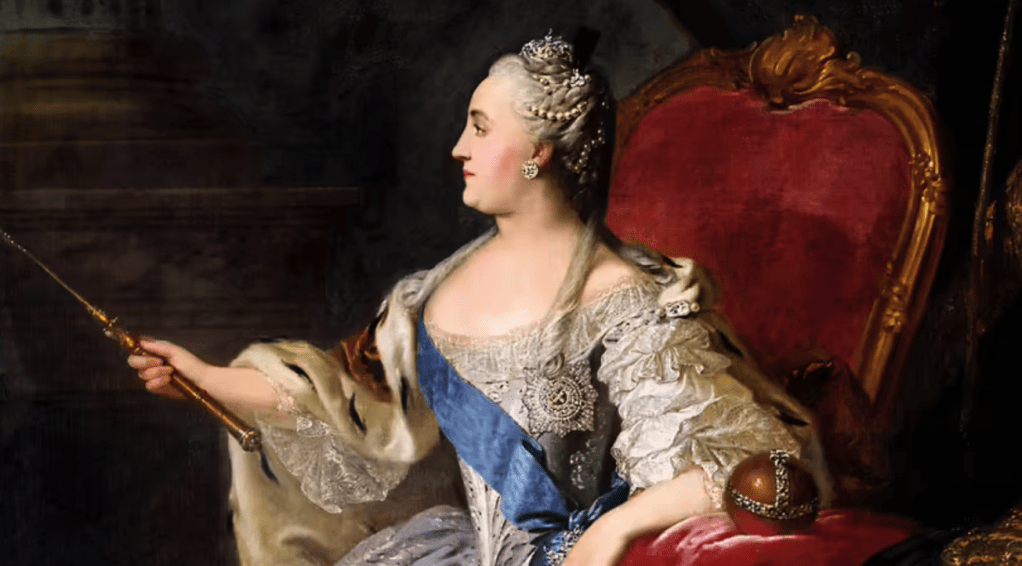
Image Source – https://arthive.com/ru/artists/155~Fedor_Stepanovich_Rokotov/works/11735~Portret_Ekateriny_II
 NICKELED AND DIMED