
By Harshita Hari
Abstract
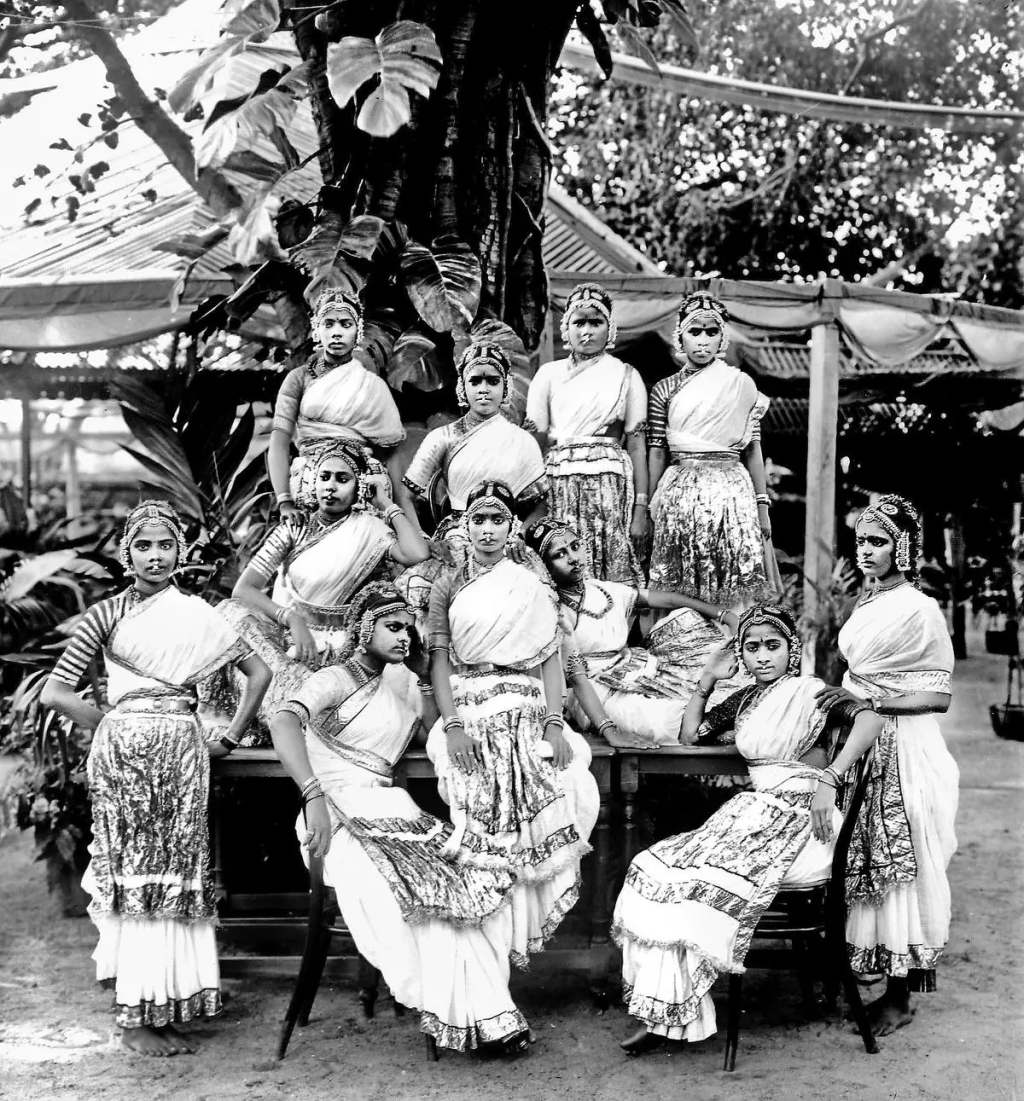
Devadasi or jogini are words that are derived from Sanskrit which means “female servant of the god.” Devadasis as characters are seen to emerge from usually Southern parts of India, heavily seen in the states of Karnataka, Tamil Nadu, and Andhra Pradesh. They are women who serve in temples as holy dancers and singers and are seen as courtesans in God’s Court. These women often enter the profession before attaining puberty and are seen as fulfilling the goddess’s orders of ‘serving’ the local community. Devadasis are seen as subjects that follow the goddess, Yellamma. Young girls are married off to Yellamma by the temple priest. This ritual of marrying Yellamma is to mark the new journey that the girl embarks on, the journey of becoming a Devadasi. Since they are the god’s wife, no mortal can marry them. But when a devadasi reaches puberty, usually her virginity is taken by the head priest of the temple as it’s a ‘religious order’ that must be followed. This ritual is also called the ‘Uditambuvad’. This practice was made illegal in 1988, but it continues mostly because of the root of the evil – caste.
Emergence of Devadasis
The practice of devadasi is seen to have emerged in the 7th century when the girls were married off to the goddess of Yellamma to begin their journey as Devadasi and serve the wishes of the goddess. This idea came from the Puranas, specifically the Agni Purana and Bhavishya Purana, which stated that, for a man to attain punya they must dedicate a few dancer girls to the temple of the sun for its needs and worship. Most wealthy men started dedicating devadasis to the temple of the sun. Devadasi participation grew out of just serving in the temple of the sun but became common in most temples during the Rajput Dynasty era. They were also invited to festivals and weddings and their attendance was seen as an auspicious occasion. Devadasis were seen with high regard and associated with prestige and grace as they were servers of God. Until the 10th century, there was no indication of Devadasis selling sex or being prostitutes. It is also important to note that ancient scriptures which guide the idea of who a devadasi is, present them as women who have become servants of the god and show their obedience by participating in daily affairs of maintaining the deity. However, there is no record of needing to engage in an exchange of sexual activities to show their ‘obedience’.
After the 10th Century, Devadasis entered prostitution for a few reasons. The first and the major one is the change of dynasties and ruling in regions. Several kingdoms invading the land during the warrior king era led to displaced Devadasis and command on what they must do. Many of these ruling kingdoms wished to impose on what must go especially to women of the era who engaged in social activities. This led to building a new outlook on Devadasis, who were once seen as prestigious creatures of religious belief and worship to women of sexual pleasure and exploitation of need for the warriors and royalty. This became a precedent for commoners as well.
Caste in the Devadasi Practice
The conversation of caste within the devadasi practice has been delicate and nuanced. This is because it’s an underlying facet when it comes to the development of this so-called sacred tradition. Although the practice is outlawed currently, it continues discreetly. The current form of the profession is one of the most common jobs taken by Dalit and Harijan women. As seen earlier, the image of a devadasi was an embodiment of femininity, beauty, and allure. Earlier, many women from higher castes also enjoyed and took part in the practice and were devoted by their families to the temple. But as the practice got exploited for men’s sexual pleasure, upper-caste families and women stopped enriching themselves in the practice as it was tabooed and invited ‘all sorts of men’. These ‘sorts’ of men mean with any class and caste. This meant a scheduled caste man could seek pleasure from an upper-class woman and that wouldn’t be socially tolerated, it was seen as a crime to even ponder on it. This left scheduled caste women in the practice. Currently, the practice of devadasis is constructed on the backs of scheduled caste women.
Several forms of violence are used to aid caste oppression. Particularly with women, sexual and physical violence is one of the most common forms of violence perpetuated. In a report on caste violence by Human Rights Watch, a local government official in a rural village in Tamil Nadu said, “Everyone practices untouchability when it comes to sex.” Issues of caste and discrimination, especially in rural villages where the devadasi practice is seen, thrive on the sexual exploitation of women. Rape is used as a form of retaliation by upper-caste men perpetuating a message to the ‘lower-caste system.’
Currently, lower caste underage girls are devoted to the temple, their virginity is bought by an upper caste man for any nominal amount. After this, the woman is seen as untouchable by any other man as already a man has claimed his hand on her. The man then repeatedly rapes her, abuses her, enslaves her eventually abandoning her. Often these devadasis are left with children from such traumatic abusive relations and with no choice but to enter sex work to earn for themselves, possibly their baby or family.
Babies as young as seven months old are dedicated to the Yellamma temple. This was the story of Lalita, who was dedicated to the temple as a baby and her whole life had been surrounded by the idea of her body being exploited by upper-caste men. It is easier to blame her family and system. It’s the tendency that society takes on when viewing social issues through a savior lens. This practice is something that is ingrained in her familial roots and has led to her inheriting this profession, not just for her but for all the women in her family. Being a marginalized group, with social alienation, and economic backwardness comes with it. Often lower caste women are trapped in the cycle and the choice of being a devadasi isn’t left to them, it’s a decision made by the elders of the family.
Lalita was sold for nearly Rs. 5000 which is sadly seen as a good amount. She says the man was in his forties and had a wife and two daughters, being close in age to Lalita. The Devadasi often don’t earn through the sale itself. Sometimes, the priest of the temple might take the money for himself or the family of the girl and use the money after her body is sold as a commodity.
This is just Lalita’s story, which unfortunately is the fate of many girls in many villages across India. A 2015 report by Sampark states that there are 4,50,000 Devadasis across India. In a 2018 study, it was observed that about 92% of women participating as Devadasi were minors.
Many states where the issue is prevalent have legislated laws to outlaw the practice. Still, like many policies implemented in this country, the implementation and mechanism to enforce is little to nothing. To fight the issue, it’s essential to not look at the practice as a mere illegal prostitution crisis. It must be viewed as gender-caste violence to truly understand the depth of this issue. If the acts that are being perpetrated upon lower caste to this date could be easily seen as gross acts if inflicted upon upper caste women, it is not prostitution. It’s not free, not consensual and is nothing but a vindictive caste agenda.
Author’s Bio
Harshita is a third-year law student at OP Jindal Global University. Her major interests lie in feminist and queer thought, constitutional law and the criminal justice system.
 NICKELED AND DIMED
One response to “In the Shadows of Tradition: The Systematic Misuse of Lower Caste Women in the Devadasi Practice”
Thanks for bringing this to light. I was unaware of this. I feel sad for the innocent girls!
LikeLike