
By – Chandril Ray Chaudhuri
Abstract
This article examines the evolution and development of the Strait of Hormuz as one of the most militarised global trade routes. It argues that global energy transport through the Strait of Hormuz is not secure by market forces alone, but through permanent military presence and ongoing geopolitical competition. The article also examines the role of geography, asymmetry, and energy dependence in the development of the Strait from the Tanker War to the current naval deployments. It also analyses the role and implications for India and how international trade is secured through coercive forces.
Introduction
The Strait of Hormuz is one of the most important arteries of the global economy. The United States Energy Information Administration states that “about one-fifth of the global consumption of petroleum liquids” transits via the Strait of Hormuz, a narrow waterway that underscores its centrality to global energy circulation. However, the flow of goods and services that transit the Strait of Hormuz does not result from the free market forces of supply and demand. Instead, it is secured by the constant military presence and deterrence in the area. The fact that there is a constant military presence in such an important trade route highlights the inherent contradiction that exists in the idea of “free” trade and the constant military deterrence that secures it.
Geography Creates Vulnerability
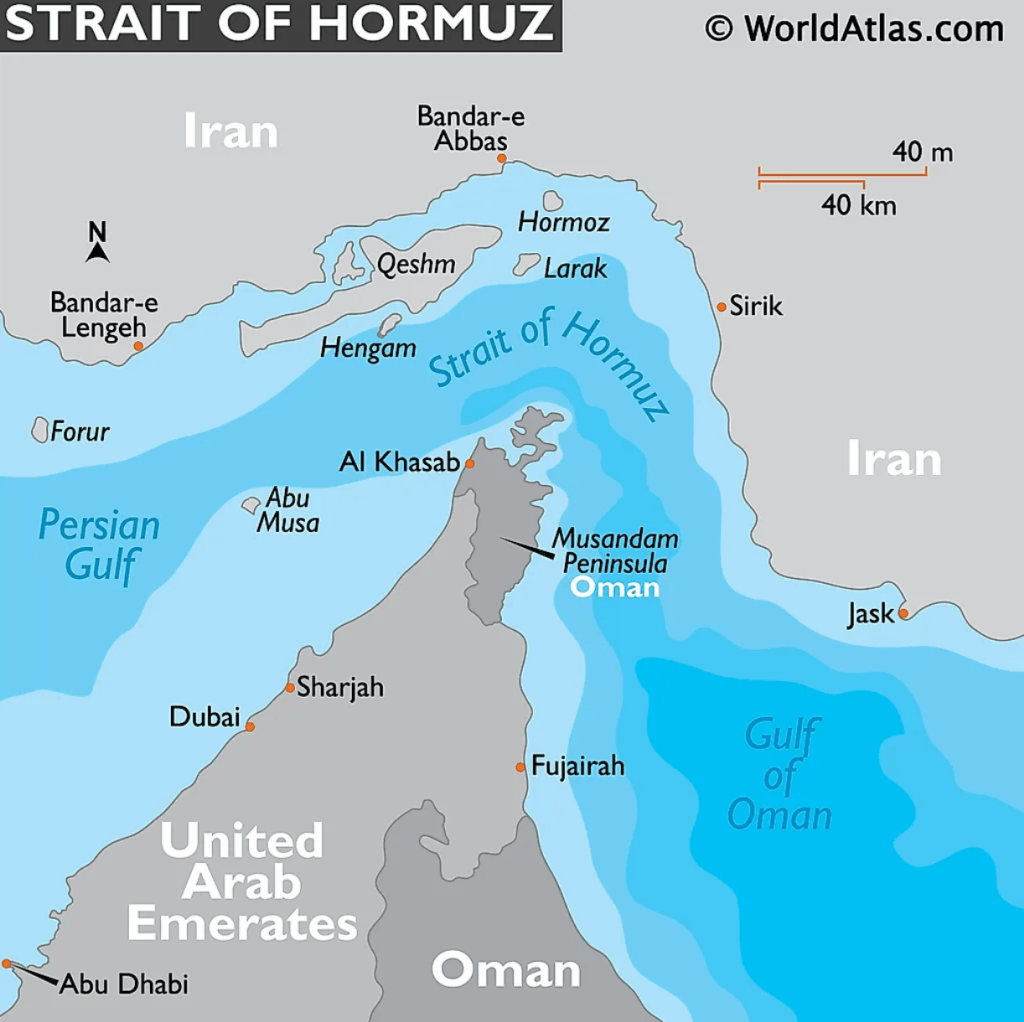
The strategic importance of the Strait cannot be separated from its geography. In its narrow point, the channel measures around 33 kilometers in width, and the shipping lanes extend only two miles in either direction. Flanked by Iran to one side and Oman to the other, the region provides traders with remarkably little room to maneuver. Yet this geography provides for the channeling of an immense proportion of global trade in a relatively confined space, creating a significant structural weakness. With only a handful of viable alternatives that have the potential to equal the capacity of Hormuz, the opportunity to do so becomes feasible and has significant global implications. In short, the role of geography cannot be seen as anything but setting the conditions in which the militarization of the sea lane becomes possible.
Historical Roots: The Tanker War
The militarization of the Strait of Hormuz can be traced back to the Iran-Iraq War, which occurred from 1980 to 1988. This war was characterized by a phase known as the Tanker War. A significant part of the Iran-Iraq War marked a new era in the maritime economy of the Persian Gulf region. From 1984, both Iran and Iraq attacked and targeted oil tankers and other ships, aiming to cut off their opponents’ economic lifelines by attacking their oil exports. Initially, Iraq targeted Iranian ships and oil installations, while Iran retaliated by attacking ships and installations of Iraq’s Persian Gulf allies, namely Kuwait and Saudi Arabia.
The maritime war was quite intense, with over 400 commercial ships damaged or destroyed during this period. This shows the high stakes of global maritime trade routes, which, if concentrated in a particular region, are extremely vulnerable to such a maritime war. The maritime war, however, led to an international intervention most notably through Operation Earnest Will by the United States in 1987, where the United States reflagged and escorted Kuwaiti tankers. This marked a new era in international maritime trade routes, where neutrality is no longer an option, and such routes must always be protected by military forces.
Permanent Naval Presence
In the years following the 1980s, the level of militarization within the region has not diminished, but has, in fact, been incorporated into the routine nature of maritime activities. The United States, through its Fifth Fleet, based out of Bahrain, has continued to assume responsibility for the Persian Gulf, including the Strait of Hormuz. This has also been supplemented by the efforts of allied nations, such as the United Kingdom and European nations, through the implementation of surveillance programs. The situation has, over time, resulted in the establishment of a stable environment, whereby naval activities and monitoring programs have come to represent an integral part of commercial shipping activities within the region.
However, this stability has, in recent times, come under further strain, as witnessed through the events of 2026, which have represented the commencement of a conflict that seems to be a “second tanker war”. The seizure and release of tankers, drone attacks, and confrontations between Iran and the United States have resulted in an increased level of uncertainty in the region, with both nations engaging in actions that are increasingly risk-laden.
Iran’s Asymmetric Strategy and the Coercion of Trade
Iran’s behavior is an example of how control of trade does not always require dominance in naval warfare. Instead, it uses an asymmetric strategy of observation, disruption, and interference, on a path through which a fifth of the world’s oil and gas travels in normal times. Through its Islamic Revolutionary Guard Corps, it closely observes all vessels passing through the Strait of Hormuz by using drones and radar, as well as directly communicating with them. These actions do not constitute a blockade; however, they do constitute uncertainty and risk, which in effect control trade passing through these routes.
The main argument is that it is not necessary for the Strait of Hormuz to be completely shut down in order for Iran to exert control over it. By making it costlier and riskier to pass through these routes: through harassment, seizure, and effective ransoming of vessels, and even threats of escalation, it is able to effectively control trade. In some instances, it has even threatened to deny passage unless vessels passing through are considered to be “non-hostile.”
Oil is a strategic commodity, and its uninterrupted flow is seen to be vital to the functioning of industrial economies. However, in the case of Hormuz, it is not infrastructure that guarantees reliability but the strategic placement of military power. Naval patrols and strategic alliances are aimed at providing stability to the flow of oil. The ongoing conflict in the Strait of Hormuz and the immediate escalation to the usage of military force is evidence of international capitalism thriving in a regime that is inherently coercive in nature.
Despite the high level of militarization and recent events, the Strait is rarely the site of full-scale war. Instead, the region is usually marked by tension. The 2019 tanker attacks are a clear example of the region’s vulnerability to conflict escalation and de-escalation, as a series of strikes on commercial vessels in the Gulf of Oman rapidly heightened tensions between regional and global powers while stopping short of full-scale war.
Implications for India
In the case of India, the Strait of Hormuz is at the core of its energy security, given its substantial crude imports from the Gulf region. Any problem here translates into increased prices, higher rates of inflation, and subsequently into the overall economic stability. This has become increasingly evident over the past few years. While India has traditionally maintained diversified energy relationships, including substantial imports from Russia, its recent geopolitical alignment with the US has put these relationships into jeopardy. With the ability to rely on Russian crude oil gone, India has become more dependent on Gulf supplies and hence more vulnerable to any instability emanating from the Strait of Hormuz.
Conclusion
The Strait of Hormuz ultimately reveals that international commerce, and particularly international commerce in the energy sector, is driven not by the natural forces of the market but by the enduring power of geopolitics. The Strait of Hormuz, from the Tanker War to the current naval confrontations, reveals the evolution of the region in terms of the ways in which geography, conflict, and strategy intersect. The enduring military presence in the region reveals that stability is not natural but is instead maintained. This is particularly relevant for countries like India in terms of the ways in which they are placed in a state of structural vulnerability.
About the Author
Chandril Ray Chaudhuri is an undergraduate student of law at O.P. Jindal Global University with a strong interest in critical theory, media studies, and economic politics, global and domestic. His work often deals with understanding class and resistance. He researches the morality and politics of law and its intersection with economics.
Image Source : https://www.worldatlas.com/straits/strait-of-hormuz.html
 NICKELED AND DIMED