
By — Shreya Maheshwari
Abstract
Memes often evade legal scrutiny because they are easily dismissed as jokes. However, it is often overlooked that, with the rise of social media platforms, memes have emerged as strategic tools for political communication due to their viral nature. The article argues that, unlike straightforward assertions, memes allow state actors to shape global narratives through humour and relatability, and to overcome legal and reputational barriers by invoking the “it was just a meme” defence, thereby creating an accountability gap in political discourse. Additionally, it is difficult for content moderators or policymakers to assess the impact of memes because of their humorous and satirical nature, thereby creating another barrier to accountability.
Introduction
Memes use humour and emotion to appeal to audiences, making them frequently shared among individuals and thereby increasing their virality on online platforms, owing to social media algorithms. In this context, humour serves as a shield, allowing serious political messages to pass without challenge. This raises a question of how memes actively shape political opinions and who takes accountability for these memes. Also, a broader public domain does not treat political memes critically, owing to their “just for fun” dynamic as compared to political reports, thus reducing the question of accountability. However, what is often overlooked is that repeated exposure to unacceptable political content feels familiar, thereby reducing critical scrutiny of its meaning and impact. This article argues that meme culture enables states and political actors to influence global narratives through humour and virality while avoiding accountability. This article conceptualizes how memes form a political infrastructure that enables low-cost communication, which directly impacts individual emotions. It then examines how humour and satire are used in memes to function as shields, reducing the accountability of meme creators. Lastly, it argues that memes are used by state actors and governments as a deliberate tool to influence public opinion and shape their narratives.
Memes as Political Infrastructure
Memes employ strategic humour, deliberately using humour by state actors to promote narratives that shape public opinion and disseminate messages that support their ideologies or interests. Thus, memes are not merely digital cultural artefacts; they are carefully shaped tools that use humour to persuade audiences to accept one’s own narrative or to cast other states or governments in a negative light by incorporating mockery or sarcasm. Additionally, memes are reposted by people and pages, making it difficult to identify the meme creator. This helps bypass accountability and creates an imbalance between the influence of memes and their accountability to the audience.
It also allows a degree of plausible deniability that straightforward assertions or claims do not. If a state actor creates a meme that negatively impacts others, it can invoke the defence that it was merely a meme when challenged. This shows that state actors shaping narratives through memes require less accountability than issuing official statements, making it a low-risk communicative strategy in political discourse. These readily available gaps serve as the foundation of the meme accountability gap.
Humour as shield
An effective technique employed in memetic warfare ( a modern type of information warfare and psychological warfare involving the use of memes on social media) is the use of satire and irony to create ambiguity. This ambiguity serves as an insulation, as no clear intention can be established, thereby making responsibility contestable. Memes use satirical content that works through layered meanings by blurring the boundaries between humour and political assertion. This allows creators to circulate harmful content under the guise of humour while denying a serious intent. Further, states can direct criticism at others by reframing it as a parody or a sarcastic meme, thereby invoking a defence of harmless humour. For example, a politician shares harmful and misleading memes, however when it’s challenged the framing of the argument becomes “I was just joking. Can’t you take a joke?”. The content may circulate as if it were factual; only after pushback does humour become the interpretive frame. However, here the humour destabilises the link between state actions and its accountability. Moreover, in public discourse, humour is not treated as critically as other serious political content, including official statements, because it reduces scrutiny of arguments and is often dismissed as merely fun. Hence, the audience does not cross-verify what is presented to them as a fun element, making it easy for state actors to convince people about their narrative without any accountability. Additionally, memes, due to their humorous nature, can also be used to make extreme content more palatable through their satire or sarcasm, unlike straightforward assertions, making unacceptable content acceptable due to its appeal. Thus, state actors can use memes to promote extremist ideologies without being directly accountable for them, as they can be easily dismissed as jokes. This allows the humorous element of memes to serve as a shield towards accountability of state actors.
From Participatory Culture to Narrative Warfare
This section examines how memes are transitioning from participatory online culture to a formalised tool which is actively used by state and political actors to shape audience opinion and perform diplomacy. For example, Memes are often used on platforms such as 4chan as a deliberate strategy by the alt-right to make fringe political positions, such as white supremacism, more acceptable to mainstream audiences. These strategies depict how memes can serve as a blueprint for state actors to shape public opinions. Memes are not mere jokes but rather form an important part of communication. Politicians can use memes to spread their messages as an important measure to influence public opinion on a certain subject. These actions of political actors show that communication via memes is strategically designed to normalise extremist agendas. By incorporating ideological messages with humour, satire, etc., political actors change the boundaries of what is acceptable. Memes require low technical or communication effort as the cost of production is low. However, it serves as a powerful tool to influence public opinions by persuading individuals to follow a particular ideology via visual communication. Additionally, humour is increasingly used by states and affiliated actors to present foreign policy events in a particular light. This actively shapes public opinion in specific directions that state actors want. Thus, highlighting use of memes as a formalised way of memetic communication. Hence what began as a tool for humorous communication has been adopted by state actors into instruments of public diplomacy and geopolitical framing.
Conclusion
The rise of memetic communication reveals a fundamental shift in the architecture of political influence: humour has become a vector for power rather than merely a social lubricant. Memes’ apparent frivolity conceals a strategic logic, enabling state actors to shape perception, normalise fringe ideologies, and manipulate discourse without clear accountability. In bypassing traditional scrutiny, they exploit the structural blind spots of digital platforms and public reception, demonstrating that influence is no longer tied to formal authority or explicit statements. This evolution challenges conventional frameworks for understanding political responsibility, suggesting that in the memetic era, the boundary between persuasion, propaganda, and play is deliberately blurred, and that the governance of truth itself is now contested in the space of a joke.
About the author
Shreya Maheshwari is a second-year law student at O.P Jindal Global University.
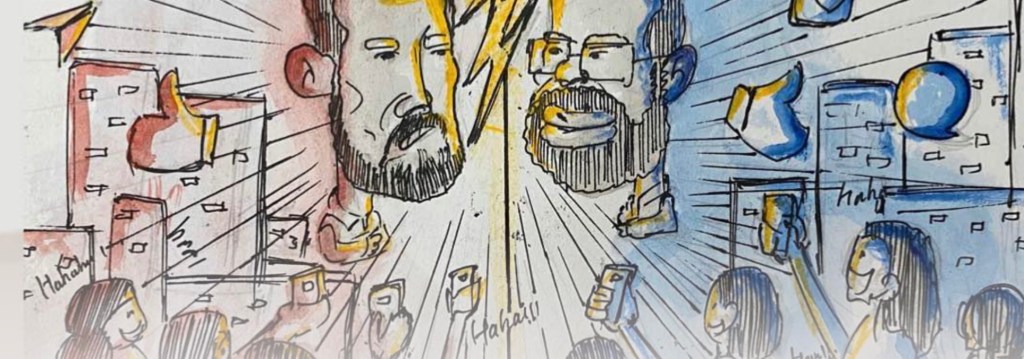
Image Source: https://armchairjournal.com/hero-meme-social-media-political-images/
 NICKELED AND DIMED