
By — Mansi Khetan
Abstract
Social media has transformed how political legitimacy is constructed and contested in contemporary world politics, extending governance beyond territorial borders. This article examines how digital platforms enable political actors to perform and affirm claims of legitimate authority before global audiences. By analysing Ukraine’s digital strategy during the Russia-Ukraine war and China’s wolf-warrior diplomacy, it demonstrates how legitimacy is increasingly negotiated through visibility, narrative control, and online political affirmation. While social media can strengthen international legitimacy by mobilising support and shaping perceptions, it also renders political authority more fragile and contested. The article argues that governance today operates within a global digital public sphere, where legitimacy must be continuously asserted rather than institutionally assumed.
Introduction
In the run-up to the New York mayoral election, political power unfolded not just in rallies or press conferences, but through viral clips and social media posts that reached audiences far beyond the city’s voters. A single video could humanise a candidate overnight, while global audiences engaged with and formed opinions on a local election without participating in it. This moment reflects a broader shift: legitimacy is no longer produced solely through electoral outcomes or institutional authority, but increasingly through digital visibility and narrative performance before transnational audiences. Political authority today is not just exercised, but continuously contested online. This article examines this transformation by analysing contemporary case studies of digital political communication, focusing on how social media reshapes the construction and contestation of legitimacy in the international sphere.
Rethinking Political Legitimacy
To understand how social media has internationalised governance, it is first necessary to reconsider the concept of political legitimacy in contemporary world politics. Traditionally, legitimacy has been understood as authority grounded in formal institutions like constitutional rule, electoral consent, legal procedures and international recognition. Classic political theory treats legitimacy as deriving from established systems of rule, whether legal, rational, traditional, or charismatic, and it assumes relatively clear boundaries between domestic governance and international politics. In International Relations, legitimacy has similarly been associated with recognition by other states, compliance with international law and acceptance within institutional frameworks such as the United Nations and multilateral regimes. These understandings positioned legitimacy as relatively stable and territorially anchored, produced through institutional validation rather than public performance.
Social media fundamentally disrupts this institutional model by relocating legitimacy into open, networked digital spaces. Authority is no longer validated solely through formal procedures but is continuously affirmed, challenged and negotiated through online visibility, engagement and narrative control. Crucially, digital visibility translates into political legitimacy through specific platform mechanisms: quantifiable metrics such as likes, shares, and trending status function as signals of mass endorsement; affective resonance generates emotional alignment with audiences, transnational reactions produce symbolic solidarity, and media amplification converts online performance into mainstream political narratives. Governments and political leaders increasingly perform legitimacy by signalling responsiveness, moral positioning, and competence in ways that are instantly observable to global audiences.
In this environment, legitimacy becomes dynamic rather than fixed, dependent not only on legality or recognition, but on sustained digital affirmation. This shift transforms political legitimacy from a status conferred by institutions into an ongoing performative process. As domestic political actions circulate internationally through platforms, governance itself becomes internationalised, subject to global scrutiny and transnational public judgement. This shift is visible in the case of Volodymyr Zelenskyy, whose informal wartime communications project authenticity and immediacy, helping construct credibility and moral authority for international audiences. At the same time, it is important to distinguish between external legitimation, efforts to secure recognition within existing global norms, and contested legitimation, which seeks to redefine the standards of authority themselves. China’s digital diplomacy, for example, is not necessarily aimed at gaining acceptance within Western liberal frameworks, but at reshaping what counts as legitimate governance by foregrounding sovereignty, development, and stability as alternative benchmarks.
Social Media as a Site of Political Affirmation
The internationalisation of legitimacy through social media is most clearly visible in moments of crisis, where political authority must be asserted, defended, and justified in real time before global audiences. The two contemporary cases, first the digital strategy adopted by Ukraine during the Russia-Ukraine war and China’s use of “wolf-warrior diplomacy”, illustrate how states deploy social media not merely as a communication tool, but as a mechanism for legitimising governance beyond borders. Following Russia’s full-scale invasion in February 2022, Ukraine rapidly transformed social media into a central arena of political legitimation. President Volodymyr Zelenskyy’s daily video addresses, often filmed informally on a smartphone, without elaborate staging, were circulated widely across platforms such as X (Twitter), Instagram, and Telegram. These messages were not only directed at Ukrainian citizens but deliberately crafted for international audiences, framing Ukraine as a sovereign, democratic state resisting aggression and defending international norms.
This strategy played a crucial legitimising role. By maintaining constant digital visibility, Ukraine reinforced its claim to lawful governance and moral authority, even as its territorial integrity was under attack. Crucially, this visibility translated into legitimacy through identifiable platform mechanisms: engagement metrics such as shares, trends, and viral circulation signalled mass endorsement; affective resonance generated emotional alignment with global audiences; transnational audience reactions created symbolic solidarity; and mainstream media amplification converted online performance into diplomatic capital. Social media enabled Ukrainian leadership to bypass traditional diplomatic bottlenecks and speak directly to foreign publics, lawmakers, and international organisations. In particular, Zelenskyy’s informal, selfie-style wartime communications functioned as a legitimising performance. His projection of authenticity, proximity, and emotional immediacy operated as political signals that substituted for traditional diplomatic formality, constructing credibility and moral authority through perceived sincerity rather than institutional ritual.
The widespread circulation of battlefield updates, civilian testimonies, and symbolic acts of leadership helped consolidate international support, translate public sympathy into material aid, and sustain Ukraine’s recognition as a legitimate political authority in the global arena. Significantly, Ukraine went beyond narrative projection and formally integrated social-media actors into governance itself. Influential Telegram channels and digital volunteers who had built credibility through real-time reporting and mobilisation were incorporated into advisory and communication roles within the defence ecosystem. This institutionalisation of online authority demonstrates how legitimacy generated on platforms can be converted into formal political power. At a broader level, Ukraine’s strategy exemplifies a form of external legitimation, seeking approval and recognition within existing international norms of sovereignty and lawful defence. By contrast, other states such as China often engage in contested legitimation, using digital diplomacy not merely to gain acceptance but to redefine what counts as legitimate authority in global discourse.
China’s Wolf-Warrior Diplomacy
China’s approach to social media legitimacy offers a contrasting model. Rather than seeking moral validation through vulnerability or transparency, Chinese officials have used platforms to assert confidence, strength and narrative control. Since the late 2010s, Chinese diplomats and state representatives have adopted a confrontational communication style on social media commonly referred to as “wolf-warrior diplomacy” to defend state policies and challenge Western criticism. Through official embassy accounts and prominent diplomats’ profiles, China has sought to legitimise its governance by projecting decisiveness and national pride. During controversies surrounding COVID-19, Hong Kong, Xinjiang, and Taiwan, Chinese actors used social media to reject external scrutiny, accuse critics of hypocrisy and frame China’s governance model as effective and sovereign. These performances were not aimed solely at domestic audiences but at reshaping international perceptions by contesting dominant narratives in real time. This can be further clarified by distinguishing between external legitimation and contested legitimation. External legitimation refers to efforts by states to seek approval and recognition within existing international normative frameworks, such as aligning with established standards of sovereignty, democracy, or lawful self-defence to secure diplomatic support. Contested legitimation, by contrast, does not primarily seek acceptance within prevailing norms but instead aims to redefine the standards themselves. In this sense, China’s digital diplomacy is not necessarily oriented toward gaining approval under liberal institutional criteria but toward reshaping what counts as legitimate authority in international discourse. Through coordinated digital messaging, narrative framing, and rapid response communication strategies, Chinese officials present China’s governance model as effective, sovereign, and development-oriented. These performances are not aimed solely at domestic audiences; rather, they seek to influence global opinion by contesting dominant Western narratives in real time. Legitimacy here is not passively requested but actively reconstructed, as China advances alternative benchmarks of stability, economic performance, and non- interference as valid foundations of political authority.
While this strategy has often generated backlash, it nevertheless underscores the changing nature of legitimacy. China’s digital diplomacy reveals that legitimacy in the international sphere is no longer dependent only on quiet recognition within institutions. Instead, it is increasingly fought over in public, performative spaces where visibility, repetition, and narrative assertion matter. Even when contested, these digital performances signal China’s refusal to allow legitimacy to be defined exclusively by Western media or international norms. Taken together, these cases reveal a deeper transformation: legitimacy is becoming pluralised and platform-dependent rather than governed by a single institutional standard. Social media has emerged as a central arena in which authority is constructed, defended, and disputed across borders. Ukraine’s digital strategy shows how social media can generate international affirmation through transparency, moral framing, and emotional resonance. China’s approach, by contrast, highlights how states may seek legitimacy through assertive narrative control and symbolic performance. Despite their differences, both cases confirm that governance today is no longer legitimised solely through formal recognition or institutional procedures; instead, legitimacy increasingly depends on sustained digital visibility, audience engagement, and the capacity to perform authority convincingly within a fragmented global public sphere.
Conclusion
This article examined how social media enables political actors to construct, affirm, and contest legitimacy before global audiences. The cases of Ukraine and China show that legitimacy is no longer grounded solely in institutional recognition, but increasingly in digital performances that circulate beyond national borders. Ukraine’s strategy demonstrates how visibility and engagement can translate into international support, while China’s wolf warrior diplomacy highlights efforts to challenge and redefine dominant standards of legitimacy. Together, these cases reveal that legitimacy is now continuously negotiated in open, contested digital spaces. While this makes political authority more immediate, it also renders it more fragile and vulnerable to misinformation. Governance today operates within a global digital public sphere where legitimacy must be constantly asserted and defended. Understanding this shift is essential to grasp how power and authority function in the twenty-first century.
About the Author:
Mansi Khetan is a third-year B.B.A. LL.B. student at Jindal Global Law School with research interests in constitutional law, international trade, and corporate litigation. She has interned with leading practitioners, published on contemporary legal issues, and writes on foreign policy and global governance.
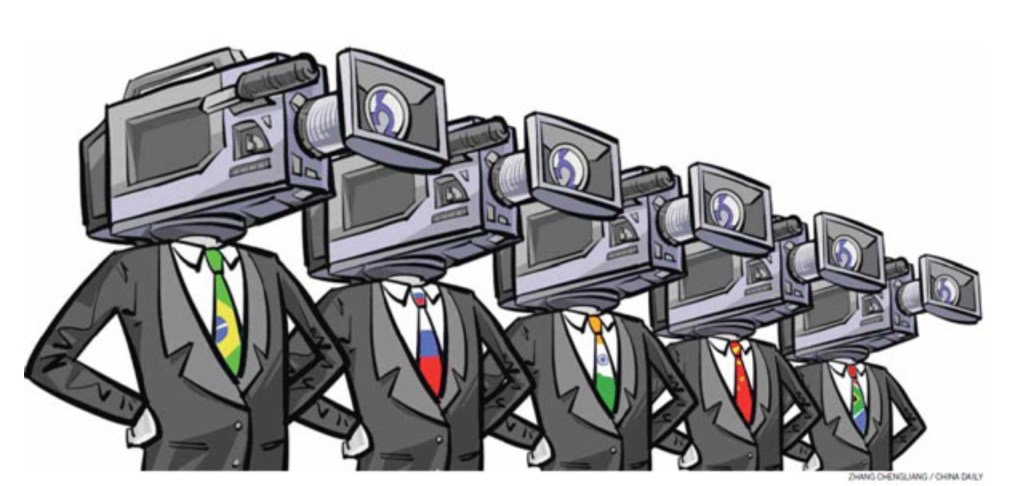
Image Source: https://www.thebalochnews.com/2017/04/29/role-media-international-relations/
 NICKELED AND DIMED