
By – Rianne Michael
Abstract
The Strait of Hormuz is one of the most critical maritime chokepoints in the global trading system that facilitates a significant share of the world’s energy and commodity flows. Following the escalation of hostilities between Iran, the United States of America, and Israel in February 2026, threats have been made by Iran’s Islamic Revolutionary Guard Corps, leading to the restriction of navigation through the Strait, which has raised concerns about global economic stability. This article examines the potential consequences of such disruption, focusing on its impact on global oil supply, fertiliser trade, and food security. It also analyses the legal question of whether Iran can close the Strait under international maritime law, particularly under the United Nations Convention on the Law of the Sea. The article argues that closure of the Strait would lead to widespread economic disruption as the Strait contributes as a major trade route for numerous continents.
Introduction
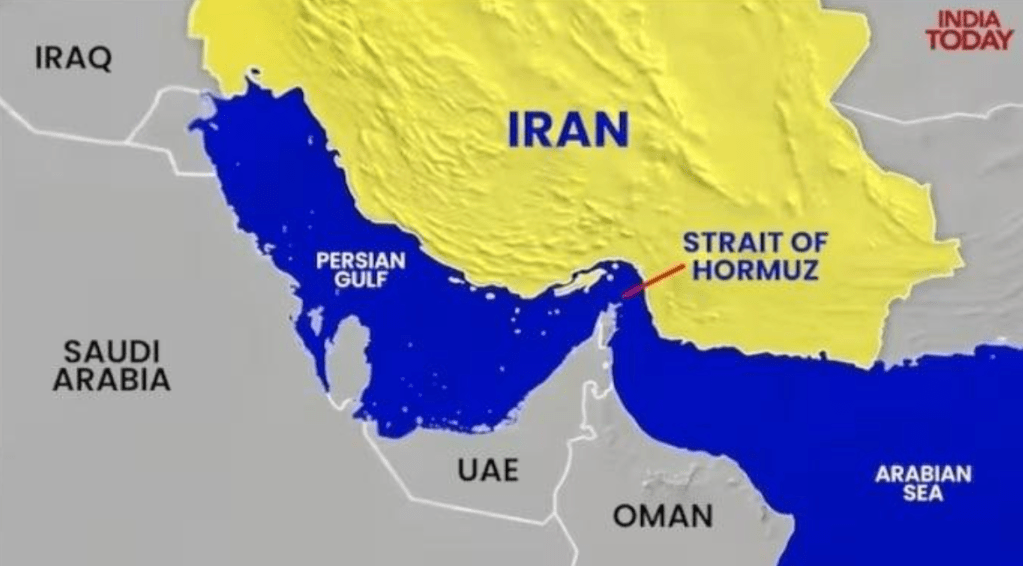
The Strait of Hormuz is a narrow channel between the Omani Musandam Peninsula and Iran. The Strait contains eight major islands, out of which seven are controlled by Iran, and it continues to maintain a military presence over the same. Every year, around 34% of the seaborne oil export and 19% of the seaborne natural gas trade pass through the strait. Beyond energy, the Strait transports a large volume of fertilisers to South and Southeast Asia, which is vital to their food security. It leads to economic disruption for the entire global trading system, as it remains a vital choke point in global trade due to its geographical location. However, on 28th February 2026, after the military strikes on Iran by the United States of America and Israel, leading to the death of Supreme Leader Ali Khamenei, Iran launched a missile strike on US military bases in the Gulf states. Consequently, the Islamic Revolutionary Guard Corps started prohibiting the entry of vessels and threatened to attack any vessels attempting passage. This has led to the Strait of Hormuz becoming a fulcrum of geopolitical risk and implications for global energy markets, agricultural supply chains and international trade.
Disruption to Global Oil Supply and Strategic Reserves
Roughly one-fifth of the globally traded crude oil and a large amount of liquefied natural gas pass through the Strait. India imports roughly 67% of its LPG and 90% of that flows from the Strait of Hormuz. Roughly 60% of South Korea’s oil flows through the Strait of Hormuz. Further, Japan relies on it for three-quarters of its imports. In this crisis, Japan faces a direct risk of disruption due to its high share of oil that is traded through this route and its continuous reliance on imported energy. While South Korea ranks second and India ranks third.
Closure of this Strait could lead to numerous structural disruptions in the economy. This inability of the oil to pass the major chokepoint can lead to multiple supply delays due to longer routes and consequently raising shipping costs. This closure has led an LPG crisis in India which is widely used in cooking. Most than 90% of restaurants depend on LPG cylinders to run their kitchen; such low demand and high costs is leading to closure of business and job losses. This disruption has forced restaurants to switch to alternative methods such as inductions stoves especially in Bhopal. Further, Hyderabad has been forced to switch to firewood and many eateries in Chennai have stopped serving their fuel-intensive food.
Therefore, we come to the critical question of whether this can be solved by taking alternative routes. While Saudi Arabia’s East-West pipeline to the Red Sea and the UAE’s pipeline to Fujairah allow partial circumvention of the Strait, the help is very limited. As the sustainable loading rates at these terminals depend on storage capacity, berthing slots and tanker availability, all of which are not completely adaptable in a condition of emergency. If regional producers attempt to reroute exports through alternative infrastructure, these systems cannot rapidly absorb the sudden value of transit. Iraq’s northern pipeline illustrates the structural constraints. These routes cannot fully substitute for the Hormuz Strait, and scaling alternative corridors would require significant time, political coordination and commercial renegotiation, limiting their ability to provide immediate relief in the event of a disruption.
If such a hindrance continues, the adjustment would extend to supplier realignment. Countries like Brazil and Guyana would end up finding new demand opportunities in trade corridors. Russia has already started redirecting flows eastward, and that has helped deepen its market share in Asia. Further, European countries might start to rely on Norway and Western African suppliers to prevent the risk of price increase. Lastly, this crisis and non-usage of the Strait could give numerous strategic advantages to those countries that would like to supply oil to Asian countries, allowing them entry into the marketplace.
Affecting the Fertilizer Supply Chain and Global Food Security
The closure of Hormuz would lead to a substantial fertilizer shock, where prices of fertilizers would go up due to a lack of supply, leading to a risk to global food security. In a country like India, where agriculture remains the backbone, the country will face serious disruptions in the supply of fertilizers in the coming kharif season. Any reduction in the supply of urea could lead to an impact on the production of a key soil nutrient, which would considerably affect food security, as Kharif crops account for more than half of India’s food grain production. Furthermore, it remains more concerning in sub-Saharan Africa, where the use of fertilizer is already low, and a further rise in price would lead to cutting yields and a lack of food grains. Changing where fertilizers are produced cannot take place overnight. Financing and building these plants takes numerous years and investment. This would directly lead to food price inflation, which historically has led to social unrest.
Questioning Iran’s right over the Strait of Hormuz
While numerous issues emerge with Iran’s restrictions on the movement in the Strait of Hormuz. One starts to question whether Iran has the legal right to close the Strait and if such a closure is practically possible. The United Nations Convention of the Law of the Sea allows countries to exercise control over territorial seas up to 12 nautical miles from their coastline. While the Strait has not been legally closed, the IRGC has sent warnings to shut down the Strait. However, straits that are used for international navigation, such as the Strait of Hormuz, are governed by a separate legal regime known as the right of transit passage. This doctrine ensures that ships and aircraft of all states are entitled to continuous and unobstructed passage through such straits, even when parts of the waterway fall within the territorial seas of coastal states. As a result, the ability of any single state to unilaterally close a strait that serves as a vital international shipping route is extremely limited under international maritime law. Under international law, the Corfu Channel Case states that countries must allow neutral vessels through international states even during armed conflicts. Therefore, Iran cannot exercise a blanket suspension of commercial navigation.
IRGC official Ebrahim Jabari stated that the Strait has been closed, and if anyone tries to pass it, the navy will set the ship ablaze. As a result, while Iran possesses the capability to disrupt traffic in the Strait of Hormuz, maintaining a complete and prolonged closure would be considerably more difficult in practice. A prolonged closure of the strait would carry enormous risk for Iran as its own oil exports move through the waterway. Further, the U.S. Navy is capable of hunting down sites and launching missiles, as one of their main aim is to wipe out Iran’s navy. Such a situation prevents Iran from achieving permanent closure of the state. However, the temporary closure of the Strait is enough to disrupt global oil markets. By threatening the world’s most important oil chokepoint, Iran already possesses a strategic lever capable of shaking the entire global economy.
Conclusion
The Strait of Hormuz continues to be one of the most important critical chokepoints in the global trade of oil and fertilizers. Any disruption to its shipping lanes would have significant consequences for global energy markets, fertilizer supply chains, and food security, particularly for import-dependent economies such as India, Japan, and South Korea. Such disruptions can already be seen in India with respect to the LPG shortage. While Iran may possess the capability to disrupt maritime traffic in the region, international maritime law and the strategic importance of the Strait make a sustained closure difficult to maintain. The crisis, therefore, highlights the broader vulnerability of global trade to instability in key maritime chokepoints.
About the Author
Rianne Michael is currently doing her BA LLB at Jindal Global Law School. Her interests lie at the intersection of caste discrimination law and criminal justice particularly how systems respond to caste-motivated violence and how procedural frameworks can either reinforce or dismantle social inequality.
 NICKELED AND DIMED