
By – Hansin Kapoor
Abstract
This article explores the radical transition from policy-based legitimacy to aesthetic resonance in contemporary global politics. As the traditional Westphalian order enters a state of polycrisis, the technical language of international law is increasingly superseded by the affective power of the “Vibe Shift.” By analyzing aesthetic movements such as “Little Dark Age” edits and “NATO-wave,” alongside the psychological appeal of lo-fi music and grainy filters, this article identifies a growing vibecession of diplomacy. In this new paradigm, political authority is no longer anchored in the logos of the UN Charter but in the pathos of the fifteen-second video loop. This shift suggests that for the digitally native public, the perceived authenticity of a leader’s aesthetic brand has become the primary metric of geopolitical truth, replacing institutional compliance with atmospheric alignment.
Introduction
For decades, geopolitical legitimacy was defined by the policy paper. Within the Liberal International Order, authority was a product of analytical logic, empirical statistics, and a rigid adherence to legal frameworks. This was the era of the logos, where a leader’s standing was measured by their proficiency in navigating the rule-based nuances of the international system. However, a fundamental rupture is occurring. A global public, exhausted by climate volatility and institutional stagnation, is participating in a sociological “vibe shift.” In this new paradigm, political authority is no longer anchored in technical policy, but in the affective resonance they project.
This is not merely a change in trend; it is a movement away from specific policy objectives toward an all-encompassing aesthetic experience. In the world of meme politics, legitimacy is no longer built on what a leader does, but on how they feel. We have entered the age of the vibecession of diplomacy, a state where the public has largely withdrawn its emotional investment from the material realities of international law. Instead, support is garnered through curated digital personae that match the frenetic, emotive energy of the digital zeitgeist. Politics is moving from the slow deliberation of reason to the immediate impact of the fifteen-second loop, where a grainy filter or a synth-heavy beat can do more to justify a military intervention than a thousand-page legal brief.
The Vibecession of Diplomacy
The term vibecession was originally coined to describe the massive disconnect between a healthy economy and the negative perception the public has of it. In the realm of statecraft, it is argued that that we are seeing a similar disconnect regarding the rule of law. The technical legality of a policy under the UN Charter has become a secondary concern for a public that evaluates global events through a gut-level feeling. If a leader’s vibe aligns with the perceived needs of the moment (whether that be strength, tradition, or disruption), their actions are granted a form of aesthetic legitimacy that bypasses traditional scrutiny.
Digital diplomacy is increasingly less about communication and more about the performance of social aesthetics. Diplomats and leaders utilise social media to project ritualised markers of authority, from staged family photos to high-definition footage of military hardware. These visual rituals serve a symbolic social ordering function, maintaining the illusion of a stable order even when the underlying structures are fracturing. When the vibe is correct, the public is willing to overlook the absence of a legal mandate. We see this in the rise of populist figures who prioritise their digital brand over institutional adherence, effectively curating a hyperreality where the simulation of leadership replaces the actual practice of governance.
The Architecture of Affect
The transition from policy to vibe is facilitated by the specific architecture of platforms like TikTok and Instagram Reels. These 15 to 60-second loops are optimized for speed and emotional impact rather than nuanced debate. In this environment, the traditional rhetorical triangle is being tilted heavily toward pathos (emotional appeal) at the expense of logos (logical reasoning). While political institutions might still attempt to use rational resources, studies of political TikTok accounts show that logical arguments frequently generate the lowest number of audience interactions.
Instead, the most successful digital actors employ a strategy of playful trauma and affective bonding. By utilizing vivid imagery and impactful adjectives, creators build an immediate connection with their audience. This is the essence of the path toward aesthetic legitimacy, when information is delivered through fast, snappy content, the pace of conversation accelerates to the point where deliberation becomes impossible. The audience does not evaluate the facts; they evaluate the feeling. This peer-to-peer communication feels more authentic than traditional media, yet it allows political truth to dissolve into a landscape where a deepfake or a stylized edit carries the same weight as a verified report.
Romanticizing Power through Grain and Grit
To understand the aesthetics of this shift, we must look at the specific movements that have captured the digital imagination: the Little Dark Age edits and the NATO-wave aesthetic. Both utilize lo-fi music and grainy filters to evoke a sense of nostalgic order or futuristic dominance. These are not just videos; they are instruments of strategic storytelling that package complex ideologies into recognizable and seductive frameworks.
The Little Dark Age edits, set to the melancholic synth-pop of MGMT, often juxtapose scenes of historical military glory with the perceived decay of modern society. This phenomenon represents a contemporary iteration of what Walter Benjamin identified as the “aestheticization of politics”, where the visual beauty of the past is used to mask the radical goals of the present. The use of heavy film grain and VHS glitch effects is a calculated choice. These imperfections signify a return to a perceived truth in a world that feels overly airbrushed and fake. Psychologically, this aesthetic of imperfection acts as an emotional regulator, helping the viewer escape the anxieties of the present by embedding themselves in a vague, idealized past. It turns political affiliation into a lifestyle choice.
NATO-wave operates with a similar logic but for the centrist, interventionist project. It reclaims the neon grids and synth-heavy aesthetics of Vaporwave to glorify modern military hardware like fighter jets and tanks. This mirrors Jean Baudrillard’s theory of Hyperreality and the “Precession of Simulacra.” Much like his argument that the Gulf War was primarily a media event, NATO-wave renders kinetic violence as a retro-futuristic simulation. By applying this filter, NATO-wave makes institutional defense feel exciting and culturally relevant to a generation that views traditional diplomacy as obsolete.
In both cases, the legitimacy of the military power being displayed is derived not from its legal justification, but from the aesthetic quality of the edit. This reflects Byung-Chul Han’s work on “non-things”, where digital media replaces stable “objects” (like international laws) with fluid “information” and vibes. The vibe of technological supremacy or ancestral heritage becomes the ultimate arbiter of whether the power is just.
Hyperreality and the Participatory Warfare of the Fellas
The most visceral case study of the vibe shift in action is the North Atlantic Fella Organization (NAFO). NAFO represents a new mode of participatory warfare that exerts what scholars call hypermemetic agency. Instead of a centralized command structure, NAFO relies on a decentralized web of anonymous users who use the Doge meme (a Shiba Inu avatar) to counter Russian state propaganda through ridicule and absurdism.
NAFO does not wait for a policy mandate from a sovereign state; it creates its own mandate through the management of the pro-Ukraine vibe. By turning internet users into a community with a shared visual language, they have gained the power to challenge state-policed narratives in real-time. This is strategic storytelling at its most potent, blending pop culture with high-stakes geopolitics to raise actual funds for the military. In the world of NAFO, the distinction between the physical battlefield and the virtual one is increasingly erased. The legitimacy of their mission is confirmed every time a fella edit goes viral, proving that in the digital age, the ability to command the narrative is the highest form of sovereignty.
Conclusion
Geopolitics has entered a post-policy era where the management of the vibe is the primary task of statecraft. The vibecessation of diplomacy marks the moment when the public pivots toward the feeling of authority as more important than the fact of it. As we move deeper into this age of hyperreality, the challenge for democratic societies will be to find a way to re-anchor politics in tangible externalities without losing the ability to speak the aesthetic language of the digital age.
The aesthetics of vibe-shifting are not a temporary trend but a fundamental reorganisation of political value. When the public no longer cares if a policy is legal as long as the vibe is correct, the normative constraints of the international order begin to dissolve. We are entering the “precession of simulacra,” where the “edit” of a conflict becomes more “real” to the public than the conflict itself. We are left in a landscape of competing simulations, where the most polished edit or the most nostalgic filter determines the course of nations. To survive this shift, we must develop a rigorous aesthetic literacy. We must learn to deconstruct why a lo-fi beat creates a sense of safety or authority to understand the actual human consequences that the vibe seeks to obscure.
About the Author
Hansin Kapoor is a final-year Criminology Student with a deep interest in geopolitics and law.
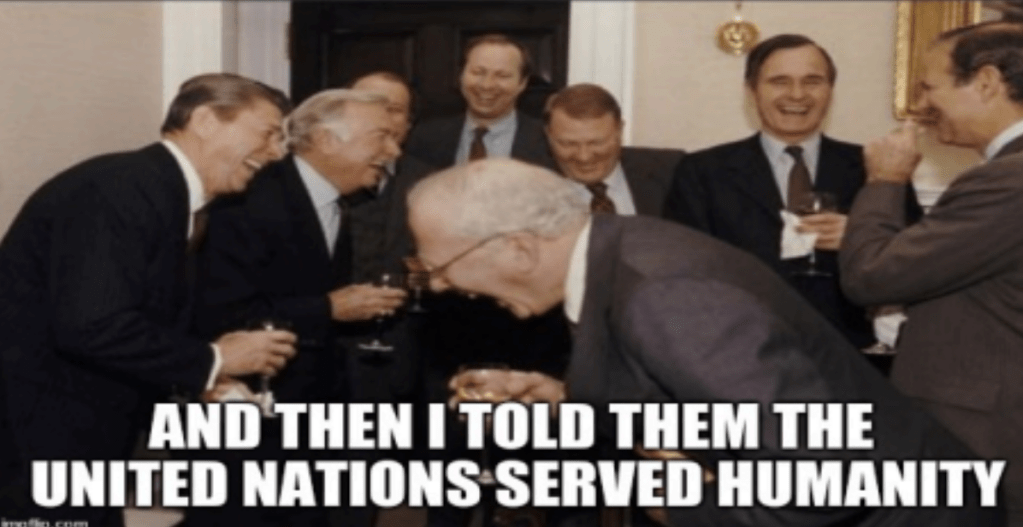
Image Source : https://imgflip.com/m/politics/tag/the%20un%20is%20useless
 NICKELED AND DIMED