
By — Hritika Mishra
Abstract
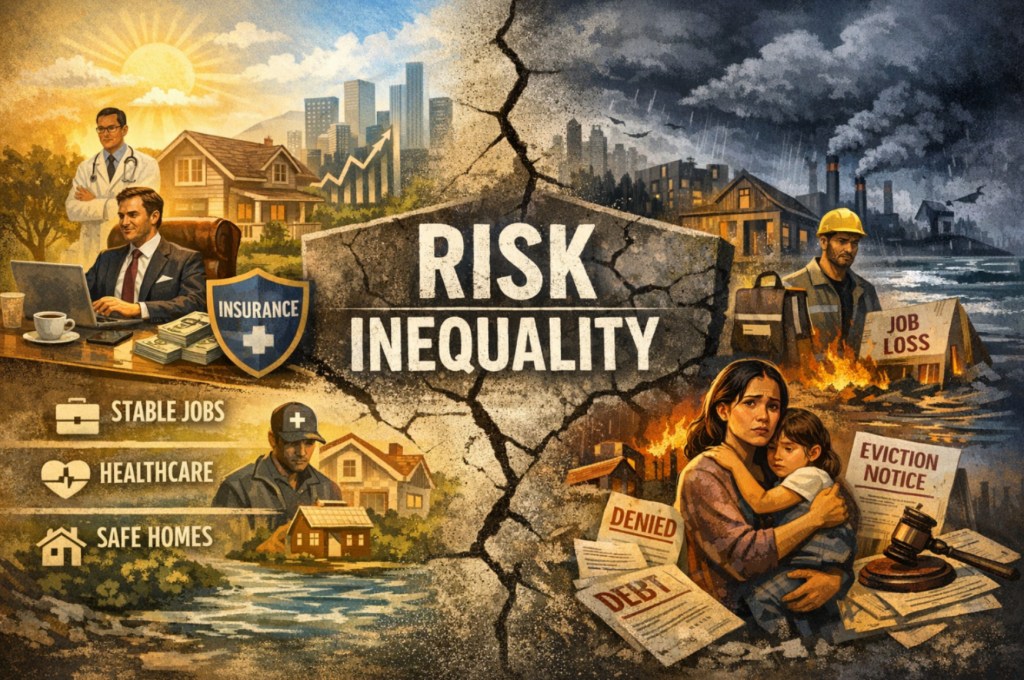
This article argues that current forms of economic disparity are also influenced by unfairly distributed risks of injustice, in addition to unequal incomes. Although economic inequality is often understood primarily in terms of differences between the rich and the poor, the fact is that a person’s exposure to risk in their everyday life, due to unstable employment, poor health, climate change, and uncertainty about the legal system, has a significant impact on their economic security over time. By looking at examples using labour markets, health care, climate change, and legal systems, this paper shows that the risks faced by individuals are created through the political and legal systems, which allow certain groups to have a higher degree of protection from these risks while other groups do not have that same level of protection. As such, tackling economic inequity must involve redistributing security and predictability, not just addressing income disparity.
Introduction
When a crisis strikes, whether a pandemic, a flood, or a sudden job loss, it does not strike evenly. For some households, shocks are absorbed through savings, insurance, and institutional support. For others, the same event becomes catastrophic and leads to debt and displacement. What separates these experiences is not merely wealth, but the presence or absence of buffers against risk.
This article argues that modern inequality is best understood not as a gap in resources, but as a gap in exposure to uncertainty. As affluent groups are increasingly able to purchase predictability through stable employment, enforceable contracts, insurance, and access to institutions, middle- and lower-class people are forced to live with constant volatility, facing unstable work, health shocks, and environmental crises with little protection. This distribution of risk is not accidental and is an essential consideration to understand modern inequality.
Risk as a socially distributed burden
Traditional accounts of inequality often focus on income and wealth. While these measures are important and relevant, they fail to capture how uncertainty and risk also shape everyday life. Even among individuals with comparable incomes, levels of risk can vary significantly depending on job stability, access to healthcare, housing security, or legal status. These conditions shape whether income results in lasting security or remains fragile. Thus, while income inequality is crucial to examine, exposure to uncertainty has emerged as a distinct and compounding dimension of inequality. It determines who can plan, recover from shocks, and invest in the future, and who remains perpetually vulnerable to disruption.
Risk is often understood as an economic phenomenon, and thus, it is treated as an unfortunate by-product of markets or individual choice. However, such a narrow view often fails to consider how risk allocation shapes modern inequality. In modern society, risk goes beyond financial loss and determines who is protected during uncertainties such as sudden illness, environmental displacement, job instability, and legal uncertainty. These risks shape all our daily lives and influence whether individuals can plan for the future or are forced to respond constantly to crises. Sociologist Ulrich Beck described modern societies as “risk societies,” in which threats are increasingly produced by social and technological systems rather than nature alone. However, the fact that risks are widespread does not mean it is universal. Some individuals are protected through insurance, stable employment, and enforceable rights; others are left exposed to volatility with minimal support.
Legal Scholar Martha Fineman’s ‘vulnerability theory’ can help explain the imbalance within risk allocation. Fineman argues that while vulnerability to risk is a universal human condition, the institutional response is deeply unequal. Institutions choose which vulnerabilities to address and which to ignore, reinforcing social hierarchies rather than mitigating them. In this sense, risk is not just an economic phenomenon but a political and legal one.
Political and Social Inequality of Risk
A great example of this unequal distribution of risk is in the labour market. The gig economy, while granting flexibility to the workers, largely benefits employers by enabling them to transfer risks onto workers. By classifying workers as independent contractors, platforms shift responsibility for injury, illness, unemployment, and retirement onto individuals, while avoiding obligations traditionally associated with employment. This is not the result of an absence of labour law, but of how existing legal categories are used and enforced. Gig workers fall outside formal employment protections not because work has become unregulated, but because it has been deliberately reorganised in ways that place uncertainty on workers while preserving stability for firms.
Similar patterns can be seen in health and environmental risks. Illness is a universal risk, but the consequences are deeply unequal. For individuals with good insurance, paid leave, and savings, health shocks are disruptive but manageable. For others, they can mean job loss, debt, or untreated conditions. During the COVID-19 pandemic, studies by the WHO (World Health Organization) depicted how socio-economic status shapes vulnerability to both illness and its economic consequences.
Similarly, the Intergovernmental Panel on Climate Change has found that climate change disproportionately affects those with the least capacity to adapt. Floods, heatwaves, and displacement are not only environmental events. They are social shocks that intersect with poverty, housing insecurity, and weak legal protection. These risks accumulate. A climate event can trigger health crises and lead to job loss, displacement, and thus, compounding vulnerability.
Law and Risk
The legal system is often viewed as a source of predictability and order. However, for many people, it functions as a sign of uncertainty. Delays, judicial discretion, and procedural complexity create risks that disproportionately burden marginalized groups. Access to welfare benefits, housing rights, or legal remedies usually depends on documentation, compliance, and administrative processes, which aren’t always easy to access. Small errors or delays can result in exclusion. Legal uncertainty becomes a form of governance, disciplining individuals through the constant threat of denial or delay.
These procedural burdens often affect those with the least institutional literacy and time drastically. As welfare systems increasingly rely on conditions, checks, and discretionary decisions, support starts to feel unpredictable. Instead of reducing risk, the legal system can end up adding another layer of anxiety, where people are constantly waiting, unsure whether help will arrive or not.
While individuals are exposed to uncertainty, the state and capital are often shielded. Financial crises offer a clear example. When markets fail, losses are frequently socialised through bailouts, while gains remain private. Wolfgang Streeck describes this as a transformation in which states act to protect markets rather than citizens. This reveals the paradox within risk allocation. Risk is treated as unacceptable when it threatens capital or state stability, but inevitable when it affects individuals. The result is an economy in which risk is normalized for some and intolerable for others.
Conclusion
Thus, the modern inequality is not just about who earns more, but also about who has predictability and support during a crisis. Risk allocation has thus become central in social stratification and shapes the health, work, and legal standing of individuals. Law and policy do not simply respond to this reality; they produce it. Thus, to seriously address the inequality in the twenty-first century, it is essential to consider who is protected through institutions and who is the most vulnerable to uncertainty.
Since modern inequality is also affected through risk allocation, addressing it requires more than the redistribution of income. It requires redistribution of predictability. Amartya Sen’s capability approach emphasizes that freedom depends on real opportunities, not formal rights alone. Without basic predictability, it is difficult for individuals to plan, aspire, and recover, and thus they are less likely to be able to reduce modern inequality. Policy responses might include universal social protection, stronger labour guarantees, predictable welfare systems, and climate adaptation strategies centred on vulnerable communities. The International Labour Organization’s Social Protection Floors framework provides one such model.
About the Author
Hritika Mishra is a second-year law student at Jindal Global Law School. Her research interests lie in law, policy, and social justice, with a particular focus on gender rights, child and youth justice, and the role of legal systems in promoting equitable outcomes.
Image Source: ChatGPT
 NICKELED AND DIMED