
By — Rianne Michael
Abstract
Social media has reconfigured how people engage with democracy. It has made communication and participation easier and instant. This paper examines how social media has transformed democracy from an institution-mediated to a digitally-networked model allowing political participation and legitimacy to be continuously produced through formal mechanisms, online interactions, visibility and debates. Social media has shifted democratic engagement to digital spaces hereby making it more inclusive and allowing citizens to express opinions, organized movements, and keep the government accountable beyond traditional institutional channels. At the same time, it has introduced various challenges through political polarization and manipulation of public opinion through digital campaigns. It draws the conclusion that contemporary democracy is now a hybrid system allowing institutional authority and digital public participation to coexist, making it essential to pay attention to both constitutional structures and digital landscapes to understand the functioning of modern democratic systems.
Introduction
Social media has become a powerful modern tool that influences public opinion, allowing people to freely express their thoughts and feelings in society. It is used by various individuals, governments and other stakeholders to promote a specific narrative. According to the Digital India Report 2025, there are currently 692 million active social media users. It has become a central space where political ideas are discussed, contested and legitimized leading it to transform how people engage in democracy.
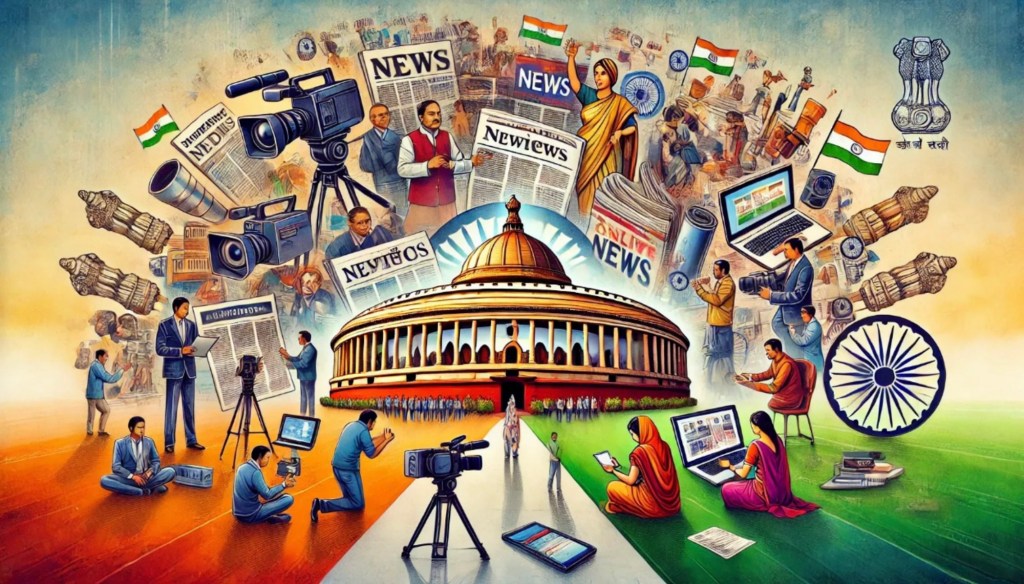
During the Black Lives Matter protests, social media played a major role in leading mass protests, discussing ideas on police reforms and creating international pressure on the government. This depicts how democracy is shaped not just by elections but also through online mobilization. Currently, most debates surrounding social media focus on whether it is a threat to democracy due to misinformation, political manipulation and polarization or is it used to strengthen democracy by giving marginalized voices a platform to be heard and increasing political participation. Both these perspectives remain important; however, they fail to catch the deeper transformation into democracy. Social media is not merely strengthening or ruining democracy, instead it is reconfiguring it. This paper argues that social media is transforming democracy by moving it from an institution-centered model to a platform-mediated model. In this new form of democracy, participation and legitimacy are not just produced through mechanisms such as elections and parliaments but also through digital interaction and mobilization. Democracy has become more immediate, emotional, continuous and fast-moving because of social media.
From Institutionally Mediated Democracy to Platform-Mediated Democracy
The classical notion is that the democracy of a country flows from three major institutions, namely the executive, legislature and the judiciary that directly enable democracy. They helped in the functioning of democracy by creating channels of participation such as the Election Commission and electoral systems, that dictate how elections are conducted and results are communicated. These bodies enable discharge of the democratic process through disbursement of funds, election process and recruitment through various bodies of the countries. Most importantly, they help in safeguarding the rights of the citizens. Democracy, public debate and media pluralism was mainly supported by newspapers that allowed public participation. The coming of social media increased democratic participation and shifted it from institutional spaces and print media to digital ones. Political influence no longer flows vertically through channels controlled by those in power but horizontally through digital networks that citizens has complete autonomy over. Social media has led to political communication becoming rapid through informal channels and has removed it from the control of institutions. It has started becoming less dependent on institutional mediation and more dependent on connectivity and visibility, relocating it to decentralized spaces to which many had access. This form of democracy, however, does not give complete autonomy as visibility and processing of information continues to depend on algorithms that are run by huge corporates. Each one has its own specific political agenda that is furthered through manipulation of information. One clear example indicating the shift that social media has brought to democracy is online protest mobilization. Earlier, protests used to be organized by unions, political parties and elite groups. Today, movements can begin online through a trending hashtag, a viral post that can bring thousands of people together without a formal organization. The Arab Spring protests and climate protests show us how social media has enabled ordinary citizens to be a part of a movement without any need of an institutional framework.
The Accessibility of Democratic Participation
Social media connects people worldwide irrespective of location and boundaries. It helps exchange of information and ideas from all over the world promoting international cooperation and solidarity. It enables political leaders and citizens to interact and participate in various debates, expressing their concerns and organizing movements at the grassroot level. It also allows elected representatives to remain more accountable to actions and decisions due to public scrutiny and feedback giving citizens a huge role in the political sphere. This makes political engagement less dependent on physical presence or institutions. Individuals that were once excluded from politics due to lack of status or other barriers can now participate in political debate and mobilization with minimal cost.
Current election campaigns focus heavily on digital advertising and online presence; The 2020 United States presidential elections saw unprecedented spending on social media platforms to gather support for the party and to change voters’ opinion. In India, political parties rely on WhatsApp and Instagram to reach young and first-time voters. This shows us that democratic participation has moved to online environments. This digital shift creates more political inclusion, and democracy is easy to access by all citizens giving them a level playing field. One does not have to run to courts and wait for the process to be carried out to hold the government accountable for its actions. News can spread quickly through media creating pressure on the government to amend its ways which was seen in the Supreme Court’s verdict on stary dogs. At the same time, social media makes it competitive, and political relevance is only decided based on engagement metrics.
Democratic Participation becoming Continuous Process
Traditionally, democratic participation peaked during elections, parliamentary debates and declined afterwards. However, social media has transformed democracy into a continuous process as digital platforms ensure that political engagement of the citizens in constant. Citizens can now discuss issues, critique, and monitor political authority on a daily basis. Pierre Rosanvallon coined the term “counter-democracy” that explains that democracy is not just present in institutions and is not just defined by voting but is identified in the role of citizens. This illustrates that democracy is not only about choosing governments but also about constantly enabling and scrutinizing their decisions. Social media has made public opinion visible and now government and political leaders must maintain legitimacy through digital engagement. This continuous process of democratic participation enhances the accountability of those in power. During the COVID-19 pandemic, governments had heightened responsibility and had to justify lockdowns and various strategies not just in Parliament but also on social media where misinformation travelled rapidly.
Media manipulation and Disinformation
Though social media enables democracy, at the same time there are many risks that accompany the use of social media. Misinformation and propaganda spread rapidly affecting public opinion. It leads to political polarization focusing on content that is biased and caters to the views of the individuals. This hinders constructive dialogue. It also inhibits growth of democracy by manipulation of public opinion influencing their outcome through targeted advertising and more. Further, it continues to undermine the integrity of the democratic process by misusing people’s information for political purposes by having micro-targeting ads. Use of social media is a two-edged sword; it works for and against democracy at the same time depending on its usage. Social media involves spreading of false and misleading information which leaves a negative effect on public consumption. The current media ecosystem manipulates news, propagates agendas, and ideas through posts. Often, far right groups develop certain techniques of “attention hacking” to increase visibility of their ideas and influence bias views.
One such example is during the Russia-Ukraine War, Russian and Belarussian disinformation spread rapidly to undermine the confidence of the Ukrainian government through fake accounts and inauthentic personas across a range of social media services such as Facebook, Instagram and Twitter. They used AI- generated pictures to appear more believable in order to form dissent in Ukraine and to gain supports internationally for Russia. This leads to a rupture in democratic participation on the internet as it stops being truly democratic in nature.
Conclusion
Social media has not simply weakened or strengthened democracy. It has reconfigured the way democracy functions. It has enabled democracy to move online, become easily accessible, structured and continuous. Contemporary democracy is neither purely institutional nor purely digital. It has become a hybrid system in which the power of citizens flows through elections and digital platforms, law and public opinion. To understand the current system of governance and the political sphere in a country, we need to analyze not just the institutions of governance but how the digital infrastructure functions and mediates political life in the nation.
About the Author
Rianne Michael is currently doing her BA LLB at Jindal Global Law School. Her interests lie at the intersection of caste discrimination law and criminal justice particularly how systems respond to caste-motivated violence and how procedural frameworks can either reinforce or dismantle social inequality.
Image source: https://legal-wires.com/lex-o-pedia/untitled-29/
 NICKELED AND DIMED