By – Delisha Clara Rao Essampally
Abstract
The war between Russia and Ukraine is often framed through the Eurocentric history of International Relations as a classical great-power rivalry between NATO and Russia. This framing diminishes Ukraine to the status of a geopolitical buffer state and distorts the more profound post-imperial relations that shape the war. This article argues that the war ought to be seen as a decolonisation battle against Russian coloniality, and not as a proxy war between opposing blocs. Based on the decolonial theory, especially, the idea of coloniality of power, coloniality of knowledge, and coloniality of being, the article aims to show how Russia has utilised the discourses to justify the imperial expansion and at the same time, deny the political agency of Ukraine. At the same time, the struggle of Ukraine demonstrates the way decolonisation of the mind reorganises conceptualisation of power, sovereignty and security in modern international politics. The war thus reveals the shortcomings of Eurocentric IR and the urgency of the need to have a post-Western analytical approach.
Introduction
The field of international relations developed under the shadow of the European empire. Its foundational concepts of power, sovereignty, security, and order were developed primarily to explain relations among imperial states rather than between empires and their colonies. Because of this, IR theory has traditionally marginalised the political subjectivity of civilisations positioned as peripheral or subordinate while elevating the viewpoints of big powers. This epistemological legacy still influences interpretations today, especially when it comes to the conflict between Russia and Ukraine, where Ukraine is often portrayed as a buffer zone between Russia and NATO rather than as an independent political actor.
These framings replicate what decolonial researchers refer to as the coloniality of knowledge: the presumption that non-Western or post-imperial experiences are secondary or derivative, whereas Western categories of explanation are universal and neutral. Therefore, decolonizing knowledge entails more than just incorporating fresh perspectives; it also entails challenging Western-centric ideologies that claim to be objective and universal and displacing the West as the standard theoretical framework for international politics. When this epistemic shift is extended to Eastern Europe, the conflict in Ukraine is seen as a struggle for political survival within a post-imperial order that has long normalised Russian dominance rather than just a security issue.
Coloniality and Decolonial International Relations
Decolonial thought starts with the realization that formal colonial governments are not the end of empire. Long-standing power systems that influence governmental authority, economic reliance, cultural hierarchy, and the creation of valid knowledge allow colonialism to endure. According to Maldonado-Torres, coloniality is a state in which, even in officially sovereign governments, dominance endures through control over being, meaning, and legality. Thus, coloniality functions concurrently at the existential, epistemological, and material levels.
International Relations has traditionally distinguished, often implicitly, between states that are viewed as full political subjects and those that are treated as strategic zones. Strong states are seen as having legitimate agency, and their judgments, concerns, and interests are viewed seriously as factors influencing world affairs. On the other hand, weaker or post-imperial powers are often reduced to areas whose futures are negotiated by others. Ukraine has frequently been placed in this latter category in Western strategic discourse. The more fundamental premise that Ukraine’s political choices are legitimately subject to foreign negotiation is rarely questioned by realist and liberal approaches, which instead focus on whether NATO expansion provoked Russia or whether deterrence failed, thereby reproducing an imperial logic that treats Ukrainian sovereignty as conditional and subordinate to great-power stability.
Eurocentric IR and the Normalization of Spheres of Influence
Mainstream International Relations theory has traditionally treated spheres of influence as a normal and even stabilising feature of international politics. This way of thinking assumes that powerful states have a legitimate right to shape the political direction of the countries around them, an idea that originates in nineteenth-century European imperial practices and was later reinforced during the Cold War[AK1] . Within this framework, the sovereignty of smaller or weaker states is not fully equal but implicitly conditional. In the case of Ukraine, its independence is recognised only to the extent that its political choices do not conflict with Russia’s perceived strategic interests. When Ukraine moves beyond those limits, for example, by seeking closer ties with Europe or NATO, it is treated not as a sovereign actor exercising its rights, but as a problem to be managed within a larger geopolitical order.
Instead of using decolonial IR as an impartial analytical instrument, it reveals this logic as an extension of imperial thought. The stability achieved by enforced hierarchy is not peace but managed dominance. By acknowledging Eastern Europe as a territory of legitimate Russian influence, Eurocentric IR upholds colonial hierarchies under the pretence of pragmatic realism. Knowledge of colonialism is evident in this assumption’s unwillingness to be challenged.
Russia’s De-Westernisation and the Appropriation of Decolonial Language
Russia has been framing its operations as part of a worldwide anti-colonial struggle against Western hegemony ever since the full-scale invasion of Ukraine. According to Putin, Russia has historically spearheaded the struggle against imperialism and currently stands in for the Global South against a unipolar Western order. A growing post-Western world is demonstrated by organizations like the Shanghai Cooperation Organization and BRICS.
However, this rhetoric reflects de-Westernisation rather than decolonisation: as Eve Tuck and K. Wayne Yang warn, decolonial language can function as a ‘move to innocence’ that disavows one’s own imperial power while redirecting blame outward. In Russia’s case, anti-Western discourse masks the continuity of its own colonial domination, allowing the Kremlin to pose as a victim of the empire even as it wages a colonial war against Ukraine.
Russia has always operated as a colonizing empire rather than a historically colonized state. Ukraine and other peripheral areas have been under direct and indirect imperial administration since the Tsarist era, the Soviet era, and the present. This dominance was frequently concealed throughout the Soviet era by universalist rhetoric that presented Russian authority as progressive and liberated. In actuality, it maintained profound power, cultural, and identity hierarchies. This pattern is maintained by the current invasion of Ukraine, which justifies the reassertion of imperial authority by claims of cultural superiority, historical unity, and forced political integration.
Ukraine as a Decolonial Political Subject
Ukraine’s opposition is both military and intellectual. Alongside armed resistance, it directly contests Russia’s claims to control Ukrainian politics, history, and language through deliberate acts of epistemic and symbolic defiance. The war is increasingly framed in Ukrainian political discourse as a process of decolonisation from a Russian empire that has long sought to erase, marginalize, and assimilate Ukrainian identity. This is visible, for example, in Ukraine’s systematic rejection of Russian historical narratives in international forums, where it invokes international law and collective memory to challenge portrayals of Ukraine as a synthetic or artificial nation and to assert its status as a sovereign political community. People’s struggles, rather than those of states alone, form the foundation of decolonial praxis. This is reflected in Ukraine’s mobilization of legal arguments, historical memory, and transnational solidarity not merely as diplomatic instruments but as tools of intellectual resistance that expose and delegitimize imperial narratives. At the same time, Russia’s Indigenous and marginalized peoples have linked their own struggles to Ukraine’s resistance, revealing how the war also destabilized Russia’s internal colonial order. In this way, international politics have already been reshaped by a Ukrainian agency. Ukraine has made visible the persistence of empire in supposedly post-imperial Europe and forced a rethinking of post-Soviet hierarchies by turning the battlefield into a site of both military and epistemic contestation.
The Limits of Eurocentric IR
Liberal institutionalism depicts the war as a failure of international institutions and diplomacy, whereas realist thought views it largely as a struggle for dominance between NATO and Russia. Both strategies marginalize colonialism. They believe that to maintain peace and stability, great-power interests must be accommodated, even at the price of the sovereignty of weaker governments.
This idea is rejected by decolonial IR. Eurocentric IR perpetuates the very hierarchies it purports to analyze by continuing to present Ukraine as a buffer rather than a subject. As Ukraine struggles for its political survival, it permits powerful nations to discuss Ukraine’s destiny[AK2] .
Conclusion
Decolonizing international relations is a political imperative rather than an optional academic exercise, as the conflict between Russia and Ukraine illustrates. Russia’s use of decolonial terminology demonstrates how imperial atrocities can be concealed by anti-Western rhetoric. In contrast, Ukraine’s resistance demonstrates what true decolonial agency means: the refusal to be erased, governed, or spoken for.
By undermining the notion that only powerful nations create history, decolonizing IR reclaims agency. By doing this, it forces international politics to address not only who holds power but also who is acknowledged as a valid political subject within the international system.
About the author
Delisha Clara Rao Essampally is a second-year undergraduate student of Diplomacy and Foreign Policy at the Jindal School of International Affairs. Her academic interests focus on environmental governance, geopolitics, peace and conflict studies, and the analysis of public policy and institutional frameworks that shape global action. She has a strong inclination towards interdisciplinary research, particularly at the intersection of sustainability, security, and international cooperation. In addition to her academic pursuits, she actively engages in research writing and policy analysis.
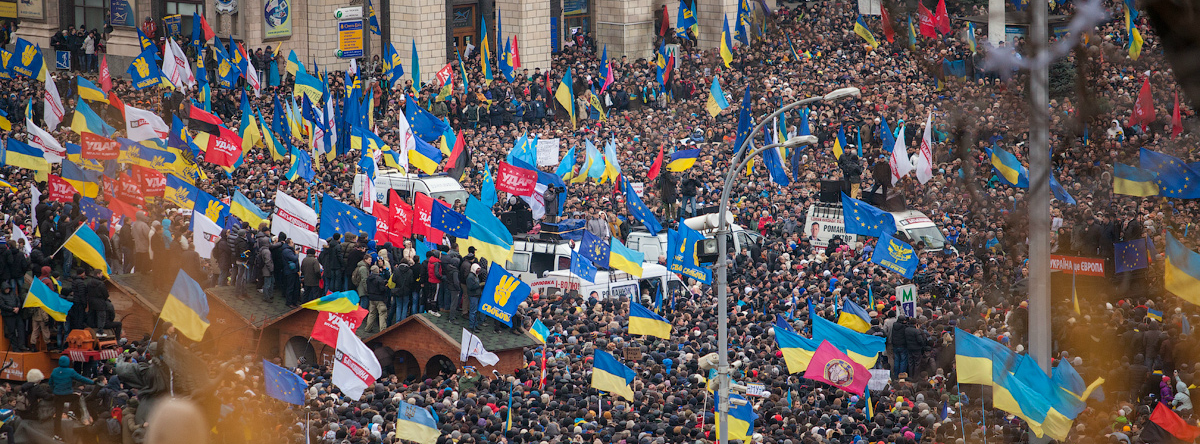
Image source: Euromaidan_Kyiv_1-12-13_by_Gnatoush_005.png
 NICKELED AND DIMED