
By – Poorvanshi Tyagi
Abstract
Cinema’s interplay with realities of sexual desire and physical intimacy often overlap with cultural notions and societal perceptions of sexuality. The role of cinema in portraying desire and sexual attitudes remains contested in India due to public perception and discourse on the same. This article explores the portrayal of sexed bodies and desire – its historical evolution and conceptualisation in Bollywood.
Introduction
Cinema is an important tool for regulating, shaping, containing, as well as transforming public perception and contributes significantly to building new notions of normalcy while challenging old norms. Cinema attempts to represent reality in conscious or unconscious ways. It, therefore, actively participates in hegemonic discourse – in part by becoming an instrument of the state which provides legitimacy to state sponsored norms and moralities.
Cinema’s evolution plays out in tandem with the evolution of society. Transformation of censorship rules and ethics in filmmaking are dependent, if not decided by societal acceptance and political power. In this context, the portrayal of sexuality and sexual desire in Bollywood has been shaped by change in public perception, acceptance, and socio-political as well as national circumstances. Conceptualisation of sexual desire in Bollywood is marked by inter-related complexities which diversify what desire and sexual identities mean to people and how might these attitudes be challenged and/or contained through visual media.
Sexual Attitudes : An interplay of religion, tradition, and politics
The existing sexual attitudes in India have helped shape its representation in Bollywood. Studies suggest that Vedic era saw sex as a central and natural component of the Indian psyche and life. Works such as Panchtantra (200-300 BC) and Kamasutra (2nd- 4th Century CE) emphasise three pillars of Hinduism – “Dharma,” “Artha” and “Kama” representing religious duty, worldly welfare and sensual aspects of life respectively. Post-vedic period however, was marked by a decreased importance and confinement of women to the household as focus shifted solely towards men as the head of the household, giving importance to sexual gratification of men. By the time coloniality entered India, Indians were subjected to the British guardians of morality. Colonial influence not only termed India’s sexually liberal values as ‘barbaric’ but also prompted to shape a more stigmatized and puritanical view of sex and desire within the subcontinent.
In Woman, Body, Desire in Post-colonial India, Jyoti Puri argues how perception of sexual desire and sexed bodies in India are controlled and regulated by the state, asserting that sex education literature in post-colonial India is built on a definable Indian cultural identity, in turn reinforcing notions of a unique Indianness, sustained through opposition against the modernist constructs of the West. Sexuality, desire, and sexual identities thus become a part of a larger project of nation-building by adhering to national and cultural notions of what it means to be Indian. She discusses how sexuality is key for the very formation of state governance as states consistently use anti-sodomy laws as a way to police sexual and social minorities. Nation-building also centered itself around the city – a symbol of modernity, one that confronts traditional values. Such progress has been equated to moral degeneration of a nation in India, wherein Western notions of modernity and progress are analogous with increasing female promiscuity and sexual transgression. Thus, with the coming of globality and modernity, female sexual transgression is both a centre of empowerment and containment through state regulation.
Representations in Bollywood
Representation of sexual imagery in Bollywood continues to change with shifting boundaries of sexual attitudes and, especially, conceptions of femininity and masculinity.
In the pre-liberalised era of 1950-70s, Bollywood films portrayed women as idealised sexual objects, existing primarily for the male gaze. The main focus of sexual attitudes and behaviour in Bollywood has largely been centered around male pleasure, often portraying sexuality as an instrument of control over female bodies.As depiction of female desires and exploration of female fantasies became more mainstream, scholars like Kaur have argued that early 1970s-2000s era featured transformative conceptions of eroticism with songs like Baahon Mein Chale Aa and Zara Zara wherein female voices suggested a subtle openness to sexual comfort. The era of Liberalisation brought changes to the way femininity, eroticism and desire was pictured in Bollywood films. Due to globalisation, Bollywood underwent an evolution to cater to the changing tastes of a cosmopolitan audience. The ‘new woman’ archetype marked by ambition, independence, and assertiveness took over Bollywood films. Scholars like Nijhawan argue that this evolution also marked a departure from the early notions of suppressing desire.
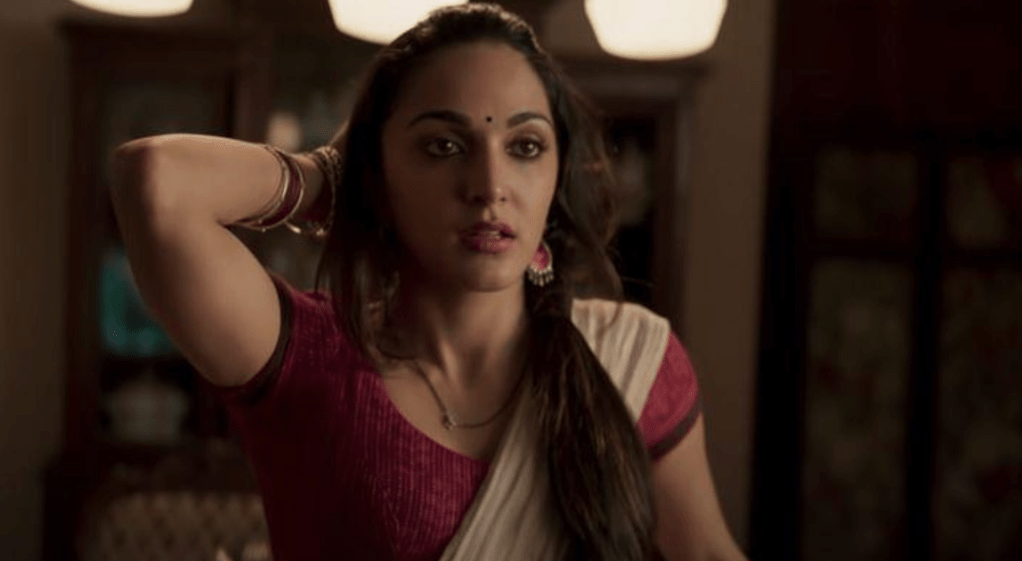
Interestingly, the portrayal of female sexual desire did not necessarily go through a positive change as films like Aitraaz and Murder continued to scrutinise sexuality as an instrument of manipulation and control, whilst also antagonising female promiscuity. This shows a contradiction within post-liberalisation cinema. This conception however has not been so uniform in non-mainstream films which make an effort to challenge traditional notions of desire and redefine the unwritten complexities of sexual desire. Alankita Srivastava’s Lipstick Under My Burkha presents a story of four distinct female characters with their different struggles to overcome subaltern conditions and achieve emancipation from male discourse. The film deals extensively with the societal challenges that come with accepting one’s sexual identity and desire as a woman. It attempts to tackle the mainstream Bollywood perception of sexual vigour as a key definer of hyper masculinity and puts female sexual desire to the forefront. Similarly, the popular two part Netflix series Lust Stories attempts to deal with desire in ways that rethink the importance of female pleasure at a societal level. Yet, these projects face the scrutiny of male gaze perspectives, given the film industry’s history of objectification of the female body. The prevalence of male gaze in Bollywood highlights societal sexual behaviours and the perception of female sexed bodies
Conclusion
Cinematic representation and conceptualisation of sexual desire in Bollywood shifts and shapes itself through religious, traditional, cultural, as well as socio-political landscapes of the nation. Over time, Bollywood has been subjected to a transformative evolution of sexuality such that it is met with a diversification of ideas on sex, female desire, and eroticism as a whole. The coming of OTT platforms have further embraced this change as watching films gets redefined as a private act, giving more leeway to filmmakers when it comes to portrayal of profanity as well as sexual desire. The further departure of censorship certificates creates space for creative freedom which otherwise would be undermined due to adherence to social acceptance and politics of the state.
About The Author
Poorvanshi Tyagi is a second year student at Jindal School Of International Affairs, O.P. Jindal Global University, Sonipat. She is currently pursuing a Bachelor’s in Global Affairs and a diploma in Literature. She is a published poet and an avid reader. She is open to research opportunities in the field of education, sociology and cultural anthropology. Besides, she enjoys dancing and music.
Image Source : https://in.pinterest.com/pin/532691462188767412/
 NICKELED AND DIMED