
By — Nandini Pandey
Abstract
The Meiji Empire restored to Japan in the 19th century had ideas that envisioned their nation as the colonial power of Asia, cultivating feelings of nationalism and Japanese superiority over external forces. A product of this sentiment of loyalty of the population towards their nation was Tsuda Sanzo. Devoted to his nation, he took it upon himself to help the nation realise her errors by attacking the Tsarvitch of Russia during his visit to the city of Otsu, commonly known as the “Otsu incident”. The result could only be for him to find his beloved nation turned against him. The following essay seeks to look into Japan during this Meiji period, through the character of Sanzo, to explore how the same feelings of patriotism it cultivated, both birthed, and killed a man. The essay argues that Sanzo and his actions were a direct by-product of what the nation designed, and such a fact was ignored when the act had been done.
Introduction
The essay discusses how the features of the restored Meiji Empire both birthed and killed a man. The Meiji Empire, when restored, was committed to modernising and expanding Japan, and it sought to do so by adopting certain principles. One exceedingly important objective of Japan was the determination that she shall not be colonised. For such prevention to be ensured, it was understood that the solution could be to become the coloniser. Thus, with the closing of the 19th century Japan set out on her journey to become the colonising power of the East, and thwart attempts at domination by the West through cultivating principles of nationhood and Japanese superiority.
The Construction of a Patriot
Japan required from her people a strong unity and devotion to satisfy this construction of a new empire. Such an advent was largely associated with processes of increasing imperialism and militarism. This militarism not only included the expansion and modernisation of the army, but also included the establishment of factories dedicated solely to providing for the new Japanese military. Such an advent allowed the military to benefit from modernising Japan, and in turn help modernisation through development strategies adopted by the armies. However, such a feeling of nationhood, when accompanied with building cordial relations with the Western powers, seemed to show the contradictions between the empire’s internal persuasions and its external pursuits. Groups who were committed to their nation detested the interference of Western powers; xenophobic mindsets were often common. Thus, the devoted Japanese remained wary of incoming Western relations.
Tsuda Sanzo was a product of such conflict of understanding within a nation. Sanzo was a person who had lived much of his life under the Meiji rule. He had served the army for a decade, and towards the end of his days was serving as a policeman. He was a nationalist as constructed by the empire and thus served the empire.
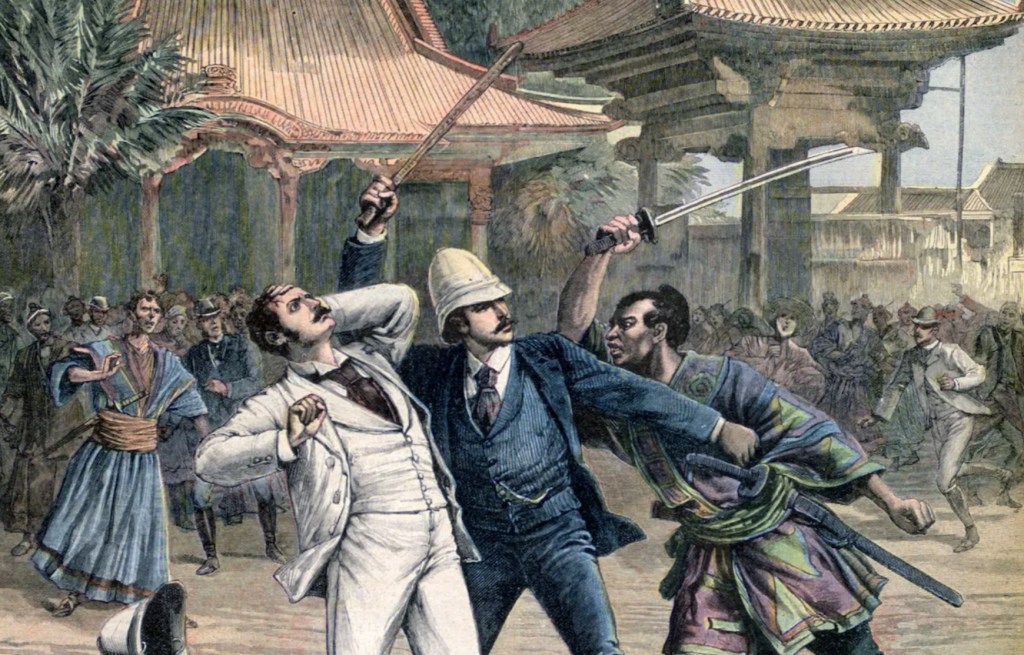
It was during this time, in 1891, that the Tsarevich of Russia, Nicholas II embarked on a ten-month visit to Japan. The reasons behind it only ex facie seemed to be the deepening of cordial relations between the two empires. However, political motivation behind the visit remained unconveyed. Sanzo was suspicious of the reasons adopted by the Russian empire, sure that there were motivations to colonise Japan, and decided to take matters into his own hands and struck the Tsarevich with his sword, causing two wounds to his head.
His efforts, however, were in vain and the Tsarvitch did not suffer a fatal injury. However, Sanzo’s action was seen as that of betrayal, and his character was deemed untrustworthy.
A Destruction Thereof
Questions throughout the nation at the time of Sanzo’s attempted assassination arose asking why a patriot had betrayed his people? How could his years of loyalty have culminated into such an act? The answer was simply that Sanzo had not abandoned his patriotism through this action, but had merely displayed it.
The action of Tsuda was a result of the connection between militarism and nationalism which had been created amongst various groups in Meiji Japan by the structure of the empire itself. Japanese expansion had seen a great generation of feelings of nationhood and pride, through the object of militarism. Furthermore, the histories of the colonisation of his neighbouring Asian countries, and the attempts by the West on his own, had taught him to dislike the Westernisation of his country, and view the sudden realisation of cordial relations with the West with caution. In such a reality, Sanzo’s mistake for Japan lay not in attempting the assassination, which was common amongst the patriots, but doing so against a Western power. Such an act, for the Japanese, had jeopardised the position they sought to make at a global level, thus acting as a betrayal towards the Japanese empire.
Tsuda Sanzo had intended his actions to awaken his nation. He wished to convey the faults in relying on the West, their secret intentions of taking over the sacred Japanese lands. His statements indicated that he found the Tsarvitch lacking in respect for his emperor, a notion constructed by years of disinclination towards the patronising West. Thus, in his view his act aligned with the Japanese idea of patriotism, where self sacrifice was used to make known one’s devotion.
However such intentions and understandings were ignored, and the general take away from the incident was only that Nicholas II, who was already disapproving of the Japanese, was furthered in his feelings by the attacks. Such thoughts took ground and settled, and Sanzo’s apparent display of loyalty and respect for the emperor was ambushed by the nation at large. The matter of importance here was clearly thus, the loss of trust of a Western power. The Otsu incident proved to be a source of embarrassment for much of the empire and the King’s counsel proceeded with charging Sanzo for a crime fit for capital punishment.
Although the judiciary exercised its discretion and only granted life imprisonment, Sanzo passed away within a few months of his verdict, with the knowledge that to the entity he had shown loyalty for had turned against him with the utmost tide. The nation had simply rejected what it had built for the simple reason of inconvenience.
Conclusion
Sanzo’s action was, for years to come, seen as a betrayal and a reversal of his patriotism, and was disassociated with by the Japanese, who took to calling him a samurai, or attributed to him a “history of mental illness”. However, the Japanese empire refused to accept that the act of deviating from patriotism was simply the patriot act it had created over the years.
Sanzo’s act had further given the West an excuse for instilling its biased view of the East, and its interpretation of the incident went lengths to prove their continuance in viewing Japan as a subject of colonisation.
Thus, though Sanzo’s action drew attention to the Western influence he wished to point at, it was an inconvenience for the current objectives of the empire. The patriotism and militarism that he had been taught to embrace by his empire was used to banish him by his very teacher.
About the Author
Nandini Pandey is a second year student at O.P. Jindal Global University pursuing a bachelors in Law.
 NICKELED AND DIMED