
By – Aashrith Rajesh
Abstract
India’s shift to the E20 blend aims to cut pollution and reduce crude oil imports but faces major economic and practical challenges. Ethanol while being renewable, corrodes fuel systems since the older vehicles are not equipped for this higher ethanol content. On the supply side, diversion of sugarcane for the increased production of Ethanol risks economic imbalance through inflation and food shortage affecting low-income individuals. A gradual increase in ethanol blending alongside stronger public transport systems could achieve the environmental goal without directly effecting the commoner.
Introduction
The fuel you used to fill your tank a while ago, is not the same as the one you use today. India has started blending ethanol into regular fuel. This is a big step aiming to curb pollution and cut down import of crude oil.
Biomass refers to organic material used as a source of renewable energy, and ethanol is one of them. Ethanol is mixed with fuel to reduce pollution. Ethanol is a clear colourless liquid, otherwise known as ethyl alcohol, grain alcohol, or EtOH. There are two major ways of producing this, either using corn or using sugarcane; in either case, the chemical properties remain unaffected.
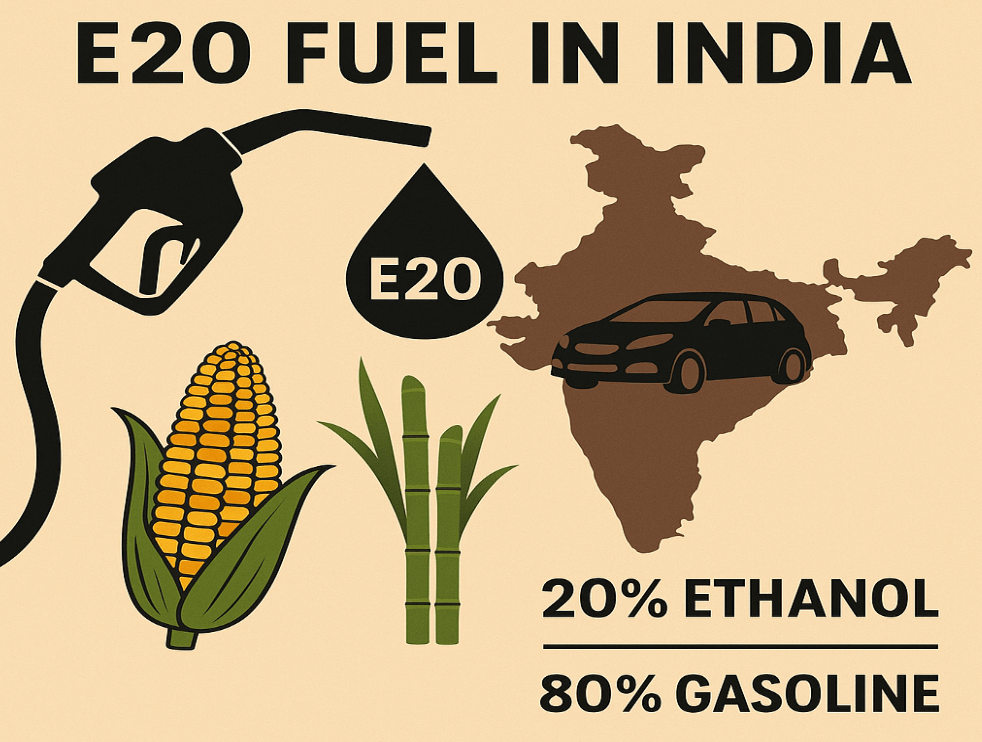
Around the world, different countries mix their fuel with ethanol in different ratios to reduce pollution. For example, the gasoline in the United States is a blend of 10% ethanol and 90% gasoline. Ethanol has a higher-octane number than gasoline; minimum octane number requirements for gasoline prevents engine knocking and ensures driveability. Hence, lower octane gasoline is blended with 10% ethanol to reach the standard eighty-seven octane fuel. India has recently adopted a 20-80 blend of ethanol with fuel. The use of ethanol in the eyes of the policy makers aims to hit two birds with one stone. Firstly, it reduces import dependence of crude oil as India imports around 87%-90% of its crude oil, thereby saving precious foreign exchange. Secondly, the reduced environmental impact of less fossil fuels used in combustion engines.
While this seems straightforward, the implementation of such a policy in India raises important practical and economic problems that require dialogue.
The Automobile Problem
On the face of it, a major problem that arises in India is the compatibility of the fuel with the automobile. A report by Centre for Science and Environment suggests that by 2025, India will have over two crore old vehicles. India sees a varying pattern of old vehicles between the urban and rural centres. Urban centres like Delhi have over 41% of vehicles that are older than 15 years, making the percentage of old cars even larger. Industry experts have raised concerns regarding the compatibility of older vehicles with the E20 blend. Given that a substantial portion of the Indian automobiles have been manufactured prior to 2023, the question of compatibility comes into play. Mahindra and Mahindra clarified that while E20 ethanol-blended fuel is safe for newer cars, the older vehicles are not calibrated for the same, thus reducing efficiency and performance. They suggest that models like the Scorpio and Bolero are affected by this blend. This is because ethanol is more corrosive than gasoline because of its higher oxygen content. Vehicles manufactured before 2023 were not designed for the high ethanol content. The fuel system, including the pumps and injectors, are typically designed for regular gasoline and not for the highly corrosive nature of ethanol, which may cause malfunction because of continuous degradation. Moreover, a NITI Aayog report in 2021 shows that there is around 6%-7% loss in mileage, meaning people must pay more to cover the same distance while using a fuel blend that adversely affects their vehicle. This is assuming fuel prices stay the same.
The sheer volume of older vehicles that cannot run on the newly announced blend suggests that a substantial portion of owners will face increased maintenance costs and performance degradation. Without having safety nets in place, the intended positive outcome would be shadowed by the economic burden. While vehicle compatibility is a pressing concern, the challenges extend beyond automobiles and affects the supply of ethanol itself.
Economic Problem of Production
India mainly sources its ethanol using sugarcane while slowly increasing the proportion of ethanol produced through corn. A parallel can be drawn to the experience of the United States. The U.S diverted a large quantity of corn production toward ethanol production, leading to a significant inflation of corn prices (cornflation). The increase in corn prices increased food prices and increased the cost of feeding livestock. Applying this effect to India, sugarcane which is primarily used for sugar production, is used for ethanol. A logical assumption based on the U.S model is that more sugarcane is required to meet the higher requirements of ethanol available. This would require more sugarcane to be diverted towards ethanol production, affecting the supply of sugar and thus driving up sugar prices. This matters for countries where sugar is widely consumed, implying that the poor who are already hungry would not be able to afford the increase in food prices, which is a result of the increase in sugar prices.
Having to deal with rising sugar prices, policymakers might turn to enforcing a price ceiling to protect consumers. From an economic perspective, tools such as price ceilings may be used to curb the increase in sugar prices to protect the hungry. However, it comes with its own problems. While it prima facie protects the consumer, the immediate effect is an increase in demand and a decrease in supply as the lower price discourages farmers to cultivate more. This creates a supply shortage, giving room for under-the-table trades, which would defeat the whole point of a price ceiling.
Logically, if most of the vehicles are old, and experts confirm that cars manufactured before 2023 are not compatible with E20 due to their design systems suited for regular petrol, causing a significant number of vehicles to experience performance related issues.
Conclusion and Potential Way Forward
While the government’s goal to reduce pollution by adopting the E20 ethanol blend is commendable, it fails to consider the reality of millions of older vehicles on the road, which were not built for such a drastic change. A more effective way forward is to adopt a gradual increase in the ethanol blend, thus allowing sufficient time for most if not all vehicles to be compatible with e20 blend if not a higher blend. If the primary motive of the ethanol mix is to reduce pollution, the government must increase the standards of public transportation while encouraging the public to use it, instead of arbitrary policies that would affect the daily lives of common people.
The jury is still out on the exact impact of E20 on older vehicles even as the government is determined to march ahead with its plans.
About the Author
Aashrith Rajesh is a third-year law student from Jindal Global Law School (JGLS) particularly interested in Constitutional Law, Contracts Law and Intellectual Property Law. He enjoys reading on topics related to the world of finance and economics.
 NICKELED AND DIMED