
By – Apoorva Lakshmi Kaipa
Abstract
This article examines the indirect legacies of Partition in Tamil Nadu, focusing on the Dravidian movement, anti-Hindi agitations, and linguistic state formation. Drawing on scholarly and journalistic sources, the article highlights how Tamil politics developed unique strategies in response to the post-partition centralisation and language imposition.
Introduction
Partition is often studied through the violence and displacement of Punjab and Bengal, yet its reverberations extended far beyond the northern borders. Tamil Nadu, a state in southern India, did not experience the same scale of Partition-related violence and refugee flows that tore through Punjab and Bengal. However, southern experiences of colonial rule and localised conflicts remain critical, even if they have historically been under-acknowledged in dominant Partition narratives. The challenges of holding India together after Partition led to stronger centralisation. This led to attempts to impose Hindi as the national language, becoming an urgent project for the government. In Tamil Nadu, this collided with an already thriving regional movement for social justice, cultural self-respect, and linguistic pride. This article argues that Tamil Nadu’s politics of language and autonomy must be understood as part of Partition’s indirect legacies, where cultural resistance became a powerful alternative to violent fragmentation.
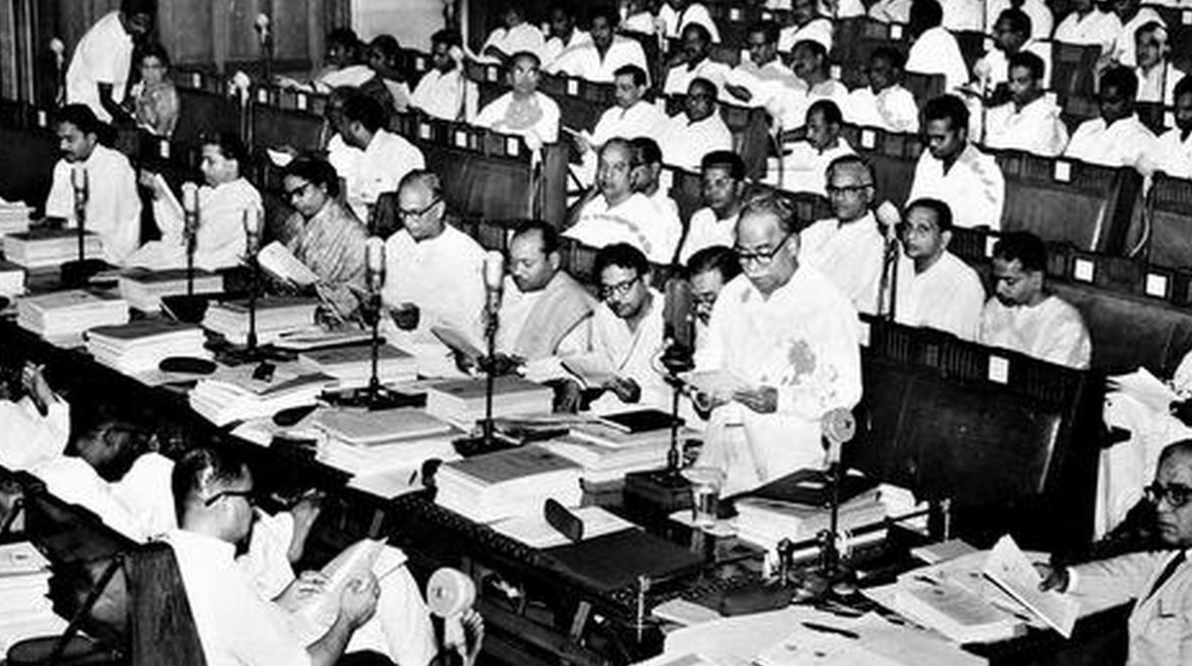
Image Source : https://www.thehindu.com/news/national/tamil-nadu/when-parties-united-for-tamil-nadu-in-madras-assembly/article19298340.ece
Political Legacy of Partition in Tamil Nadu
Partition reinforced anxieties about centralisation in postcolonial India. Tamil leaders questioned the concentration of political power in Delhi, especially in the context of cultural and linguistic assertion. The Dravidian movement, spearheaded by Periyar E.V. Ramaswamy, found new urgency in this climate. Scholars like C. Sibley argue that the binary of “Dravidian” versus “Aryan” identities acquired sharper political meanings in post-partition Tamil Nadu. These discourses did not just stop at being symbolic; they translated into demands for social reform, caste justice and regional autonomy. The partition also influenced the question of linguistic reorganisation of states. The demand for Tamil identity, solely based on linguistic grounds, grew alongside similar demands in Andhra, Karnataka, and Kerala. The States Reorganisation Act of 1956 was, in part, a response to the centrifugal pressures unleashed after 1947. Scholars such as Subramanian Swamy and others trace how linguistic politics in Tamil Nadu gained strength in this environment of redefining India’s federalism.
Social Justice through the Dravidian Movement
The Dravidian movement has its roots in the self-respect movement. It gained political prominence in the decades following Partition. During the 1950s and 1960s, it evolved from being a social campaign to a full-fledged political force, which ultimately led to the rise of Dravida Munnetra Kazhagam (DMK) to power. Recent research on the “Dravidian Model”, i.e. the case study of Tamil Nadu, explicates the fusion of social and economic advancement in the latter’s development. It is argued that Tamil Nadu’s politics and its subsequent future were forever altered due to the implementation of affirmative action policies and welfare reforms. These policies were informed by the post-partition jitters and set Tamil Nadu apart as a state markedly different from the Hindi “mainland.” The Dravidian parties have framed a legacy of resistance by resisting cultural homogenisation and caste hierarchies, which are currently at the centre of the Tamil identity.

Cultural Memory and Resistance
One of the most enduring legacies of the Partition in Tamil Nadu lies in the anti-Hindi agitations. While partition intensified the national efforts towards linguistic unity, Tamil Nadu resisted the Hindi imposition with sheer determination. Archival material such as the “Hindi Imposition Papers” documents the chronology of these protests, particularly the 1965 student-led agitations that reshaped state politics. Contemporary commentary emphasises their importance. The controversy has been called a “test of cultural federalism”. They note how Tamil Nadu’s rejection of the three-language formula remains a cornerstone of its policy. The 1965 agitations have also been seen as playing a key role in DMK’s rise and Tamil linguistic pride movements. These are the kinds of movements that show that the legacy of Partition was not only a territorial separation but also embedded in the cultural politics of the south.
Tamil Nadu’s Identity Formation
Tamil Nadu’s cultural memory of the partition is not tied to trauma or violence but to resistance and assertion. The Dravidian ideology reinterpreted colonial racial theories and constructed Tamil identity as inherently distinct. Sibley says that the “Dravidian race” became a political category over the cultural one. It completely shaped the state’s narratives of selfhood. This identity continues to influence cultural production, from cinema to literature. To date, the partition’s legacy continues to shape identity politics. Tamil Nadu’s trajectory also needs to be placed in a comparative South Asian perspective. Studies of Tamil mobilisation in India and Sri Lanka point to similarities between how Tamil identity was politicised transnationally. In each of these, cultural and linguistic pride were foci for democratic assertion. Partition reordered linguistic aspirations within and outside India by shaping new narratives of the imagined community. We, however, cannot view Tamil Nadu’s resistance as mere defiance. It instead shows how the assertion of regional identities can strengthen Indian federalism by demanding space for diversity. Therefore, the legacy of the partition in the south reveals not only fracture lines but also democratic possibilities that continue to enrich India’s plural political fabric.
Conclusion
While Partition didn’t trigger displacement in Tamil Nadu, its legacies continue to shape the state’s politics and culture decades later. Through the Dravidian movement, social justice policies, and anti-Hindi agitations, Tamil Nadu created a distinct response to the challenges of post-colonial India. This legacy continues to shape its politics, from resisting central impositions to promoting welfare-driven governance. The Tamil experience is a reminder that the legacies of 1947 extend far beyond the borders of Punjab and Bengal.
About the author
Apoorva is a second-year student at JGLS majoring in business administration and law. She is an avid reader and artist, actively trying to incorporate creative fields into her everyday work.
Image Source : https://www.tv9hindi.com/elections/lok-sabha-election-parties/dravida-munnetra-kazhagam-15
 NICKELED AND DIMED