
By — Bhavya Shivhare
Abstract:
In the age of algorithmic warfare, corporations have become embedded in the machinery of conflict, not as observers, but as financiers and enablers. This article traces how dual-use technologies, research subsidies, and private capital sustain the AI-driven assault on Gaza, revealing a war economy where destruction generates dividends and the boundary between civilian and military domains quietly dissolves.
Business of Blood
As modern warfare evolves beyond tanks and trenches to businessmen and boardrooms, over 2.3 million Palestinians fall victim to a devastating catastrophe: one orchestrated not only through missiles and military, but through data centres, research labs and corporate investments that turn human suffering into shareholder profit. Time is testimony to this unfolding machinery: decade after decade, the technologies of repression have become more precise, the networks of complicity more transnational and the profits more immense. Today the conflict turns into war, in Gaza, but not of Gaza alone. As the catastrophe goes global, the bombs kill in Israel but the chips lie elsewhere, not far away. From Silicon Valley to Brussels, from Wall Street to research labs in Berlin and Milan, what unfolds in Gaza is the violent convergence of digital colonialism with international capital coded in foreign algorithms and profited from on distant stock exchanges. This is precisely the substance UN Special Rapporteur Francesca Albanese calls the “economy of genocide.”
Conflict as Capital: Funding Militarism
Since October 2023, while missiles scorched Gaza’s skies, a quieter storm gathered over Israel, one not of ash but of grants, falling like rain courtesy of those in distant glass towers too eager to let it evaporate. Over the span of a few months, over €238 million has flown into Israeli institutions under the banner of scientific cooperation. Among the recipients are some of Israel’s most storied academic institutions: Weizmann, Technion and Tel Aviv University, all proudly enmeshed in the country’s military-industrial complex. The grants are tied to projects marketed with civilian labels: border monitoring, disaster response, speech technology, but these facades have done little to mask their proximity to Israel’s war-making infrastructure. Israel Aerospace Industries (IAI), one of the regime’s key arms suppliers, was awarded €640,000 since the beginning of the conflict. Euro doctrines insist this funding is strictly for civilian use. Yet, the path from “dual-use” to full militarisation is not merely a risk, it is the expectation. The fine print permits technologies that can be later adapted for military aims, provided the stated intention sounds civil enough to satisfy polite paperwork. While ethics reviews are said to exist, attempts to examine these guardrails have been met with institutional silence. A formal request for disclosure was curtly refused, with the stewards of these funds claiming the documents to be “irrelevant”. This lack of transparency raises questions about the effectiveness of oversight mechanisms and the potential disjunction between stated ethical safeguards and the actual application of funding.
While one continent subsidises science, another has engineered the architecture. The digital infrastructure sustaining Israel’s military operations has been largely constructed not within its borders, but through long-standing partnerships with some of the most powerful private technology conglomerates in the world. Among the most consequential examples is a $1.2 billion cloud services agreement executed through two of the most influential corporate entities in the digital sphere. The lawyers at Google and Amazon drafted Project Nimbus, a legally resistant document enforced through public profit funds even in the event of public dissent. Subject to international criticism, it nevertheless persists, shielded by binding clauses and institutional silence. The technological deliverables under this arrangement have enabled the deployment of AI-powered targeting systems such as “Lavender” and “The Gospel” platforms that algorithmically generate kill lists from vast troves of surveillance data. As described by former intelligence personnel, these systems are configured to prioritise operational velocity over verification, reducing the identification of human targets to statistical patterns and metadata inputs. This mechanised abstraction of violence has prompted serious concerns about the minimisation of human oversight, especially in decisions of life and death. Other Tech players are no less complicit. IBM reportedly maintains Israel’s Eitan System, a national population database used to track Palestinians via biometric data. One such firm, Palantir, renowned for its analytical prowess and strategic proximity to military institutions, is reported to have furnished tools enabling both predictive policing and algorithmic targeting on active frontlines. Since the escalation of hostilities in late 2023, this entity has significantly expanded its footprint within Israel, exemplifying the deepening entanglement between private capital and militarised governance.
Beyond infrastructure and investment, digital platforms are also complicit. A recent investigation by Al Jazeera found Meta accepting over 100 advertisements promoting illegal Israeli settlements. These included luxury listings in Ma’ale Adumim and Ariel, settlements deemed illegal under international law. More disturbingly, Meta approved ads fundraising for sniper tripods and drone units in Gaza, possibly violating international humanitarian law. Airbnb, which once promised to delist properties in occupied territories, reversed its decision and now donates proceeds to humanitarian causes, a strategy denounced as “humanitarian-washing.” Such platforms normalize occupation and militarization by turning them into lifestyle and charity opportunities. Their algorithmic moderation policies often suppress pro-Palestinian voices while amplifying content supportive of Israel, reinforcing narratives that erase systemic violence.
Scholarly Supply Chains
Universities, traditionally spaces of inquiry and dissent, have become nodes in the war economy. According to scholar Maya Wind, institutions like the Technion and the Weizmann Institute are not neutral actors. They are hubs that helped blueprint the very drone technologies and missile systems now unleashed over Gaza. Projects such as ResponDrone, funded under Horizon Europe, involving Technion and IAI, were marketed as humanitarian. However, critics argue that the resulting 3D mapping and drone tech are easily repurposed for military reconnaissance. Similarly, the COPAC project, involving Elbit Systems and the Hebrew University, focused on quantum dot technology with obvious military implications. The Israeli academia’s entanglement with the defense sector is systemic. Students from these universities are often recruited directly into elite military units. Research hubs double as innovation labs for weapons development. Countries funding them therefore, become a force multiplier in sustaining the war.
Returns on Conflict
The convergence of technological innovation and militarised infrastructure continues to be underwritten by private capital. Between 2019 and 2023, Israeli tech enterprises attracted more than $32 billion in investment: over half of which originated from financiers based across the Atlantic. Public expenditure on defense has surged by an estimated 65% year-on-year, reaching approximately $46.5 billion, a figure that places the country among the highest global spenders per capita. Alongside its militarisation, financial markets have responded with fervour: the Tel Aviv Stock Exchange recorded an unprecedented $157.9 billion increase in market value. This alignment of escalating violence with surging investor confidence offers a stark illustration of how in today’s geopolitical economy, war once waged, is capitalised.
Risk Capital: Emerging Case for Divestment and the Costs of Complicity
The question arises: are these corporations legally culpable? According to the UN, the answer is yes. Under international law, companies must ensure that their supply chains do not contribute to human rights abuses. Failure to conduct due diligence or withdraw from illegal operations may lead to criminal liability, including for executives. With the International Court of Justice’s 2024 ruling that Israel’s occupation must end by 2025, corporate partnerships with Israeli institutions sustaining the occupation may soon fall under the scrutiny of international criminal law.
What is unfolding in Gaza cannot be confined to the realm of military conflict alone. It is a manifestation of global capitalism in its most violent form: where innovation, capital, and infrastructure are quietly repurposed to sustain long term cycles of violence. While the physical destruction is concentrated in Gaza, the repercussions of such a war economy ripple far beyond its borders. The financial, technological and institutional entanglements now shaping this conflict are indicative of a deeper global pattern, one in which the lines between civil and military enterprise are increasingly obscured. This blurring, often rationalised under the logic of dual-use technologies or market efficiency, has systemic consequences. Over time, economies that enable such frameworks risk eroding their own normative foundations, as profit motives are gradually separated from and later abandon ethical accountability. Corporations shield themselves by claiming neutrality to position themselves as enablers of innovation. In Gaza, there is no neutrality. When the servers run, the missiles follow and while the AI scans a database, every dot erased is a life taken. For Gaza, the implications are devastating: decimated infrastructure, obliterated livelihoods and a generation deprived of economic agency. The economies of those providing the tools, funding and platforms for this violence are not insulated from harm.
Conclusion
As the world watches a genocide unfold in real time, corporations face a moral reckoning. The more global markets become implicated in the apparatus of war, the more difficult it becomes to disentangle capital from conflict. This has far-reaching consequences, not just for justice, but for the integrity of international finance, research collaboration and innovation itself. In the absence of corrective action, what begins as passive complicity may evolve into structural dependence. What remains uncertain is whether the states and corporate actors implicated will persist in a trajectory defined by strategic short-termism, or whether they will reckon with the economic ramifications of their involvement. The question remains whether those profiting today are prepared to bear the costs of complicity tomorrow.
About the Author:
Bhavya Shivhare is a third year BBA LLB student with a keen interest in law, economics and the intersections between policy, governance and society. Her writing explores the crossroads of legal frameworks and economic structures- ranging from questions of justice and rights to decoding market reforms. As an author, she aims to bridge academic insight with contemporary debates, contributing to shaping conversations on building a more equitable society.
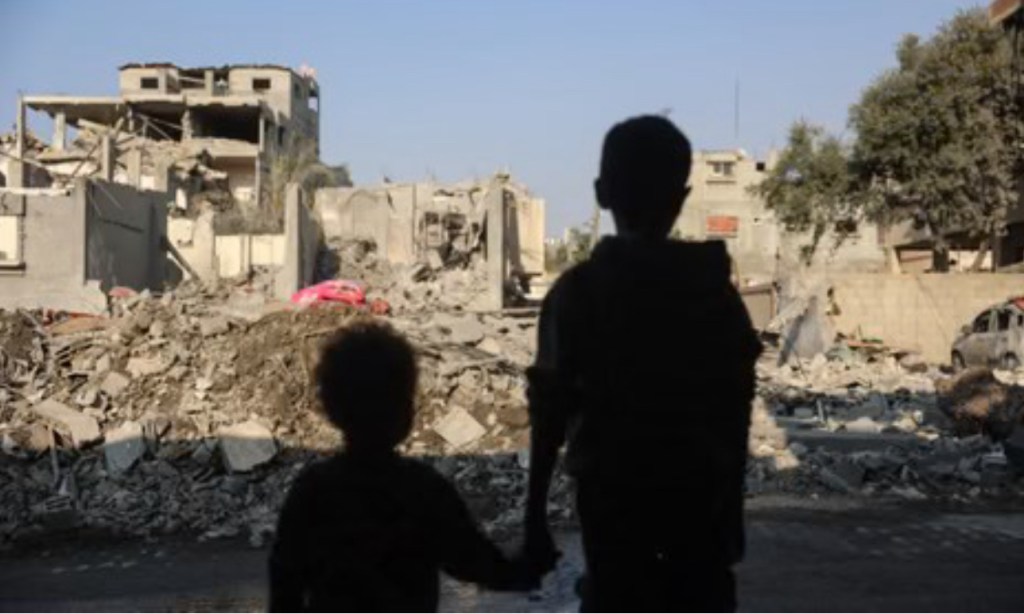
Image Source: https://www.theguardian.com/world/2025/jan/13/israel-gaza-war-15-months-unimaginable
 NICKELED AND DIMED