
By – Sahasra Sai Murtineni
Abstract
This article examines the profound impact of chess on Russian culture and politics, particularly during the Soviet era. It argues that the Soviet Union strategically cultivated chess excellence as a symbol of its intellectual superiority and a tool for projecting its ideological dominance on the world stage. The rise of Soviet chess legends like Botvinnik and Karpov is analyzed within the context of this broader political and cultural project. The article concludes by exploring the enduring legacy of Soviet chess, its influence on Russian national identity, and its continued significance in the global chess landscape.
Introduction
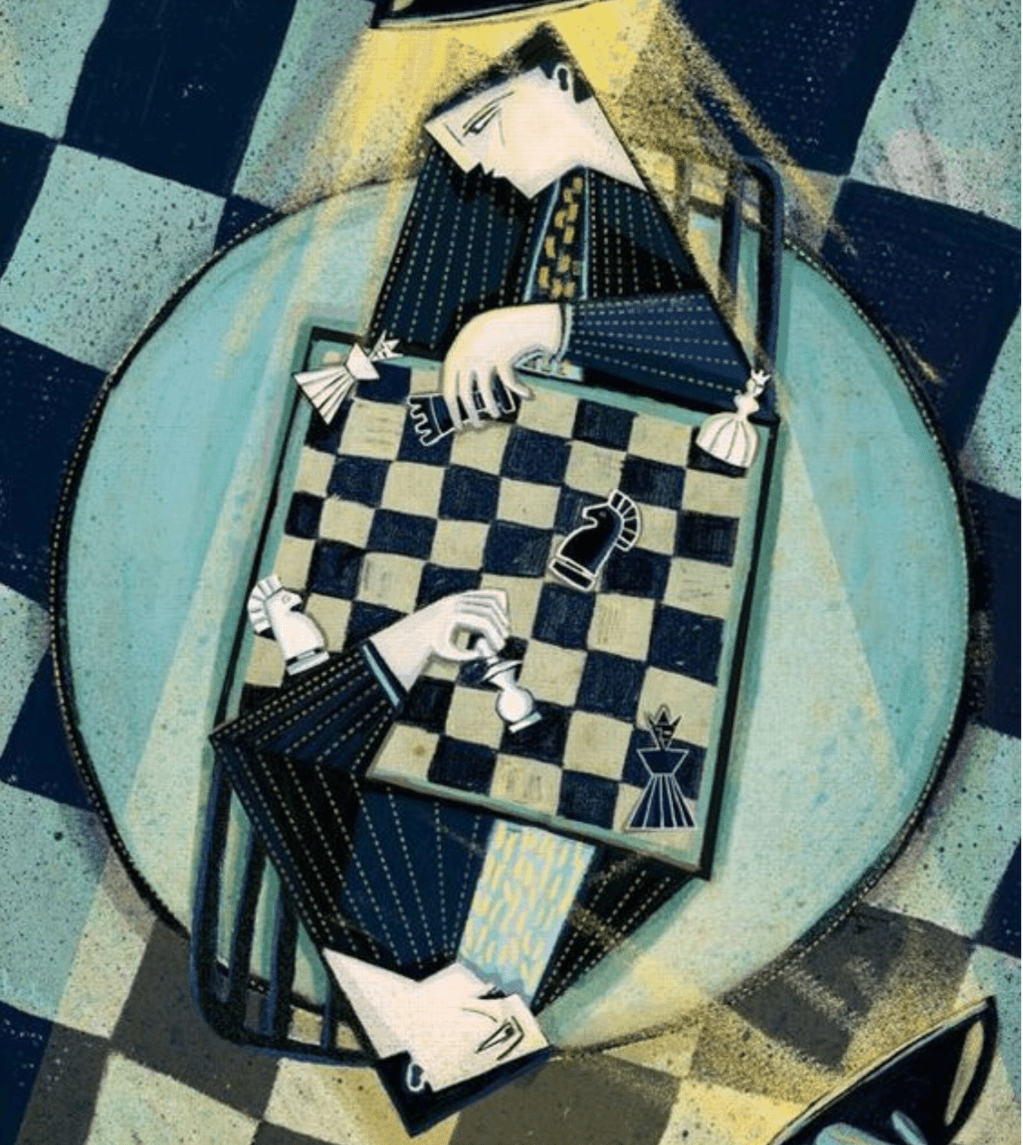
Chess is a performance. Naming it a sport does not fairly and fully account for its cultural and political significance in global history. Chess is a sport, yes, but a more meticulous description would probably rest in calling it a play. An act of theatre showcasing war fought between the black and the white on an action space, that is staged on a checkerboard of 64 squares: half filled and half empty. This description however renders the cultural and political significance to be far too poetic. If one were to look at the real-life ramifications of chess as a power tool, the global chess circuit resembles the stage on which the war between the black and the white, for a significant bit of chess history, was analogous to competing views of communism and capitalism; ideological warfare if you will.
Although India is known for being the birthplace of chess, the game’s increased popularity in the international circuit was initially brought about by the Russians. The rise of Russian dominance in chess, the aftermath of the Bolshevik Revolution, and the formation of the USSR have more in common than one may realize. After the October Revolution, as the Bolsheviks took over the Soviet state and the fabric of society was re-woven from one that held the ideals of the Russian Orthodox Church in pre-Soviet times, to a society that was newly formed and malleable enough to absorb revolutionary ideals and hold them as if they were their own, chess became not just a game, but a symbol—a tool for asserting dominance on the global stage. This piece delves into how the Russians, with their cultural and political aspirations, embraced and propelled chess as a vehicle for strengthening their national identity, using it to assert global cultural dominance, and as an instrument to establish the Soviet empire’s intellectual supremacy.
The Role of Chess in Russian Culture and Politics
The introduction of chess into Russian society can be traced back centuries, but its true rise to prominence began in the late 19th and early 20th centuries. The Russian Empire, even before the revolution, was already steeped in intellectual and cultural pursuits, but it was the Bolshevik Revolution of 1917 that gave chess its defining role in Soviet life.
The early Soviet government recognized chess as more than just a recreational game; as it became a tool for political propaganda and a way to solidify Russia’s emerging identity on the world stage. After the revolution, the Bolsheviks sought to distance themselves from the old Tsarist regime while simultaneously asserting their intellectual superiority. The Soviet Union’s relationship with chess was, therefore, both a political strategy and an ideological necessity. Chess was an ideal match for the Soviet state: it was structured, strategic, and had a rich history, but it also required the kind of intellectual rigor that the new Soviet leaders wanted to promote. As a result, chess was institutionalized at all levels of Soviet society, with state-sponsored programs like the establishment of ‘Pioneer Palaces’ that nurtured prodigious talent from a young age.
During the early years of the USSR, the government poured resources into developing world-class chess players as a means of asserting Soviet intellectual dominance. Chess tournaments became global spectacles in which Soviet players consistently triumphed, thus positioning the Soviet Union as a superpower not only in politics and military but in intellectual pursuits as well. The USSR used these victories to symbolize the success of its socialist policies, demonstrating to the world that its system produced superior minds. This was particularly important during the Cold War era, where every domain, from space exploration to athletics, was seen as a battleground; an opportunity to demonstrate ideological supremacy, between the Soviet Union and the United States.
The Rise of Soviet Chess Legends
The most prominent example of Soviet dominance in the chess world is the legacy of Soviet chess grandmasters, beginning with Alexander Alekhine and followed by iconic figures such as Mikhail Botvinnik, Anatoly Karpov, and Garry Kasparov. Mikhail Botvinnik, who became World Chess Champion in 1948, was a pivotal figure in Soviet chess. He not only dominated the world chess scene but also helped to create a chess school in the Soviet Union that would eventually produce multiple generations of champions. Botvinnik’s influence extended beyond the chessboard; his systematic approach to preparation and his role in the development of Soviet chess training programs made him a key figure in the Soviet cultural project. Chess, in this sense, became a mirror of Soviet ideals—discipline, structure, and collective effort.
Botvinnik’s successors, such as Anatoly Karpov and Garry Kasparov, continued this tradition of excellence. Karpov, who succeeded Botvinnik as World Champion in 1975, dominated the chess world for over a decade. He was seen as the embodiment of the Soviet intellectual- calm and methodical. This was in stark contrast to his fiery rival Kasparov. Kasparov, who would go on to become one of the greatest chess players in history, represented the new wave of post-Soviet intellectualism.
Chess as a Political Tool
Chess, however, was not just a game for Soviet chess masters. The USSR used the game to project power and influence on the international stage. One of the most famous instances of chess as a political tool occurred in the Cold War, when chess became a proxy for the ideological struggle between the Soviet Union and the United States. The 1972 World Chess Championship match between Boris Spassky, a Soviet grandmaster, and Bobby Fischer, an American challenger, became a symbol of the East versus West struggle. The match was seen, not just as a contest of two players, but as a battle between the ideological forces of capitalism and communism.
The Soviet Union’s success in chess provided it with a platform to demonstrate the superiority of its social system. When Spassky lost to Fischer, it was portrayed as a temporary setback, but the political ramifications of the match were immense. The defeat led to a reassessment of the Soviet system’s ability to produce intellectual talent in the face of Western competition.
The Legacy of Soviet Chess and Its Cultural Impact
Even after the dissolution of the Soviet Union in 1991, the Russian legacy in chess continued to resonate. It remained a dominant force in the chess world, and its intellectual traditions continued to shape the game. Russian chess schools, which had produced a series of champions, remained influential, and the national focus on chess continued in schools and training programs. Even in the post-Soviet era, Russian grandmasters like Vladimir Kramnik and Sergey Karjakin have been prominent figures in the international chess scene. Moreover, the influence of Russian chess extends beyond the game itself. It has become a symbol of Russian intellectualism and cultural pride. Chess remains a vital part of Russian culture, a cultural export that brings global recognition to the country and highlights its historical contributions to intellectual and strategic thought.
Conclusion
The history of chess is inextricably linked to the rise of the Russian state and its political aspirations. What began as an ancient game in India became, through the efforts of the Soviet Union, a tool for cultural and political dominance on the world stage. Russian grandmasters and chess institutions became symbols of Soviet power, intellectual rigour, and ideological superiority. Chess was not just a sport—it was a performance, a strategic play that symbolised the larger ideological struggles of the time. Through chess, the Soviet Union and its successors not only asserted their dominance in intellectual matters but also used the game as a way to project cultural strength. The Russian influence on chess is thus a testament to the game’s ability to transcend mere recreation and become an essential element of national identity and global influence.
About the Author
Sahasra is a sophomore at O.P Jindal Global University, currently pursuing her undergraduate studies in Law. With a background in science, she is deeply interested in exploring the intersections between law and scientific disciplines. She is constantly seeking to uncover new areas of interest and expand her understanding of how different fields converge in the legal realm.
Image Source : https://in.pinterest.com/pin/79376012172659627/
 NICKELED AND DIMED