
By – Bhavya Agarwal
Abstract:
What is the value of legal structures if the real power lies in the hands of the powerful?This article examines the selective application of international humanitarian law by comparing the political and global legal responses to the attack on the civilian infrastructure in Kyiv (Ukraine) and Rafah (Gaza). It is well known that the conflicts have entailed extensive civilian and infrastructure harm, the clear disparity in the legal framework, particularly while using terms like “war crimes”, “genocide,” and self- defence.”It is critical to reveal how international justice is manipulated by geopolitical interests. By analysing the roles of the ICJ, ICC and media narratives. This article will analyse how the International Criminal Justice system, though symbolically vital, remains largely impotent in the face of the great powers of world politics and strategic impunity.
Introduction
The backbone of international humanitarian law is to cater to civilians during armed conflicts between nations. Despite its enhanced legal framework, the actual application of these laws often reflects the underlying geopolitical interests of powerful nations, ignoring the universal ideals these laws are meant to protect. To give it a closer view and understand the nuances of it, in the international response to the attack on civilian infrastructure in Kyiv (Ukraine) and Rafah (Gaza). Both the participants of war have witnessed and experienced indiscriminate violence, yet it is apparent that the global diplomatic, media responses, and legal framework highlighted deep-rooted problems of selectivity and inconsistency. This article adopts a critical stance: the principal international legal institutions—including the International Court of Justice (ICJ) and International Criminal Court (ICC)—have repeatedly demonstrated their impotence in the face of great power politics, leading to a fractured enforcement of basic humanitarian norms.
Attack on the Infrastructure in Kyiv and Rafah
Kyiv: Systematic Targeting, Legal Framing, and International Outrage.
Since February 24, 2022, Russia’s large-scale invasion has involved multiple fronts. The initial actions of Russia’s involvement in Ukraine that escalated into the current conflict began in Crimea and the eastern Donbas regions in 2014. It has widely sustained attacks on energy grids, hospitals, residential complexes, and public facilities in Kyiv and throughout the nation. Several UN and human rights reports establish serial attacks on hospitals and other obvious civilian facilities—a classic breach of International Humanitarian Law’s basic precepts, notably distinction and proportionality.
The terminology used to describe these events reflects a much deeper and distinct geopolitical pattern phrases like “war crimes,” “crimes against humanity,” and “serious breaches of the Geneva Conventions” are habitually used by Western powers such as the United States of America, the UN, and major NGOs- more importantly when addressing adversarial state like Russia.
Rafah: Catastrophe, Contestation, and Legal Obfuscation
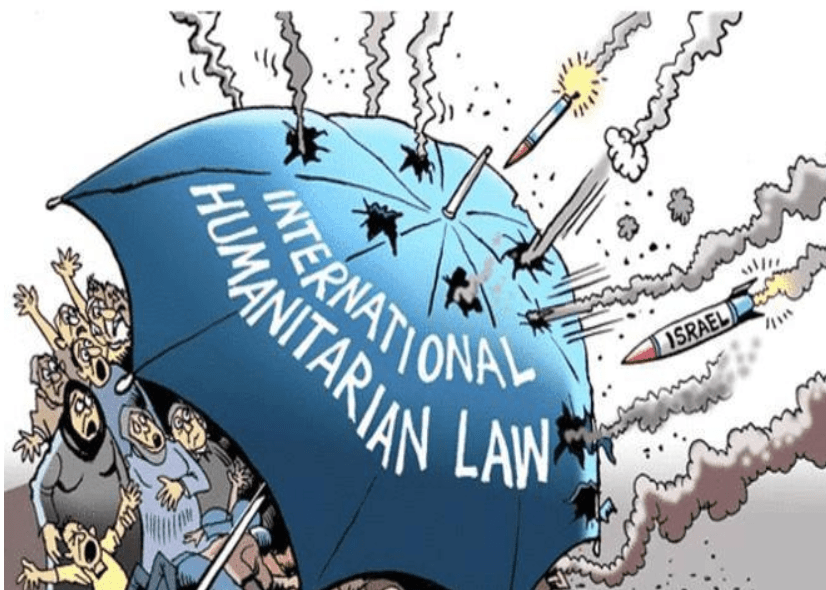
Since May 2024, Israel’s attack on Rafah and throughout Gaza systematically destroyed central civilian infrastructure—destroying houses, hospitals, water and electricity systems, and internally displaced people’s shelters. Air bombardments in populated areas and serial bombardment of the few remaining hospitals have triggered massive humanitarian disasters while alarming throughout the world. Although Israeli Defense Forces (IDF) asserted that targets were militants, independent probes and eyewitness accounts have long shown a grossly disproportionate number of civilian deaths. Various accounts of attack and witness statements show the destruction and direct attack on the civilian infrastructure. Arguably one of the most terrifying instances, the Tel al-Sultan airstrike set fire to a tent camp, killing a minimum of 45 civilians. The systematic targeting of Gaza’s health system and persistent blocking of humanitarian corridors indicate a deliberate strategy of warfare that disregards the fundamental principles of international humanitarian law and goes against the legal framework that has been set by these laws.
International legal debate in this respect has become more polarized and politicized ever since this incident, although the language of “war crimes” and indeed even “genocide” has been used in official court proceedings—most prominently by South Africa in its complaint against Israel before the International Court of Justice (ICJ)—most Western governments have otherwise put forward Israel’s actions in terms of the doctrine of “self-defense, “ which raises serious question on the understanding and integrity pf these powers in the realm of humanitarian laws and the stance of the International Justice system and the ICC on it. That hesitation to use the more dramatic legal labels betrays a profound asymmetry in international legal and diplomatic reactions, deflating both universality and credibility of international humanitarian norms that have been set in place for this very reason.
The ICJ and ICC: Impotency and legal powerlessness
To better understand the functioning mechanisms of International Justice mechanisms, it is essential to analyse the roles played by the ICJ and ICCTo better understand the functioning mechanisms of International Justice mechanisms, it is essential to analyse the roles played by the ICJ and ICC. In the significant global conflict of Ukraine vs Russia, Ukraine invoked the 1948 Genocide Convention at the ICJ., The petition involved an immediate action to halt Russia’s military operations. Amid the invasion by Russia, which took place on February 2022, in the month of March, the court issued provisional measures, ordering Russia to suspend its offensive measures, which were bluntly and very vocally ignored by Russia. The court authority remains unenforced, and the violence continues till this date, the legal move by Ukraine. It appears powerful on paper but crumbles under the weight of geopolitical interests.
South Africa in December 2023 took a case to the International Court of Justice (ICJ) charging Israel with genocide in Gaza under the 1948 Genocide Convention. In its first-ever interim ruling, on January 26, 2024, the ICJ found the charges “plausible” and directed Israel to stop genocidal acts, permit humanitarian assistance, and report back. Follow-up orders issued in March and May, calling for an end to the Rafah offences.
The ICC issued arrest warrants for Russian leaders, including President Vladimir Putin, with western fervour. The warrants that were issued are, however, useless because Russia will not cooperate, and it is outside the ICC’s jurisdiction. It can be seen in late 2024 in the historic move. The ICC also issued an arrest warrant for Israel, Prime Minister Benjamin Netanyahu, the defence minister Yoav Gallant, and senior Hamas officers, for war crimes and crimes against humanity, including starvation, which was used as a weapon of war. This shows the clear exploitation of the Humanitarian law. Alias from different countries, such as Hungary wild flat-out non-corporation, which further illustrates the court’s reliance on the United States corporation. Different reactions to the Gaza and the Ukraine cases the war highlight a deeper fault and the international system of justice, while it is true that the ICC does issue strong, symbolic verdicts. It looks good on paper, and it has a systematic symbolic value, but it remains ineffective in times of global conflicts.
The Impotence of the International Justice System
It has been noted in war-like situations, countries simply opt out or flatly ignore the judgments passed by the ICJ and ICC when adverse to their interests, as the Russia-Ukraine and Israel-Palestine cases blatantly illustrate. Powerful nations, including the Global North and its allies, are successful in shielding themselves from the reach of international justice on their own discretion. It can be said that the ICC, meanwhile, is stymied by state non-cooperation and lacks independent enforcement resources, which makes its power only advisory rather than being implemented. It is important to understand that while landmark rulings may carry moral reliance, they are largely symbolic, with their enforcement depending on the political association rather than any legal authority. In many other global conflicts, particularly those which are marked with deep-rooted ethno-national tensions, war has now become a means of ethnic cleansing while on the face of it citing other geopolitical issues. Thus, it is fair to say that in the International Realm, “Justice” is not determined by legal principle, but by power dynamics, using international law as a tool of narrative dominance by politically strong nations, rather than being used as a guarantor of human protection.
Conclusion
In this unbalanced world order, which is highly dominated by great powers and cynical pragmatism, it is often the case that the International Humanitarian law is often ignored and unvalidated; it is seen that the ruling is upheld or ignored selectively, its concept deployed with an eye to alliance and advantage rather than principle or precedent. This reveals a deep-rooted reality that global institutions function not as impartial guardians but as theatres for the projection of power. There is an important need for change in the current working of the international justice system, from the current bankrupt paradigm of legal selectivity. Until then, the International Justice System remains impotent and in the most crucial times, a toothless giant, which has a symbolic value but is impotent in action.
About the Author
My name is Bhavya Agarwal. Currently, I am studying BBA LLB ’24, at Jindal Global Law School. My interest lies in meeting new people and learning about new cultures.
Image Source : international-humanitarian-law – Nghiên cứu quốc tế
 NICKELED AND DIMED