By – Uditi Kalra
Introduction:
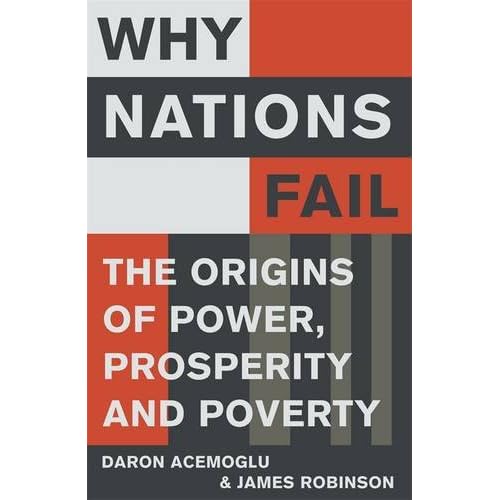
Why Nations Fail: The Origins of Power, Prosperity, and Poverty (2012), written by economists Daron Acemoglu and James A. Robinson, tackles one of the most enduring and vital questions in the social sciences like, ‘why are some nations rich while others remain trapped in poverty?’ Against the backdrop of history and current events, the authors set out to challenge the widespread belief that factors such as geography, culture, or the ignorance of leaders are the primary causes of national success or failure. Instead, they argue that the underlying driver of prosperity lies in the creation and maintenance of “inclusive institutions”, political and economic systems that encourage participation, innovation, and fair competition.
This book’s significance goes far beyond academic debate; it confronts the real sources of widespread inequality and political unrest that shape our world. Drawing from an extensive range of historical examples and case studies, Acemoglu and Robinson invite readers to reconsider the root causes of global wealth gaps and to reflect on possible paths for change.
This review will outline the book’s central arguments and structure, discuss its main concepts and evidence, assess its strengths and weaknesses, and offer a balanced perspective on its impact and contribution.
Overview
The book is organized into fifteen chapters plus a preface and is structured to challenge traditional explanations for global inequality. The book begins with case studies like the divided city of Nogales and the contrast between North and South Korea to illustrate how similar places diverge economically under different institutional arrangements. After dismissing geography, culture, and ignorance as primary explanations, the authors build their institutional theory: that prosperity depends on “inclusive” political and economic institutions, while poverty results from “extractive” ones.
The authors cover a broad historical range, from the rise and fall of the Mayan city-states to the Industrial Revolution in England and present-day nations. They use critical junctures (such as the Glorious Revolution or colonial conquests) to explain why nations follow different trajectories. Their analysis features a variety of evidence, including historical events, statistical comparisons, and vivid storytelling to connect institutional evolution with national success or stagnation.
Notable chapters examine how institutions drift or entrench over time, the feedback loops that keep nations locked into vicious or virtuous cycles, and rare examples of countries that have managed to break out of poverty traps. The book concludes by emphasizing the enduring significance of institutions and reflecting on the challenges of reform.
Key Arguments and Concepts
At the heart of Why Nations Fail lies a crucial distinction: “inclusive” institutions versus “extractive” ones. Inclusive institutions are those that genuinely make room for broad participation in society. They support property rights, the rule of law, and nurture environments where people are free to invest, innovate, and pursue opportunities. When these systems are in place, individuals from every background have a fair shot at improving their lives and shaping the direction of their country.
On the other hand, extractive institutions leave decision-making and rewards in the hands of a narrow elite. Power is concentrated and guarded, economic opportunities are restricted, and most people have little say or incentive to excel. What results is stagnation and frustration, not because people lack talent or culture, but because the rules are rigged for only a few to win.
A big reason these institutional differences exist is politics. Acemoglu and Robinson argue that those in power often shape institutions – political and economic alike to protect and extend their interests. Unless power is balanced and spread more widely, institutions usually remain extractive, and societies struggle to break out of poverty cycles.
Another core idea is the concept of “critical junctures”: pivotal moments in history, such as wars or revolutions, that offer a chance for institutional change. The eventual outcome, however, depends on existing power structures and previous institutional arrangements, an idea called path dependency. For example, while the Glorious Revolution of 1688 in England paved the way for broad-based political rights and eventually fuelled the Industrial Revolution, similar crises elsewhere often resulted in even more entrenched rule by elites.
Throughout the book, the authors back their arguments with striking examples: the economic gap between North and South Korea despite shared cultural backgrounds; the failure of wealth to transform societies under colonial or extractive regimes in Africa and Latin America; and the way institutional innovations in Britain led to global waves of prosperity. These cases are used not just to illustrate their theory, but to demonstrate how the rules of the game, set by those in power, ultimately decide whether nations flourish or fail.
Strengths of the book
One of the book’s biggest strengths is its clear and engaging writing. Acemoglu and Robinson manage to weave together stories from vastly different eras and continents, turning history and economics into a compelling narrative. The book’s use of case studies, such as the contrasting fortunes of North and South Korea, or the development trajectories of colonial societies, provides vivid and memorable illustrations of the authors’ arguments. The sheer breadth of historical examples, from the origins of ancient civilizations to the challenges of present-day nations, helps ground their thesis in real-world events. This approach makes their argument that inclusive institutions are key to prosperity especially persuasive, as it resonates across so many diverse examples. Additionally, Why Nations Fail has sparked important debate in economics, history, and policy circles, pushing the conversation about development to focus more closely on the intertwined roles of politics and power. Even for readers skeptical of its central claim, the book’s accessible style and ambitious scope make it an essential addition to discussions about why nations thrive or struggle.
Criticism
One aspect I found lacking in the authors’ analysis is how they largely examine countries as if each develops in a vacuum, without giving enough weight to the ongoing influence of the global system. External factors like international trade, foreign interference, and the long shadows of colonialism are mentioned, but they rarely get the depth of discussion their real-world impact deserves. In addition to this I have noticed that the book tends to revisit its central argument again and again, illustrating it with new examples but not always revealing fresh insights. The repetition, while making the thesis clear, sometimes comes at the expense of a more nuanced or multifaceted analysis.
Personal Reflection
What I found especially thought-provoking was how Acemoglu and Robinson present institutions not as distant, abstract systems, but as everyday rules shaped by those with real power, rules that evolve through conflict, negotiation, and unexpected turns. The stark examples, like the contrast between the two Nogales and the lasting impact of the Glorious Revolution, reveal how present realities are built on past struggles over who has a voice and who holds authority.
This perspective led me to set aside the familiar notion that nations are held back mainly by culture or geography, and instead reconsider how shifts in politics, incentives, and power can unlock or block opportunity for entire populations. Their focus on the “rules of the game” and how deeply embedded and resistant to change they can be reshaped has reshaped my understanding. It made clear that although real progress is difficult and slow, positive change remains possible as history is made not just by fate, but by people repeatedly challenging and reshaping these rules.
Conclusion
In conclusion, Why Nations Fail stands out for its bold argument that the prosperity or poverty of nations ultimately comes down to the quality of their institutions and the politics shaping them. By combining vivid historical examples with accessible storytelling, Acemoglu and Robinson have made a major contribution to our understanding of economic development. While the book has its limits, especially in handling global influences and repetition, it succeeds in reframing a long-standing debate and encouraging readers to look beyond surface explanations. Whether you agree with their thesis or not, this book is sure to spark new ways of thinking about why some countries thrive where others struggle, making it a valuable read for anyone interested in history, economics, or the future of global society.
Author Bio
Uditi Kalra is a Bs Economics student at The Jindal School of Government and Public Policy and a columnist at CNES.
Image Source: https://ecx.images-amazon.com/images/I/41lvQYgS72L._SS500_.jpg
 NICKELED AND DIMED