
By – Poorvanshi Tyagi
Abstract
The 1996 ecotourism initiatives at the Mawphlang sacred forests brought recognition to the essence of the area, transforming it into a wonder destination for many. A multitude of trip-advisory articles shed light on the systematic structure set in place for the exploration of these sacred groves. It raises a moral and ecological concern to this bioeconomic activity. Is ecotourism responsible for breaking off the long-standing traditional conservation of the forests? This article aims to see ecotourism of sacred forests as a product of neo-liberal forces, reducing nature and cultural heritage to commodified objects of profit.
Introduction
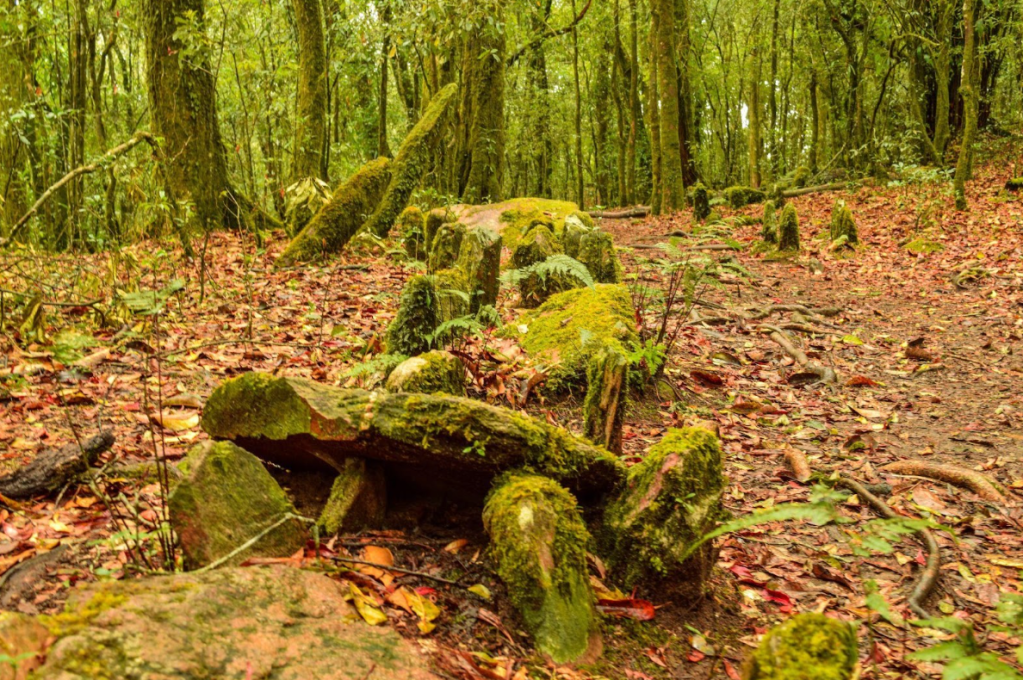
Nature envelops life like a transcendental truth that continues to bring value to the transience of human experience. The natural world often comes to represent the unknown and the mystic. Elements of nature have continued to be altars of worship, concealing within themselves a history of spiritual and sacred traditions. About 25 kilometres away from Shillong, the capital city of Meghalaya, lie the Mawphlang forests— one of the oldest sacred forests of the East Khasi Hills District. Loosely defined as untouched patches of vegetation or forested areas attributed to ancient spirits, sacred forests are home to local communities and to a diverse pool of plant and animal species. The Mawphlang Forests share a history of over 800 years, one marked by a form of allegiance to the divinity of nature. The forest is integral to the cultural identity of the Khasis, who dwell in the surrounding villages. They attribute the Mawphlang Forests to be an abode to their local deity, Labasa, the protector of the forest. The traditional belief system around the forest is the guiding principle behind its conservation. One must not pick a single stone or leaf from the forest lest they wish to suffer the wrath of the local deity. Hence, the Mawphlang forests remain unscathed, subjected to animal rituals and sacrifices only under an Elder, at the permission of the deity. The Mawphlang forests serve as a symbol of a peaceful coexistence between humans and the natural world, one that anthropocentrism, a deeply human-centric approach, puts at risk today.
The age of Neoliberalism puts utility at its forefront and aims to organise stable markets around anything and everything, including ecological systems. Nature becomes but a commodity in the face of instrumental rationality embedded in profit-making. Ecotourism or responsible travel to natural areas, was first introduced to the Mawphlang forests by conservationist and secretary of the traditional governing body Hima, Tambor Lyngdoh in 1996. It has since become a profitable venture accounting for numerous travel visits by Indian and foreign tourists alike. I argue that ecotourism initiatives in the Mawphlang sacred forests are a step towards marketing a commodified entity at the cost of ecological and cultural decadence.
Ecotourism and Capitalism : The Objectification of Nature
“Modern man does not experience himself as a part of nature but as an outside force destined to dominate and conquer” – Ernest F. Schumacher (Small Is Beautiful).
In the capitalist state of affairs, there is a distinction between that which is nature (non-human) and human. This distinction sets a premise for the objectification of nature for the purpose of wealth accumulation. It manipulates the interconnectedness between nature and man, wherein nature seemingly becomes rather distant and inferior, making it easily exploitable. Though early interpretations of nature by classical political economists like Smith and Ricardo perceived nature as a ‘free gift’ to capital. The concept of ‘natural capital’ emerged in the 19th Century as a means to conceptualise natural-material use values and was marketed as a way towards ecological conservation. Yet, this thought system is inherently flawed,considering that it does not see nature beyond its economic value. The processing and packaging of nature into quantifiable commodities only serves further the purpose of its ruin. This not only hampers nature but also with man’s connection to it. Marxist concept of reification considers social relations as illusory entities, reducing them to quantifiable objects, diminishing the human relations that go behind it. Reification of nature could point to a disregard for the human labour that goes behind its economization. It alienates man from nature, disrupting the deeper emotional and spiritual connection associated between the two.
As reified objects, ecotourist destinations present themselves in a similar way in the neo-liberal age. The Mawphlang forests, for instance, reduced to an object of mystery and wonder, are separated from the active efforts of the Khasis to restore and preserve the area. Ecotourism in Mawphlang was initiated to provide a new source of living to villagers who could now become tour guides, as well as to serve a purpose of recognition of the sacred forests across the world. There has since been an increase in tourist engagement, leading to tourism-based developments in the area. The 16- kilometre-long David Scott Trail which starts near the Mawphlang sacred grove as well as the construction of bathrooms and home stays has contributed to the formulation of the Mawphlang forests as a popular eco-tourist destination. Ecotourism not only promotes a site, but also its indigenous socio-cultural history. Tourism related blogs and promotion posts portray the Mawphlang forests as ‘mysterious, magical, untouched, and exotic’. The linguistic connotations attached to the forest suggests an Oriental perspective, one which looks at the forests as an alien entity to be known and possessed. The tourists experience a culturally immersive experience as their tour guides share with them, forest folklore and Khasi traditions. This hints towards commodification of culture itself. As Frankfurt School thinkers Adorno and Horkheimer argue, culture under capitalism is stripped of its original meaning and repackaged as a tool of control and profit. In this case, even the spiritual reverence attached to the sanctity of nature becomes a marketable and commodifiable asset. The indigenous knowledge preserved by and passed down from generation to generation now becomes an interesting selling point for promotion.
Conclusion
The core principals of ethical travel that guide ecotourism subject individuals to a sense of moral gratification, effectively sidelining the many issues that it may cause. Ecotourism in Mawphlang is carefully monitored by clan leaders and villagers. Yet, increased foot traffic in the area could contribute to soil erosion. An increasing number of tourists threatens the preservation of the forests. A shift towards employment as tour guides also distances villagers from continuing traditional occupations. Thus, ecotourism poses both ethico-moral and ecological concerns to the long standing Mawphlang forests of Meghalaya. Although ecotourism may offer a reconnection to nature which has been stripped away by the 21st Century capitalism, it very well operates within the same system. This contradiction works well as the very idea of a reconnection is embedded in neoliberal commodification strategies. Hence, the dream of reconnection ironically furthers the very alienation of which Schumacher warned.
About The Author
Poorvanshi Tyagi is a second year student at O.P. Jindal Global University, pursuing a Bachelor’s in Global Affairs and a diploma in Literature. She is a published poet and an avid reader. She is open to research opportunities in the field of education, sociology and cultural anthropology. Besides, she enjoys dancing and music.
Image Source : https://handofcolors.in/inside-the-sacred-forests-of-mawphlang/
 NICKELED AND DIMED