
By – Ann George
Abstract
This paper challenges prevailing stereotypes that label Generation Z as “lazy” or “entitled” by exploring the distinct economic challenges they face in contrast to previous generations. Factors such as soaring housing costs, stagnant wages, overwhelming student debt, and insecure labor markets, exacerbated by technological changes like AI, have created significant barriers to financial independence and traditional markers of adulthood for Gen Z. Despite these hardships, Gen Z is actively redefining work and wealth through side hustles, gig economy participation, and valuing experiences over material possessions. The article further critiques policy failures related to education affordability, labour protections, and housing, advocating for reforms including universal basic income and strengthened labour rights. Ultimately, this study underscores the necessity of a nuanced understanding and structural change to address the economic realities shaping Gen Z’s future.
Introduction:
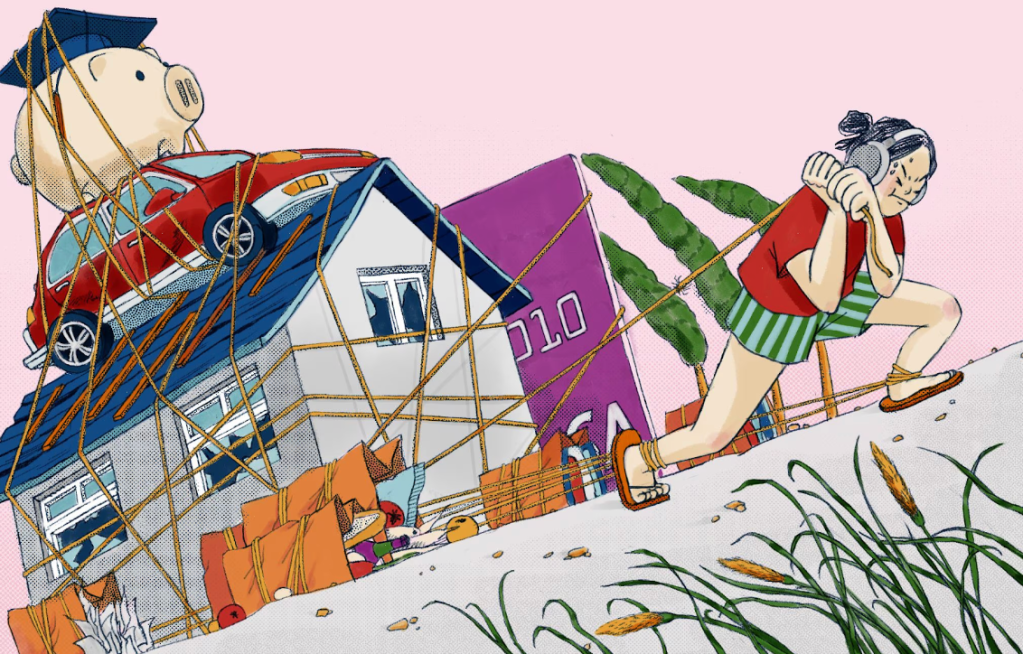
To simply paint Generation Z as “lazy” and “entitled” ignores the undeniable economic hurdles stacked up against them. Generation Z, unlike all previous generations, faces many significant impediments that uniquely alter personal financial behaviours and ambitions. Housing is only one of the many financial hurdles. Due to escalating housing prices, ownership for many in Gen Z feels like a distant dream. Consequently, this breeds more financial stress on them and causes a delay in purchasing houses or starting families. Wages have stagnated while living costs continue to rise, thus making it very hard for Gen Z to make any money at all. The majority of Gen Zs are well-educated and savvy enough to use technology, but too many of them are underemployed and face job insecurity in their quest for financial stability. These structural economic challenges have led to increased financial anxiety within Gen Z. More than 50% state they are “extremely worried about not having enough money”, thus indeed showing how financially burdensome these matters are for their mental health and general well-being. As this article argues, throwing around labels, such as “lazy” or “entitled”, at Gen Z does not take into consideration the systemic financial obstacles faced each day. These are issues that demand a more nuanced understanding of the economic machinery affecting their experience.
The Economic Reality of Gen Z:
Gen Z finds it difficult to be financially independent and to achieve significant milestones in their lives. The cost of higher education has rapidly risen for many Gen Z students to the point where they have little option other than to borrow large student loans. The rise in tuition fees over the decades far outstripped income growth to create a national student debt of more than $1.7 trillion. The average annual tuition and fees for full-time undergraduate students at four-year public in-state institutions climbed to $10,740. This has placed many young adults who depend on their parent’s finances; on average, 50% of parents contributed $1,474 monthly to adult children. Thus, Gen Z has a long way towards the goal of independence and major events like buying a house or even getting married, which is a huge milestone.
Viewing the recession as a cautious labor market, Generation Z is nevertheless facing a hard time getting adequate jobs that pay enough money for a salary. Though it thrived on short work and occasional jobs, the style indeed deprived them of opportunities to build careers from internships or entry-level jobs. Wage stagnation, which came with the rising cost of living, made it even more impossible to find money. Prices have increased both for house rent, groceries, and tuition due to inflation, so Generation Z is becoming more exposed. The increasing application of artificial intelligence is yet another factor that spells a disadvantage for entry-level jobs and adds to the dilemma of job search in the present economy. All of these factors have pointed towards young adults postponing their contribution to adult milestones such as marriage or buying a house, even while they are financially and developmentally unstable. To change these situations, higher education would become more affordable if roads were improved, legislation on equivalent wages were enacted, and jobs were made available that would provide a path to security and growth.
Housing: The Dream That’s Out of Reach
A recent report indicated that in Sydney, Australia, a median house price will require households to earn $282,000 by next year, up slightly from $268,000 once rents enter into play. Median-priced units will also increase on a similar level, requiring an income of $158,000 and up from $150,000 as well. Such increases of exorbitant magnitude have even generated the scant rental-wage growth of about 3.2% over the past year, thus making the tension more by some extent. There stands a great demand-supply gap in the housing matrix, which has only added complexity to the ongoing crisis. The Australian Government’s tax programs are also targeted straight at property investors, favouring landowners over first-time buyers. These policy measures include the capital gains tax discounts that will cost the federal budget about $22.7 billion and rental income tax deductions that will cost about $26.5 billion in 2024-25. First-time buyers, in this scenario, find it harder to enter the housing market, with property prices inflated by such policies.
The established path toward long-term renting is becoming standard for many, as it becomes a frustrating goal. “Boomer landlords,” a phrase that seems to imply the opposite trend, refers to the older generation’s attitude toward renting. Younger generations bear longer terms of renting due to already existing economic hardships. This factor further embeds intergenerational wealth inequalities. Entertaining the thought that frivolous expenses such as daily lattes are the downfall of have-nots is an age-old myth. Studies report that spending behavior among millennials is not much different from that of older generations along the lines of necessities, food, housing, and transport. The sore point is structural economic forces such as stagnant wages coupled with soaring living costs that are eroding purchasing power and are hence making it impossible to save for great milestones like starting to buy their own houses. Building relevant policies to avert the housing affordability crisis also means reforming structures for equitable accessibility to housing while addressing the underlying structural economic challenges.
How Gen Z is Redefining Work and Wealth:
Gen Z is redefining conventional paradigms of work and wealth with its embrace of side-hustles and alternative careers, while further establishing a new meaning of financial success. Traditional 9-to-5 jobs are not what Gen Z wants. The members of this generation highly value flexibility, creativity, and autonomy in their work. Therefore, a large number of Gen Z-ers are involved in side hustles not only as another source of money but also as an avenue to chase passions and gain skills. Freelancing, gig work, and content creation are popular side hustles that allow people to monetize what they love. For instance, Amy Coulston from Sunshine Coast has gone from working a full-time job to sustain herself with $10,000 a month from side jobs that include market research and freelancing tasks.
The trend is widespread, with some reports suggesting that a significant percentage of Gen Zers engage in gig economy jobs such as food delivery or ride-sharing to attain an added financial cushion. Also, many young professionals see their side hustles as strategic steps in furthering their careers: gaining experience, building skills, and maximizing career security. Experiences have become more valuable than material possessions of wealth in the eyes of Gen Z. Their new-age perception is heavily prompted by personal growth and memorable activities, thus spending much more on travel, fine dining, and entertainment. The period of anticipation, engagement, and reflection, accentuated by experience, generates enduring contentment, unlike fleeting gratification from material possessions.
Since the housing market and cars have become expensive to purchase, flexibility has become more desirable. Thus, renting and subscription-based models are becoming attractive. This aligns with their minimalist attitude and helps them to remain mobile, to accept possibilities and experiences without the financial burden of ownership. Indeed, Generation Z goes on to actively reshape notions of work and wealth, crediting side hustles and alternative careers in return for valuing experiences that are much beyond material wealth and ownership.
Policy Failures and Needed Reforms:
Gen Z has suffered significantly as a result of unreasonable public policies in such matters as student debt relief, protection of labor rights, and affordability of housing. The growing costs of higher education have accumulated overwhelming student debt: college tuition and board for four-year institutions have increased by 40% between 2001 and 2023, while median personal income has not kept pace. Because of this financial burden on the young population, they will make differentiated decisions in jobs and careers: 69% of Gen Z state that student loans impact their job decisions. In the job market, Gen Z faces labour protections that are not strong enough to protect them against economic insecurity. The gig has only strengthened the case for workers to develop labor rights that provide fair wages and job security. All of these add to the financial burden, as policies for housing affordability result in young adults feeling the pinch with skyrocketing housing prices taking away the dream of homeownership.
Such structural issues culminate in Gen-Z becoming politically active in the process of pushing for reforms such as universal basic income (UBI), stronger labor rights, and an extensive housing policy. The UBI is suggested as a solution to provide stability and reduce economic inequality. Its reform must therefore be said to be government intervention to undo the origin of economic marginalization, very essential to ensure that the opportunities to be afforded to every citizen are equitable. Given the need to bring trust back to Gen Z, it must become imperative for the government to take up policies to relieve financial burdens and ensure economic security; such a system will become the foundation for the development of an inclusive and equitable society.
Conclusion:
Gen Zs are mischaracterised as either lazy or entitled, which is a shallow classification. These terms are far from the stark economic realities affecting the money decisions and job visions of the generation. The cost of housing is sky-high. Salaries have not been raised for decades, coupled with heavy student debt, leaving Gen Z having a structural barrier in achieving the very basic markers for reaching adulthood: home ownership, financial independence, and career stability, which stands as highly improbable for their generation when compared to other generations. They do not pity themselves, unlike the previous generation; they are redefining wealth and work by adopting alternative career paths, side hustles, and valuing experiences over possessions. The movement for policy reform, like student debt forgiveness, fair labor protections, and affordable housing, emphasises the relentless commitment towards making a fairer economy in the future. Such systemic problems can only emerge if one stops calling names and opens the way toward the formation of policies that listen and respond to the unique financial struggles of this generation. Only then will change happen to make possible a future in which Gen Z, by design and intent, will have the opportunity to build stable and fulfilling lives in an economy that works for them, not against them.
Author’s Bio:
Ann Susan George is a second-year B.A. LL.B. student at O.P. Jindal Global Law School. Her interests include public policy, human rights, and law.
Image Source: https://www.washingtonpost.com/business/2024/06/22/gen-z-millennials-debt-inflation/
 NICKELED AND DIMED