
By Purvi Agarwal
Abstract
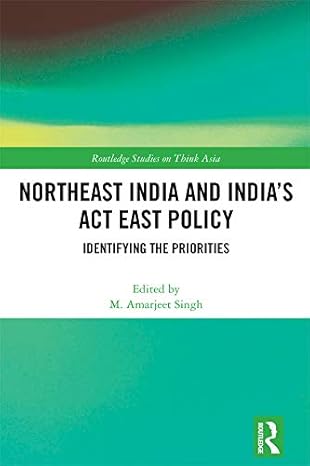
This article is set to critically review the book Northeast India and India’s Act East Policy, edited by Amarjeet Singh and examine it’s arguments. The book delves into India’s evolving engagement with Southeast and East Asia and the central role of it’s Northeast region owing to it’s proximity. The book discusses the shift from the Look East to Act East Policy in order to foster closer economic, cultural, and strategic ties within the Indo-Pacific. It emphasises local perspectives on infrastructure, political challenges, and socio-economic integration within India’s Northeastern states. Readers will particularly benefit from the book’s analysis of how India’s policy shifts, regional investments, and cultural diplomacy shape the Northeast’s role within the country’s broader foreign policy and regional ambitions.
.
The Review
The eight states of India’s Northeast region (NER), namely Assam, Arunachal Pradesh, Manipur, Meghalaya, Mizoram, Nagaland, Sikkim and Tripura, have been long neglected and underdeveloped in the history of India. It was only in the 1990s that the region began to gain attention after former Prime Minister P.V. Narsimha Rao launched the ‘Look East policy’ (LEP) with the main focus of shifting the country’s trading from the West to the East, i.e., to the ‘Tiger Economies’ of Southeast Asia (SEA). Subsequently, this policy evolved into India’s ‘Act East Policy’ which expanded its focus to include both the Indo-Pacific region and the Northeast, positioning the latter as a pivotal player in India’s relations with Southeast and East Asian countries. This frames the purview of the publication “Northeast India and India’s Act East Policy,” edited by Amarjeet Singh. The book is set to examine and distinguish between the Look East and Act East policies of India, particularly under the leadership of the Bhartiya Janta Party, while delving into local perspectives and analysis. It questions the motive, binding and local acceptance of Northeast India into the Act East policy, as well as the challenges, needs and priorities of the region. Most importantly, it aims to bridge the knowledge gaps towards North-East India and its Act East policy. Notably, it is second in the Routledge Studies on Think Asia Series, which aims to capture the complexities of the region and its politics, examining the future possibilities.
This publication has been divided into two parts, namely the changing geopolitics and Northeast India in the Act East Policy. In this context, we can also tie India’s internal struggles seeping into its international dynamics, wherein, on the one hand, it wanted to tap into the rich resources of the SEA and on the other, it wanted to counterbalance the USSR while also improving ties with the USA. The book aptly highlights how the Partition might have taken Northeast India’s economy ‘backwards by a quarter of a century’, and catching up with the rest of the country is a ‘hilarious task’ – indicating the regions’s developmental struggles. The foreword by the series editor is a great foundation for the book and sets the scene for one’s critical thinking and a minor detail is that Singh and other contributors to the book have included not only academic discourse but also activist perspectives, which truly provides holistic information and arguments.
When exploring the question of central leadership per NER, the initial chapter author is very subtle in directing the viewers towards adding “food for thought.” Adding to Prime Minister Modi’s accusation of predecessing governments in the pretext of the 2014 general elections of the Indian National Congress of being responsible for the ‘underdevelopment of the region due to a lack of economic vision, attention and infrastructure’, she notes how INC has been in power since independence, except for a few terms. The detailing again could be indicative of how the book is set to serve foreign audiences and anyone unfamiliar with Indian domestic politics. As far as the notion that previous governments subjected the NE to lack of attention goes, one would be compelled to confess that there is no plausible basis for objection to this argument. An important piece of information is our pull towards Myanmar and Bangladesh in terms of physical connectivity, as well as Northeast India and ASEAN. The book has emphasised Myanmar’s importance as the only neighbouring ASIAN country “considered a viable ‘land bridge’ or a ‘gateway’ for trade and other activities between India and Southeast Asia.” Suggestions for tackling the issue of isolation and poor infrastructure have been provided while critiquing the implementation of the Act East policy. As mentioned before, there has been an inclusion of activist perspectives, but in this particular context, we also see governmental or political discourse, which is a tricky field to inspect. Similarly, there is also mention of accelerated due emphasis on the development of the NER and the transformation of the LEP into the AEP post-2014, when the BJP came into power.
According to the book, following several ‘interventions’ by the government, the NER gained attention. The Northeastern Council was set up as a planning agency in 1972, while the Ministry of Development of the Northeastern Region and the Ministry for ‘planning, execution and monitoring of infrastructure projects’ in the region were established in 2004. Despite being the only ministries to exist pertaining to a particular region, the effectiveness of these agencies is debatable, as there is no clear distinction between their exact sphere of work. The reciprocity of this initiation can be seen through state governments exhibiting keen interest in the policy through the establishment of the committee for operationalisation of the Act East Policy by Manipur and the AEP affairs department by Assam. Thereafter, we also observe a lot of investments in infrastructure by the World Bank, Asian Development Bank and Japan International Cooperation Agency, with the NER suddenly becoming an important destination for interest and funding. India and Japan also set up the Act East Forum to provide a platform for the countries to collaborate under AEP and the Free and Open Indo-Pacific strategy.
The big question, of course, lies in closely examining the Look East Policy and Act Policy to decide whether it is a simple change in the nomenclature. Each of the contributors has deeply examined the long way AEP has come with regard to lacking factors such as integration of the NER and the Indo-Pacific, but interestingly, there is little mention of the defence cooperation, while aspects of culture, connectivity, commerce, geography, corridors, policies and even specific countries as in Myanmar, Sikkim and Bangladesh have been the theme for multiple chapters. The readers would have certainly gained from insight on defence capacity building with more emphasis on QUAD. One particular line from the text is, ‘The India-ASEAN engagement, which has matured over the years, is today one of the defining features of the Indo-Pacific. Without considerable doubt, the terms free, open, inclusive, peaceful and cooperative Indo-Pacific are widely used in the academic community and have come to be known as the buzz phrases in cooperation and policy stance. Moreover, in 2003, during the second ASEAN-India summit in Indonesia, India signed the Treaty of Amity and Cooperation (TAC) as a precondition for membership in the East Asia Summit. This is a significant milestone for New Delhi’s relationship with ASEAN and we also see a shift from political and economic engagement to more strategic agreements signed with ASEAN members. There is also further emphasises on New Delhi’s focus on ASEAN and its strategic partnership if readers are looking to explore that particular aspect.
Further, Singh discusses accentuating cultural commercial and connectivity in southeast Asian countries, which can be very much elaborated upon as well, but it would be fair and justified to conclude the review by saying this publication is an integral part of South Asian studies, Indian Foreign Policy analysis, or regional/domestic developmental evaluation. It sheds light on regime change and its proportion in the implementation of the policy, addressing different challenges and expectations in Southeast Asia, East Asia and most importantly, the Northeastern region of India. It effectively fills a critical gap in knowledge on these subjects and is a valuable resource for scholars of Indian foreign policy, South Asian studies, and regional development.
About the author: Purvi Agarwal is pursuing a B.A. (HONS) in Diplomacy and Foreign Policy at Jindal School of International Affairs, O.P. Jindal Global University. She is a research associate at the Centre for Analytical Research and Engagement and a Research Assistant at the Jindal Global Centre for G20 Studies. She has worked with ABP Network, NDTV, and the Europe India Centre for Business and Industry. Her interests include Foreign Policy, East and South Asian Studies, European Studies, and Sustainability. She is proficient in Hindi and English, with certifications in German and Japanese.
 NICKELED AND DIMED