
By Prof. Tridivesh Singh Maini
Introduction
Like any other religious group, the Sikhs are not a monolith in terms of political views – either in India or overseas. There are individuals with varying views on social and political issues and political affiliations. In India and other parts of the world, where Sikhs are active in politics, their participation is not restricted to any one political outfit. Diverse economic professions and the fact that Sikhs are spread in different parts of the world also often lead us to ignorance of diversity within the community.
Sikh community’s support during covid-19
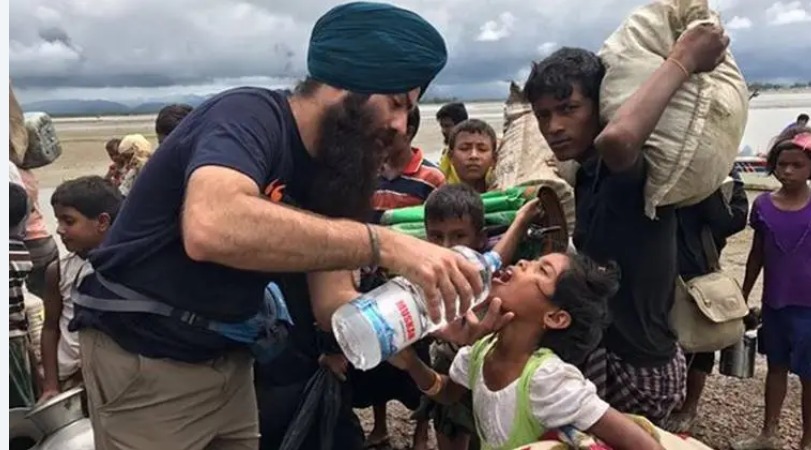
Irrespective of their political affiliations and diversity, one thing which has been clearly visible in recent years is how the community collectively rallies around individuals impacted by natural calamities in different parts of the world. This is carried out via the practice of ‘seva’, or ‘selfless service’ – an essential component of Sikhism – which is motivated clearly by the belief in ‘Sarbat Da Bhala’ (blessings/well being for all) – which is part of the Daily Ardas (Sikh prayer) .
The stellar role of Gurdwaras (Sikh religious places), Sikh religious organisations in several parts of India and Sikh charitable organisations and NGOs globally, was clearly-evident during the Covid-19 pandemic in India and overseas where Sikh organisations not only ran langars (community kitchens) but also helped in several other ways. To illustrate the aforementioned, in India, several Gurdwaras and organisations helped with providing oxygen cylinders. The concept of Langar is often simplified and reduced to the aspect of a ‘free meal’, and this often obliterates the deeper dimensions that pertain to inclusion, compassion, humility and selfless service.
Instances of Sikh community’s service which often do not get coverage
What is often missed out is how in countries where there are not very large Sikh populations, the community has distinguished itself by stepping up during times of adversity.
While commenting on the role of Gurdwaras during the covid 19 crisis, then Singapore PM, Lee Hsien Loong while speaking at the renovation of the Silat Road Gurdwara — which is over a 100 years old – while referring to the contribution of Gurdwaras during the pandemic said:
“They organised charity drives, provided rations and lent a helping hand through various assistance programmes. They offered langar – thousands of vegetarian meals freshly-cooked by the gurdwaras, by volunteers daily – to anyone in need, regardless of race, religion or background. This reflects the Sikh tradition of ‘Chardi Kala’, the ability to maintain a positive state of mind in the face of adversity”
During the devastating earthquake which recently hit Myanmar, apart from well-known global Sikh charitable organisations, even the local Sikh community and Gurdwaras in the South-East Asian nation played a stellar role in helping the local population. While the Sikh population in Myanmar is small and the diaspora there does not get as much attention as other parts of the world, it has been successful in preserving its Sikh heritage and managed to deal with political turbulence which the country has faced.
Sikh community’s solidarity with victims of terror attack and Kashmiri students
More recently, after the heinous terror attack in Pahalgam, Kashmir which killed 26 tourists, who were targeted because of their religion, Gurdwaras in Kashmir stepped in to help tourists who were in need of assistance. Sikhs in Kashmir themselves have been vulnerable as a community, but several Gurdwaras in Kashmir were quick to come to assist tourists not just by way of accommodation but even assisted with travel and other logistical issues. Above all the Sikh community in Kashmir provided solace and assurance to visitors from different parts of the country during testing times. The Sikh community had also joined candle-light protests against the terror attack.
Here it would also be pertinent to point out that while there have been instances of hate against Kashmiri students in certain parts of India, several organisations in the state of Punjab, stood by Kashmiri students in the state who faced any sort of harassment. This includes NSUI (Punjab) – the student wing of the Indian National Congress and Sikh political and civil society organisations in Punjab.
Leaders across the political spectrum in Punjab have expressed their solidarity and support to the people of Kashmir and Kashmiri students.
Conclusion
While the world and the region are facing several challenges, it is important to stand by the vulnerable during adversity, irrespective of their faith. Compassion vis-à-vis individuals who are facing difficulties is often misconstrued as weakness, but, on the contrary, is a sign of true strength. The Sikh community may not be a monolith, as stated earlier, but is bound by its commitment of leading from the front when it comes to standing by individuals, irrespective of the person’s caste or creed and other identities.
Author’s Bio: Prof. Tridivesh Singh Maini is an Assistant Professor at the Jindal School of International Affairs. He was also a Public Policy Scholar with The Hindu Centre for Politics and Public Policy and Asia Society India-Pakistan Regional Young Leaders Initiative. He was also a former South Asian Voices (SAV) Visiting Fellow (Winter 2016) with the Stimson Centre, Washington DC.
Image Source:Why Sikhs Serve: The Tradition of Seva as Justice Inspired by Love — The Revealer
 NICKELED AND DIMED