
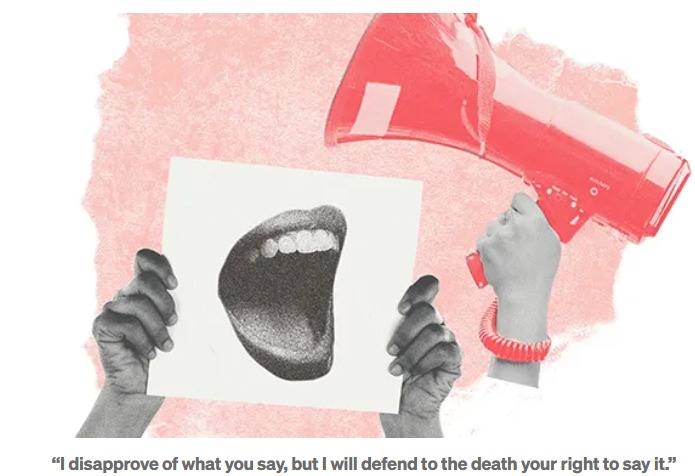
By Rufaid Imtiaz
Abstract:
In this paper, we will delve into the inimical impact of language’s influence on democracy. The paper revolves around the seminal work of George Orwell’s “Politics and English Language” in the political discourse of India and around. The study considers contemporary linguistic strategies used by state actors to gain political benefits. It further examines the parallel were setting right a wrong is done using the same tool, only to normalise the process for the future. This is not just specific to India, as state actors around the world are aware and lineated in accessing and unjustly using the same. The paper structurally sets the theme of how language, when twisted and used vaguely, can lead to the undermining of democratic principles and foster cultural homogeneity.
Introduction:
Language is popularly defined as the usage of words to communicate. The first question that arises – is it only about words? Orwell believes it is not. It is not just about the words spoken, but also the way they are spoken, what facial expressions they carry, the tones involved, and obviously what it is intended for. The power of language is not limited to mere communication; rather, it is used to express ideas and convey an endless flow of emotions. But when combined with politics, a play of power gets involved as well, making these two domains inextricably intertwined.
From ‘Bhaiyon aur Behno’ (brother and sister; to connect with the people) to ‘Mandir wahi banaenge’ (we will establish the temple there; target the people for respective gains), the use of language is not an isolated concept in the contemporary world. It helps politically rebound the idea of segregating people for own good, an ideological confrontation to sharpen the intent. Orwell, in his essay, “Language and Politics,” points out how truths are being manipulated through ‘choices of words’ in speeches and writing, which in turn leads to the destruction of democracy’s fabric. However, now it poses another question that: if it is menacing to society, then why does it even exist?
The Process of Normalisation:
Spirit of democracy talks about power with the people. Therefore, it has often been seen that the experiment of language is done to them (people) by the political actors. The way it has been carried out, not only by the ones in power and their advocates but also from the adversaries, it would not be wrong to say that it has become customary to practice and to defend it.
Though the monopolisation of language should not be permitted by any person or institution in a democracy, it is often attempted, nonetheless. The current issue surrounding the idea of ‘Nationalism’ in India, as pursued by the government in power and claimed as their patent, is an example of the same. The process of normalisation has also shifted the course of democracy towards dominance. Mere usage of force and violence could not achieve dominance; therefore, invoking threat amongst people through words such as ‘Hindu khatre mei hai’ (Hindus are in danger) earns the government the obedience of people, leading the population to act in certain ways (Mob Lynching, etc.) which can in turn benefit them.
It has even normalised stereotyping of people. Labels are given to certain communities, and the people in power use phrases such as ‘we can identify these people from their clothes’ has become typical. The current government even made sexist remarks (women are weaker than compared to men) in a Supreme Court case (2020 related to equal status for women in the Armed Forces in India, just to prove their ideological stand.
Orwell, in his essay, stated that normalisation of vague prose makes it easier for those in power to commit brainwashing of the people. This can be seen in a statement made by the President of the United States of America, Donald Trump, about the immigrants in 2018, in California: “These are not people. These are animals.” He later defended his statement by stating that it was taken out of context. Manipulative techniques like these are used to deceive the public by justifying wrongful statements. Orwell also mentions that the extent of manipulation goes to such an extent that they even think your thoughts for you and conceal their meanings for you according to themselves. This can be seen in how they make you a mere puppet, to be used when needed.
What is Right and What is Deemed Right?
As mentioned earlier, usage of language in a degenerated manner has blurred the paths. The propagation of lies has turned the wrong into right. Orwell mentions this as lazy writing, where information is copied without authenticating its validity. ‘WhatsApp University’, currently running on the platform, is a true example of Orwell’s argument, where false facts are copied and forwarded to indoctrinate people with selective information. Certain informative platforms are used to popularise certain ideologies (Hindutva), historical information (Akhand Bharat), pursued by the current government that even lacks sources. The fuel of democracy that is dissent is crushed in the name of ‘Ek Bharat.’
Dissenters are detained, people are jailed for speaking about their freedoms and rights, ‘because such words must be silenced in the name of maintaining state peace.’ ’No’ is a very powerful word because it challenges the assumptions and expectations of people or institutions, and the fear of losing authority embarks the way for justification. I also believe that measuring the effectiveness of democracy in a state should be done based on the freedom and rights enjoyed by the minorities of that respective state. Using language to target minorities aids in undermining democracy. Words like ‘corona jihad’, ‘love jihad’, etc., are used to attack them. They are intended to satisfy the majority and reinforce their ideologies. You would not be able to question the wrong because: (a) you are not allowed to, and (b) you do not have an option — “You cannot go against your nation, right?”
Conclusion:
The way language is used also helps in shaping society. For instance, if the common notion of brotherhood is popularised, it will sooner or later be adopted by the masses. Similarly, if hatred is ingrained, people will develop that as well. Therefore, it is evident that language contains the power of transformation. We cannot disagree with the fact that the debasement of language has degenerated democracy. Orwell also agrees that the decline of language and politics (democracy) go hand in hand. But on the other hand, we cannot accuse language of these circumstances.
Orwell even argues, language is a neutral tool which anyone can shape; it does not carry positive or negative forces, rather the actors of this language help in moulding it accordingly. As mentioned earlier, writers must refrain from copying information without factual validation, which Orwell remarks as Intellectual Laziness, which may pose danger as well, the decline of democracy being one of them. I also believe that Orwell and Peter Singer propose similar viewpoints in the ambit of language, that is, both believe that the statements and actions must be based on truth rather than based on lies and ignorance, which not only strengthens democracy, but also increases faith in the government. I would like to conclude with an idea of Orwell, ‘The greatest enemy of clear language is insincerity’; therefore, cautious and concrete efforts must be made while using it.
Author’s Bio: Rufaid Imtiaz is a fifth-year law student at O.P. Jindal Global University. He has a keen interest in law and its intersection with other subjects, including religion, history, and political science. He enjoys writing on law and politically lined issues.
Image Source: Freedom of Expression and the Construction of Democratic Societies: The Role of Free Speech | by Guney Yazar | Medium
 NICKELED AND DIMED